
- ASIC
- バッテリー マネージメントIC
- クロックとタイミングソリューション
- ESDおよびサージ保護デバイス
- 自動車用イーサネット
- 評価ボード
- 高信頼性(HiRel)
- アイソレーター
- メモリ
- マイクロコントローラー
- パワー
- RF
- セキュリティ ソリューションおよびスマートカードソリューション
- センサー技術
- 小信号トランジスタおよびダイオード
- トランシーバー
- ユニバーサル シリアル バス(USB)
- ワイヤレス接続
- Search Tools
- Technology
- Packages
- Product Information
- ご注文
- 概要
- 組込みフラッシュIPソリューション
- フラッシュプラスRAM MCPソリューション
- F-RAM (強誘電体RAM)
- NORフラッシュ
- nvSRAM (不揮発性 SRAM)
- PSRAM – 擬似スタティックRAM
- 耐放射線・高信頼性メモリ
- SRAM (スタティック RAM)
- ウェーハおよびダイメモリソリューション
- 概要
- AURIX™ TriCore™ MCU
- PSOC™ MCU
- TRAVEO™ T2G MCU
- XMC™ MCUs
- レガシーMCU
- MOTIX™ モーター制御SoC/SiP
- 概要
- アンテナクロススイッチ
- アンテナチューナー
- バイアスと制御
- カプラ
- ドライバアンプ
- 耐放射線マイクロ波とRF
- ローノイズアンプ (LNA)
- 高周波ダイオード
- RFスイッチ
- RFトランジスタ
- ワイヤレス制御向けレシーバー
- 概要
- Calypso®製品
- CIPURSE™ 製品
- 非接触メモリ
- OPTIGA™の組込みセキュリティ ソリューションの詳細
- SECORA™セキュリティソリューション
- セキュリ ティコントローラー
- スマートカードモジュール
- 政府ID向けスマートソリューション
- 概要
- ToF 3D画像センサー
- 電流センサー
- ガスセンサー
- 誘導型位置センサー
- MEMSマイクロフォン
- 圧力センサー
- レーダーセンサー
- 磁気位置センサー
- 磁気速度センサー
- 静電容量センサー
- Temperature sensors
- バッテリー センサー
- Digital X-ray
- コンピューター断層撮影
- Sensor interface ASICs
- 概要
- USB 2.0 ペリフェラル コントローラー
- USB 3.2 ペリフェラル コントローラー
- USB ハブ コントローラー
- USB PD高電圧マイクロコントローラー
- USB-C AC-DC および DC-DC 充電ソリューション
- USB-C充電ポートコントローラー
- USB-Cパワーデリバリー コントローラー
- 概要
- AIROC™ オートモーティブワイヤレス
- AIROC™ Bluetooth®およびマルチプロトコル
- AIROC™ コネクトテッドMCU
- AIROC™ Wi-Fi + Bluetooth®コンボ
- AIROC™ Ultra-Wide Band Solutions
- 概要
-
32 ビット TriCore™ AURIX™ – TC2x
- 概要
- AURIX™ ファミリー – TC21xL
- AURIX™ファミリー – TC21xSC (ワイヤレス充電)
- AURIX™ ファミリー – TC22xL
- AURIX™ ファミリー – TC23xL
- AURIX™ ファミリー – TC23xLA (ADAS)
- AURIX™ ファミリー – TC23xLX
- AURIX™ ファミリー – TC264DA (ADAS)
- AURIX™ ファミリー – TC26xD
- AURIX™ ファミリー – TC27xT
- AURIX™ ファミリー – TC297TA (ADAS)
- AURIX™ ファミリー – TC29xT
- AURIX™ファミリー – TC29xTT (ADAS)
- AURIX™ ファミリー – TC29xTX
- AURIX™ TC2xx (エミュレーションデバイス)
-
32 ビット TriCore™ AURIX™ – TC3x
- 概要
- AURIX™ ファミリー TC32xLP
- AURIX™ ファミリー – TC33xDA
- AURIX™ ファミリー - TC33xLP
- AURIX™ ファミリー – TC35xTA (ADAS)
- AURIX™ ファミリー – TC36xDP
- AURIX™ ファミリー – TC37xTP
- AURIX™ ファミリー – TC37xTX
- AURIX™ ファミリー – TC38xQP
- AURIX™ ファミリー – TC39xXA (ADAS)
- TC39xXX/XP
- AURIX™ ファミリー – TC3Ex
- AURIX™ TC37xTE (エミュレーションデバイス)
- AURIX™ TC39xXE (エミュレーションデバイス)
- 32 ビット TriCore™ AURIX™ - TC4x
- 概要
- PSOC™ 4 Arm® Cortex® -M0/M0+
- PSOC™ 4 HV Arm® Cortex® -M0+
- PSOC™ 5 LP Arm® Cortex® -M3
- PSOC™ 6 Arm® Cortex®-M4 / M0+
- PSOC™マルチタッチタッチスクリーンコントローラー
- PSOC™ Control C3 Arm® Cortex®-M33
- 自動車用PSOC™ 4 Arm® Cortex®-M0/M0+
- PSOC™ Edge Arm® Cortex® M55/M33
- PSOC™ Control C1 Arm® Cortex®-M0
- 概要
- ボディ用32ビットTRAVEO™T2G Arm® Cortex®
- クラスター用の 32 ビット TRAVEO™ T2G Arm® Cortex®
- 概要
- 32ビットMCU
- レガシー8ビット/16ビットマイクロコントローラー
- その他レガシーマイクロコントローラー
- 32ビットFM Arm® Cortex® マイクロコントローラー
- センシングコントローラー
- 概要
- 整流ブリッジおよびACスイッチ
- CoolSiC™ ショットキーダイオード
- ダイオードベアダイ
- Si ダイオード
- サイリスタ/ダイオード パワーモジュール
- サイリスタソフトスタータモジュール
- サイリスタ / ダイオードディスク
- 概要
- 車載ゲートドライバ IC
- GaN HEMT用ゲートドライバIC
- SiC MOSFET用ゲートドライバIC
- ハーフブリッジ ゲートドライバIC
- ハイサイド ゲートドライバIC
- ガルバニック絶縁型ゲートドライバ
- レベルシフト
- ローサイド ゲートドライバIC
- 三相ゲートドライバIC
- トランスドライバIC
- 概要
- BLDCモータードライバ
- BDCモータードライバ
- ステッピングモーターおよびサーボモーター ドライバ
- MCU搭載モータードライバ
- MOSFETを使用したブリッジドライバ
- ゲートドライバIC
- 概要
- 車載用MOSFET: 30 V~800 V
- デュアルMOSFET
- MOSFET(Si&SiC)モジュール
- NチャネルデプレッションモードMOSFET
- NチャネルMOSFET
- PチャネルMOSFET
- CoolSiC™ MOSFET
- 小信号/小電力MOSFET
- 概要
- IGBT モジュール
- MOSFET(Si&SiC)モジュール
- インテリジェント パワーモジュール (IPM)
- ダイオードとサイリスタ (Si/SiC)
- 車載用 IGBT および CoolSiC™ MOSFET モジュール
- 高密度パワーモジュール
- 概要
- EZ-USB™ CX3 MIPI CSI-2 to USB 5 Gbps カメラ コントローラー
- EZ-USB™ FX10 & FX5N USB 10Gbpsペリフェラルコントローラ
- EZ-USB™ FX20 USB 20 Gbpsペリフェラルコントローラー
- EZ-USB™ FX3 USB 5 Gbps ペリフェラル コントローラー
- EZ-USB™ FX3S USB 5 Gbps ペリフェラル コントローラー (ストレージ インターフェース付き)
- EZ-USB™ FX5 USB 5 Gbpsペリフェラルコントローラー
- EZ-USB™ SD3 USB 5 Gbps ストレージコントローラー
- EZ-USB™ SX3: FIFOインターフェースの USB 5 Gbps ペリフェラル コントローラー
- 概要
- EZ-PD™ CCG3 USB Type-Cポート コントローラーPD
- EZ-PD™ CCG3PA USB-C および PD
- EZ-PD™ CCG3PA-NFET USB-C PD コントローラー
- EZ-PD™ CCG7x シングルポート USB-Cパワーデリバリーおよび DC-DC コントローラー
- EZ-PD™ PAG1: 第 1 世代電源アダプター
- EZ-PD™ PAG2: 第 2 世代電源アダプター
- EZ-PD™ PAG2-PD USB-C PD コントローラー
- 概要
- EZ-PD™ ACG1F 1ポートUSB-Cコントローラー
- EZ-PD™ CCG2 USB Type-Cポート コントローラー
- EZ-PD™ CCG3PA車載用USB-Cおよびパワーデリバリーコントローラー
- EZ-PD™ CCG4 2 ポートUSB-CおよびPD
- EZ-PD™ CCG5デュアルポートおよび CCG5C シングルポート USB-C PDコントローラー
- EZ-PD™ CCG6 1ポート USB-C & PDコントローラー
- EZ-PD™ CCG6_CFP および EZ-PD™ CCG8_CFPデュアルシングルポート USB-C PD
- EZ-PD™ CCG6DFデュアルポートおよびCCG6SFシングルポートUSB-C PDコントローラー
- EZ-PD™ CCG7D車載用デュアルポートUSB-C PD + DC-DCコントローラー
- EZ-PD™ CCG7S車載用シングルポートUSB-C PDソリューション (DC-DCコントローラーおよびFET内蔵)
- EZ-PD™ CCG8デュアル シングル ポートUSB-C PD
- EZ-PD™ CMG1 USB-C EMCAコントローラー
- 拡張パワーレンジ (EPR) 搭載EZ-PD™ CMG2 USB-C EMCA
コアアーキテクチャ別に参照
主要テクノロジー別に参照
Browse by design resources & partners
Browse by product information
- 最新情報:
- 航空宇宙および防衛
- AIとデータセンター
- 自動車
- 通信
- 民生用電子機器
- ヘルスケアとライフスタイル
- 産業用アプリケーション
- セキュリティソリューション
- スマートホームとスマートビルディング
- ソリューション
- 概要
- AR and smart glasses
- スマートテレビ向けの完全なシステムソリューション
- コンシューマーウェアラブル
- ドローン
- 家電製品
- モバイルデバイスとスマートフォンソリューション
- 太陽光発電
- 電源アダプターと充電器
- ホームエンターテインメント アプリケーション向けの半導体ソリューション
- スマート会議システム
- 概要
- 資産管理の追跡
- バッテリー蓄電 (BESS)
- バッテリーの形成とテスト
- Digital health
- 電動フォークリフト
- EV充電
- 高電圧ソリッドステート配電
- 水電解槽
- 産業用および医療用スイッチング電源 (SMPS)
- 産業用オートメーション
- 産業用モータードライブおよび制御
- 産業用ロボット
- LED 照明システムの設計
- 小型電気自動車ソリューション
- 太陽光発電
- 電源アダプターと充電器
- 電動工具
- 送配電
- ロボティクス
- トラクション
- 無停電電源装置 (UPS)
- 風力
- 概要
- アクセス管理および発券ソリューション
- デバイス認証とブランド保護
- モノのインターネット (IoT) 向けの組み込みセキュリティ
- eSIM アプリケーション
- 公的身分証明書
- モバイルセキュリティ
- 決済ソリューション
- 概要
- 家庭用ロボット
- 空調システム (HVAC)
- ホームオートメーションとビルオートメーション
- PCアクセサリ
- ホームエンターテインメント アプリケーション向けの半導体ソリューション
- 概要
- アクティブサスペンションコントロール
- 車載用ブレーキング ソリューション
- 車載用ステアリング ソリューション
- シャーシ ドメイン制御
- 最新情報:
- デジタル ドキュメンテーション
- 評価ボード
- ファインダー & セレクション ツール
- プラットフォーム
- サービス
- オンライン シミュレーション
- ソフトウェア
- ツール
- パートナー
- インフィニオン フォー メーカーズ
- ユニバーシティ アライアンス プログラム
- 概要
- AIROC™ ソフトウェアとツール
- AURIX™のツールとソフトウェア
- 自動車ソフトウェア開発用のDRIVECORE™
- iMOTION™ ツールとソフトウェア
- インフィニオンのスマートパワースイッチおよびゲートドライバ ツールスイート
- MOTIX™ ソフトウェア&ツール
- OPTIGA™ ツールとソフトウェア
- PSOC™ ソフトウェアとツール
- TRAVEO™ ソフトウェアとツール
- XENSIV™ツールおよびソフトウェア
- XMC™ ツールとソフトウェア
- 概要
- AURIX™認証
- AURIX™開発ツール
- AURIX™組込みソフトウェア
- AURIX™マイクロコントローラーキット
- 概要
- CAPSENSE™コントローラー コンフィギュレーション ツール EZ-Click
- DC-DC統合POL電圧レギュレーター設定ツール – PowIRCenter
- EZ-USB™ SX3コンフィギュレーション ユーティリティ
- FM+ コンフィギュレーション ツール
- FMx設定ツール
- トランシーバーICコンフィギュレーション ツール
- USB EZ-PD™コンフィギュレーション ユーティリティ
- USB EZ-PD™コンフィギュレーション ユーティリティ
- USB EZ-USB™ HX3C Blaster Plusコンフィギュレーション ユーティリティ
- USB UARTコンフィギュレーション ユーティリティ
- XENSIV™タイヤ空気圧センサーのプログラミング
- 概要
- EZ-PD™ CCGx Dock ソフトウェア開発キット
- FMx Softune IDE
- Infineon GUI Designer
- ModusToolbox™ ソフトウェア
- PSOC™ ソフトウェア
- レーダー開発キット
- RUST
- USBコントローラーSDK
- ワイヤレス接続 Bluetooth メッシュヘルパー アプリケーション
- XMC™ DAVE™ソフトウェア
- 概要
- AIROC™ Bluetooth® Connect Appアーカイブ
- Cypress™ Programmerのアーカイブ
- EZ-PD™ CCGx 電力ソフトウェア開発キットのアーカイブ
- ModusToolbox™ ソフトウェアのアーカイブ
- PSOC™ Creatorのアーカイブ
- PSOC™ Designerのアーカイブ
- PSOC™ Programmerのアーカイブ
- USB EZ-PD™コンフィギュレーション ユーティリティ アーカイブ
- USB EZ-PD™ホストSDKのアーカイブ
- USB EZ-USB™ FX3のアーカイブ
- EZ-USB™ HX3PD コンフィギュレーション ユーティリティ
- WICED™ Smart SDKのアーカイブ
- WICED™ Studioのアーカイブ
- 最新情報:
- サポート
- トレーニング
- 開発者コミュニティ
- News
ビジネス&財務プレス
2026/09/17
ビジネス&財務プレス
2026/09/10
ビジネス&財務プレス
2026/08/31
ビジネス&財務プレス
2026/08/28
- 会社概要
- 私たちのストーリー
- イベント
- プレス
- 投資家向け情報
- 採用情報
- 品質
- 最新ニュース
ビジネス&財務プレス
2026/09/17
ビジネス&財務プレス
2026/09/10
ビジネス&財務プレス
2026/08/31
ビジネス&財務プレス
2026/08/28
The Orderable Part Number (OPN) is a unique and descriptive product identifier. It improves ordering, product identification and communication.
The OPN salesname can differ from the actual salesname:
- It does not contain any special characters such as blanks or dashes
- If the salesname exceeds 19 digits after the elimination of special characters it will be adjusted to fit the maximum length of the OPN (24 digits)
- Microcontroller products with an SA prefix will not have this prefix in the OPN salesname. Additionally the temperature identifier will be moved to the end of the OPN salesname (Microcontroller products only)
The OPN suffix describes the product in more detail:
- RoHS status
- Halogen status
- Totally lead free status
- Packing type
- Packing size
- Moisture protection packing
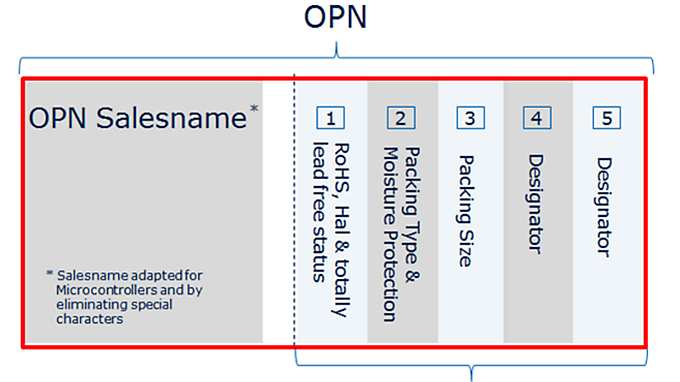
The Orderable Part Number consists of two parts: The OPN salesname and the OPN suffix.
Orderable Part Number OPN Identifiers
The descriptive identifiers within the OPN tell you more about the product attributes. Please find the related information below.
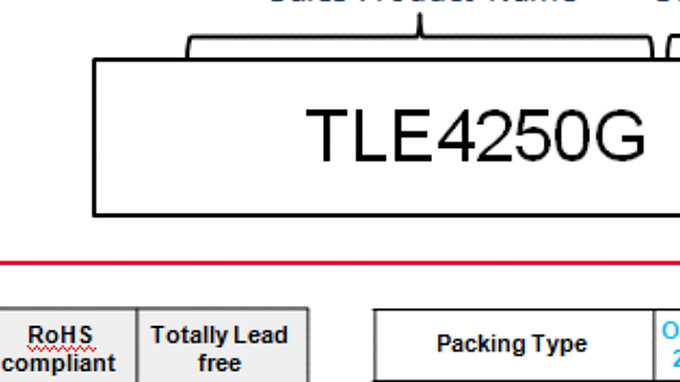
Example for an OPN (the OPN relevant suffix are the last 5 digits)
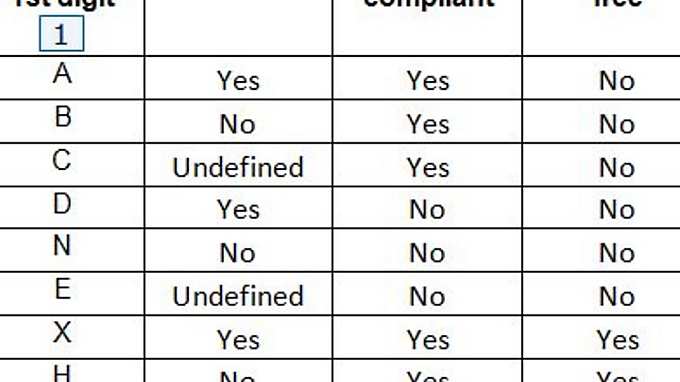
1st digit: RoHS, Halogen and Totally Lead Free Status
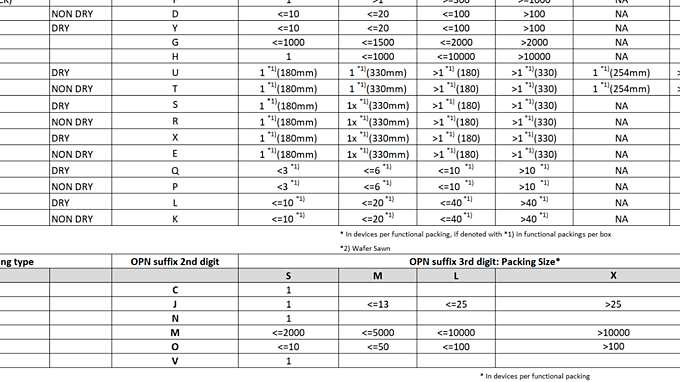
2nd and 3d digit: Packing type, Moisture Protection Packing and Packing Size
The 2nd digit shows the functional packing type in combination with the moisture protection packing.
The 3rd digit shows the number of devices per functional packing or the number of functional packings (denoted with 1)
Examples for packing type- and size
- TLE4250G with OPN TLE4250GNTSA1 and TLE4250GNTMA1. This product comes on two different reel sizes: 180mm and 330mm. One can see from the second digit that the product comes on tape & reel (T). Now the packing size can be determined by the third identifier. This product comes as “S” and “M”. “S” means 180mm, “M” means 330mm. Even if this detail was not known, it becomes obvious on first sight that TLE4250GNTSA1 is smaller than TLE4250GNTMA1.
- SAE800G with OPN SAE800GXLLA1. This product comes in Tubes (indicated by the “L” in the 2nd digit ). The third digit of the OPN is also an “L” which indicates that there are between 21 and 40 tubes per box.
- SIPC03S2N03L with OPN SIPC03S2N03LX3MA1. This product comes on Tape & Reel bare die (3). The third identifiers (M) indicates that there are between 2001 and 5000 bare dies on the reel.
Although none of the packing size indications gives an exact number of products per packing, it allows you to distinguish between two different products: You can immediately see which product
4th and 5th digit: Designator
The designator increments (e.g. from A1 to A2) whenever a new SP number is set up that does not differ from a previous product in either Salesname or the first three OPN suffix identifiers. Product variants such as different temperature ranges or ROM codes can therefore be recognized by the designator.
Existing identifiers
Currently there are two relevant product levels: Salesname and SP number. The salesname describes the functional attributes of a product (e.g. supply voltage, frequency, memory) and it is also contained in the pCPN that some customers use to order today. The SP number is the non-descriptive order relevant sub-level number to the salesname. The SP number is a concise relation to the actual part itself specifying the packing type or size, RoHS/Halogen distinctions, customer specific variants and other product variants such as temperature ranges. Because multiple SP numbers can be assigned to one salesname, the OPN is a unique and descriptive identifier with a 1:1 relation to the SP number.
How does the OPN fit into the existing part numbering scheme?
Because the SP number is the order relevant level, the OPN is a descriptive and unique identifier with a 1:1 relation to the SP number. The Salesname does not carry sufficient information for ordering because multiple SP numbers can be assigned to one salesname.
This is possible by combining the salesname and the following additional attributes:
- RoHS status
- Halogen status
- Totally lead free status
- Packing type
- Packing size
- Moisture protection packing
Because these are the main, but not the only reasons for many SP numbers under one salesname it is also possible to depict any other reason (e.g. test versions, micro codes) in the designator.
The OPN will replace the proposed Customer Part Number (pCPN) which could be used as a customer part number.
What is the OPN?
The OPN is a descriptive ordering code that consists of an adapted Infineon sales type (“ salesname”) and five additional digits describing the product in more detail. Descriptive means that the OPN can be "translated" into exact product attributes.
Why are the existing ordering codes not sufficient?
The order relevant ordering code is the SP number which is not descriptive though because it is simply a number that has no particular meaning. This means that you can´t see which product is behind the SP number (e.g. a discrete or microcontroller). It is also not possible to see differences between SP numbers. Our descriptive ordering code is the salesname. By knowing its nomenclature you can easily determine the product group and the product attributes. However, one Salesname (e.g. the microcontroller SAB C165-LM) can have several SP numbers. There are many reasons why this can happen: Different packing types, green and grey versions, customer specific versions etc. So using the SP number is not convenient because the product behind it is not visible, using the salesname is not sufficient because it can have many ordering codes. The OPN solves both problems by creating an ordering code on the SP level that shows all relevant attributes.
What is the structure of the OPN / how does the OPN look like?
The OPN consists of an adapted salesname plus five additional digits describing the product in more detail.
What is an adapted salesname?
Because special characters (e.g. commas, dots or dashes) can be disturbing, the OPN will not contain any special characters. That means that the adapted salesname is not equal to the regular salesname. For microcontroller products the adapted salesname will never show the "SA" prefix and the temperature identifier (third digit in the salesname) is moved to the end of the adapted salesname. In very few cases salesnames also had to be adapted slightly in addition to the deletion of special characters due to a maximum length of the OPN of 24 digits.
What is encoded in the OPN?
The OPN shows the RoHS status, the halogen status, the totally lead free status, the functional packing type and size as well as the moisture protection packing. Additionally you can see product variants in the last two digits: Every time a product doesn´t differ in its salesname or the attributes encoded in the OPN (RoHS, Halogen, Packing Type, Moisture Protection Packing and Packing Size), the designator increments.
How are the OPN attributes encoded?
The first OPN digit encodes RoHS, Halogen and totally lead free status, the second digit shows the combination of packing type and moisture protection packing and the third digit describes the packing size (e.g. 180mm reel or 330mm reel). Every attribute is shown by only one digit (e.g. 180mm = S).
The last two digits identify product variants.
Since the designator is non-speaking, how can I see what is behind that OPN?
There can be many reasons why a salesname has several ordering codes. To mention just a few examples: Customer specific versions, special test versions, ROM codes, different wafer thicknesses, different temperature ranges, different bonding wires etc. It is simply not possible to cover all of these reasons in a descriptive identifier.
Please refer to this answer if you want to know how to determine differences between designators.
How can I find the difference between two products with differing identifiers?
Most of the differences can be found in the Product Change Notification (PCN). If you can´t find the difference between OPNs (their designators) contact your sales person, call us at 00800 951 951 951 or write an email to support@infineon.com.
What is the maximum length of the OPN?
The OPN is limited to 24 digits.
What is the benefit of the OPN?
You can not only see the product and its attributes as you can in the salesname but also information about the RoHS status, the halogen status, the totally lead free status, the functional packing type and size as well as the moisture protection packing. You can also distinguish other product variants based on the designator.
The descriptive nature of the OPN and its order relevant level makes it easier to communicate: Talking about SP numbers is not convenient as they are simply numbers. Talking about Salesnames is not sufficient because one salesname can have several ordering codes.
Does every product have an OPN?
Yes, every productive product (except for Engineering Samples) has an OPN.
Can the OPN be used instead of the SP#?
No. The SP number is a vendors part number. Please talk to your sales contact if you plan to replace the SP# with the OPN.
Can the OPN be used instead of the Salesname?
In general - yes. The salesname can also only be used as a Customer Part Number because it is not unique. That means an order with the Salesname also needs to be translated into an SP number. Additionally it is possible that there are several SP numbers for one salesname which would increase the communication effort to find out the right SP number.
Which documents show the OPN?
The OPN is shown on the Barcode Packing Label in the 2D barcode and it is shown in the type list of PCNs, PDs and Infonotes. If you use the OPN as your Customer Part Number (You order with a part number different from the SP number) then the OPN is shown on all documents that currently display the CPN: Invoice, Packing List, Order Confirmation, Debit&Credit Notes, Dispatch Note etc.
Does the regular Label show the OPN?
Not yet in a form readable for the human eye. It is shown in field 50P in the 2D barcode (data matrix code).
Is the OPN in the datasheets?
No. The datasheet is based on an aggregate level. It is possible that one datasheet is valid for several SP Numbers or several Salesnames. Additionally new OPNs (new SP numbers) are created too frequently to update datasheets.
How can I order with the OPN?
The OPN is used as a customer part number (customer specific product name). For ordering purposes you tell us the OPN and we link it internally to the corresponding SP number. Now every time you order with the OPN we know the corresponding SP number.
If you would like to switch from your existing identifiers to the OPN, please contact your Infineon sales person.
Does the OPN replace any existing product name?
None of the official product names Salesname, SP number or MA number are replaced. However, several years ago we introduced the proposed customer part number (pCPN) which will be replaced by the OPN.
What do I need to do if I use the pCPN?
You can keep ordering with the pCPN because we still maintain the link between your pCPN and the SP number. However, we will not provide you with the pCPN in pricelists or any other document or system anymore.
We strongly recommend to use the OPN for ordering or as your internal identifier instead of the pCPN. If you want to switch to the OPN, please contact your Infineon sales person.
Do Samples have an OPN?
Yes, except for Engineering Samples all Samples have an OPN.
Is the information shown in the OPN true for samples?
Not necessarily. If a sample for product that comes on a 330mm reel is ordered it does not usually come on the reel itself.
Additionally it is possible that some sample attributes do not match the OPN attributes (e.g. OPN shows green but sample is grey).
Do Engineering Samples have an OPN?
No, Engineering Samples do not have an OPN.
Do Development Kits and Boards have an OPN?
Yes, Kits and Boards are marked with the OPN suffix "TOBO1…9" or “TOBP1…9”.
Where do I get translation tables for the OPN?
Translation tables can be found here.