
- ASIC
- Battery management ICs
- Clocks and timing solutions
- ESD and surge protection devices
- Automotive Ethernet
- Evaluation Boards
- High reliability
- Isolation
- Memories
- Microcontroller
- Power
- RF
- Security and smart card solutions
- Sensor technology
- Small signal transistors and diodes
- Transceivers
- Universal Serial Bus (USB)
- Wireless connectivity
- Search Tools
- Technology
- Packages
- Product Information
- Ordering
- Overview
- Automotive Ethernet PHY for in-vehicle networking
- Automotive Ethernet Switches for in-vehicle networking
- Overview
- Embedded flash IP solutions
- Flash+RAM MCP solutions
- F-RAM (Ferroelectric RAM)
- NOR flash
- nvSRAM (non-volatile SRAM)
- PSRAM – Pseudostatic RAM
- Radiation hardened and high-reliability memories
- SRAMs (Static Random Access Memory)
- Wafer and die memory solutions
- Overview
- AURIX™ TriCore™ MCUs
- PSOC™ MCUs
- TRAVEO™ T2G MCUs
- XMC™ MCUs
- Legacy MCUs
- MOTIX™ motor control SoCs/SIPs
- AURIX™ RC1 MCUs
- Overview
- AC-DC power conversion
- Automotive conventional powertrain ICs
- Class D audio amplifier ICs
- Contactless power and sensing ICs
- DC-DC converters
- Diodes and thyristors (Si/SiC)
- eFuses
- Gallium nitride (GaN)
- Gate Driver ICs
- IGBTs – Insulated gate bipolar transistors
- Intelligent power modules (IPM)
- JFETs
- LED driver ICs
- Motor drivers
- MOSFETs
- Power modules
- Power supply ICs
- Protection and monitoring ICs
- Silicon carbide (SiC)
- Smart power switches
- Solid state relays and isolators
- Wireless charging ICs
- Overview
- Antenna cross switches
- Antenna tuners
- Bias and control
- Coupler
- Driver amplifiers
- Rad hard microwave and RF
- Low noise amplifiers (LNAs)
- RF diode
- RF switches
- RF transistors
- Wireless control receiver
- Overview
- Calypso® products
- CIPURSE™ products
- Contactless memories
- OPTIGA™ embedded security solutions
- SECORA™ security solutions
- Security controllers
- Smart card modules
- Smart solutions for government ID
- Overview
- ToF 3D image sensors
- Current sensors
- Gas sensors
- Inductive position sensors
- MEMS microphones
- Pressure sensors
- Radar sensors
- Magnetic position sensors
- Magnetic speed sensors
- Capacitive sensors
- Temperature sensors
- Battery sensors
- Digital X-ray
- Computed tomography
- Sensor interface ASICs
- Overview
- Bipolar transistors
- Diodes
- Small signal/small power MOSFET
- Overview
- Automotive transceivers
- Control communication
- Powerline communications
- Overview
- USB 2.0 peripheral controllers
- USB 3.2 peripheral controllers
- USB hub controllers
- USB PD high-voltage microcontrollers
- USB-C AC-DC and DC-DC charging solutions
- USB-C charging port controllers
- USB-C Power Delivery controllers
- Overview
- AIROC™ Automotive wireless
- AIROC™ Bluetooth® and multiprotocol
- AIROC™ connected MCU
- AIROC™ Wi-Fi + Bluetooth® combos
- AIROC™ Ultra-Wide Band Solutions
- Overview
- Commercial off-the-shelf (COTs) memory portfolio
- Defense memory portfolio
- High-reliability power conversion and management
- Overview
- Rad hard microwave and RF
- Radiation hardened power
- Space memory portfolio
- Overview
- Parallel NOR flash memory
- SEMPER™ NOR flash family
- SEMPER™ X1 LPDDR flash
- Serial NOR flash
- Overview
-
AURIX™ TC2x - 32-bit TriCore™
- Overview
- AURIX™ family – TC21xL
- AURIX™ family – TC21xSC (wireless charging)
- AURIX™ family – TC22xL
- AURIX™ family – TC23xL
- AURIX™ family – TC23xLA (ADAS)
- AURIX™ family – TC23xLX
- AURIX™ family – TC264DA (ADAS)
- AURIX™ family – TC26xD
- AURIX™ family – TC27xT
- AURIX™ family – TC297TA (ADAS)
- AURIX™ family – TC29xT
- AURIX™ family – TC29xTT (ADAS)
- AURIX™ family – TC29xTX
- AURIX™ TC2x emulation devices
-
AURIX™ TC3x - 32-bit TriCore™
- Overview
- AURIX™ family - TC32xLP
- AURIX™ family – TC33xDA
- AURIX™ family - TC33xLP
- AURIX™ family – TC35xTA (ADAS)
- AURIX™ family – TC36xDP
- AURIX™ family – TC37xTP
- AURIX™ family – TC37xTX
- AURIX™ family – TC38xQP
- AURIX™ family – TC39xXA (ADAS)
- AURIX™ family - TC39xXX/XP
- AURIX™ family – TC3Ex
- AURIX™ TC37xTE (emulation devices)
- AURIX™ TC39xXE (emulation devices)
- AURIX™ TC4x - 32-bit TriCore™
- Overview
- PSOC™ 4 Microcontroller: Arm® Cortex®-M0/M0+
- PSOC™ 4 HV Arm® Cortex®-M0+
- PSOC™ 5 LP Arm® Cortex®-M3
- PSOC™ 6 Arm® Cortex®-M4/M0+
- PSOC™ Multitouch Touchscreen Controller
- PSOC™ Control C3 Arm® Cortex®-M33
- PSOC™ Automotive 4: Arm® Cortex®-M0/M0+
- PSOC™ Edge Arm® Cortex® M55/M33
- PSOC™ Control C1 Arm® Cortex®-M0
- Overview
- 32-bit TRAVEO™ T2G Arm® Cortex® for body
- 32-bit TRAVEO™ T2G Arm® Cortex® for cluster
- Overview
- 32-bit XMC1000 industrial microcontroller Arm® Cortex®-M0
- 32-bit XMC4000 industrial microcontroller Arm® Cortex®-M4
- XMC5000 Industrial Microcontroller Arm® Cortex®-M4F
- 32-bit XMC7000 Industrial Microcontroller Arm® Cortex®-M7
- Overview
- Legacy 32-bit MCU
- Legacy 8-bit/16-bit microcontroller
- Other legacy MCUs
- 32-bit FM Arm® Cortex® Microcontroller
- Sensing controllers
- Overview
- AC-DC integrated power stage - CoolSET™
- AC-DC PWM and PFC controller
- Overview
- Bridge rectifiers & AC switches
- CoolSiC™ Schottky diodes
- Diode bare dies
- Power stacks
- Silicon diodes
- Thyristor / Diode Power Modules
- Thyristor soft starter modules
- Thyristor/diode discs
- Overview
- GaN bidirectional switches
- GaN smart
- GaN transistors (GaN HEMTs)
- GaN with integrated driver
- GaN bare dies
- Overview
- Automotive gate driver ICs
- Gate Driver ICs for GaN HEMTs
- Gate Driver ICs for SiC MOSFETs
- Half-Bridge Gate Driver ICs
- High-Side Gate Driver ICs
- Isolated Gate Driver ICs
- Level-Shift Gate Driver ICs
- Low-Side Gate Driver ICs
- Three-Phase Gate Driver ICs
- Transformer Driver ICs
- Overview
- AC-DC LED driver ICs
- Ballast IC
- DC-DC LED driver IC
- LED dimming interface IC
- Linear LED driver IC
- LITIX™ - Automotive LED Driver IC
- NFC wireless configuration IC with PWM output
- VCSEL driver
- Overview
- BLDC motor drivers
- BDC motor drivers
- Stepper & servo motor drivers
- Motor drivers with MCU
- Bridge drivers with MOSFETs
- Gate Driver ICs
- Overview
- Automotive MOSFET: 30 V to 800 V
- Dual MOSFETs
- MOSFET (Si & SiC) Modules
- N-channel depletion mode MOSFET
- N-channel MOSFETs
- P-channel MOSFETs
-
Silicon carbide CoolSiC™ MOSFETs
- Overview
- Silicon Carbide MOSFET modules
- Silicon carbide MOSFET discretes
- Silicon carbide MOSFETs bare dies
- Silicon Carbide Bidirectional Switches
- 400 V / 440 V Silicon Carbide MOSFETs
- 650 V Silicon Carbide MOSFETs
- 750 V Silicon Carbide MOSFETs
- 1200 V Silicon Carbide MOSFETs
- 1700 V Silicon Carbide MOSFETs
- 2000 V Silicon Carbide MOSFETs
- 2300 V Silicon Carbide MOSFETs
- 3300 V Silicon Carbide MOSFETs
- Small signal/small power MOSFET
- 40V Current Sensing MOSFETs
- Overview
- IGBT modules
- MOSFET (Si & SiC) Modules
- Intelligent power modules (IPM)
- Diodes and thyristors (Si/SiC)
- Automotive IGBT and CoolSiC™ MOSFET modules
- High density power modules
- Overview
- Automotive transceivers
- Linear voltage regulators
- Power management ICs (PMIC)
- Automotive switching regulators
- System Basis Chips (SBC)
- Overview
- High-side switches
- Low-side switches
- Multichannel SPI Switches & Controller
- Automotive eFuses
- Overview
- Radar sensors for automotive
- Radar sensors for IoT
- Overview
- EZ-USB™ CX3 MIPI CSI2 to USB 3.0 camera controller
- EZ-USB™ FX10 & FX5N USB 10Gbps peripheral controller
- EZ-USB™ FX20 USB 20 Gbps peripheral controller
- EZ-USB™ FX3 USB 5 Gbps peripheral controller
- EZ-USB™ FX3S USB 5 Gbps peripheral controller with storage interface
- EZ-USB™ FX5 USB 5 Gbps peripheral controller
- EZ-USB™ SD3 USB 5 Gbps storage controller
- EZ-USB™ SX3 FIFO to USB 5 Gbps peripheral controller
- Overview
- EZ-PD™ PMG1-B1 Battery Charge Controller with USB-C PD MCU
- EZ-PD™ PMG1-S0 high-voltage MCU with USB-C and PD
- EZ-PD™ PMG1-S1 high-voltage MCU with USB-C and PD
- EZ-PD™ PMG1-S2 high-voltage MCU with USB PD
- EZ-PD™ PMG1-S3 high-voltage MCU with USB-C & PD
- EZ-PD™ PMG1-B2 Battery Charge Controller with USB-C PD MCU
- Overview
- EZ-PD™ CCG3 USB type-C port controller PD
- EZ-PD™ CCG3PA USB-C and PD
- EZ-PD™ CCG3PA-NFET USB-C PD controller
- EZ-PD™ CCG7x consumer USB-C Power Delivery & DC-DC controller
- EZ-PD™ PAG1: power adapter generation 1
- EZ-PD™ PAG2: Power Adapter Generation 2
- EZ-PD™ PAG2-PD USB-C PD Controller
- Overview
- EZ-PD™ ACG1F one-port USB-C controller
- EZ-PD™ CCG2 USB Type-C port controller
- EZ-PD™ CCG3PA Automotive USB-C and Power Delivery controller
- EZ-PD™ CCG4 two-port USB-C and PD
- EZ-PD™ CCG5 dual-port and CCG5C single-port USB-C PD controllers
- EZ-PD™ CCG6 one-port USB-C & PD controller
- EZ-PD™ CCG6_CFP and EZ-PD™ CCG8_CFP Dual-Single-Port USB-C PD
- EZ-PD™ CCG6DF dual-port and CCG6SF single-port USB-C PD controllers
- EZ-PD™ CCG7D Automotive dual-port USB-C PD + DC-DC controller
- EZ-PD™ CCG7S Automotive single-port USB-C PD solution with a DC-DC controller + FETs
- EZ-PD™ CCG8 dual-single-port USB-C PD
- EZ-PD™ CMG1 USB-C EMCA controller
- EZ-PD™ CMG2 USB-C EMCA controller with EPR
Browse by core architecture
Browse by key technologies
Browse by design resources & partners
- LATEST IN
- Aerospace and defense
- AI and data center
- Automotive
- Communications
- Consumer electronics
- Industrial
- Security solutions
- Smart home and building
- Solutions
- Overview
- Defense applications
- Space applications
- Overview
- Data center power solutions
- Edge computing
- Machine Learning Edge AI
- Overview
- ADAS & autonomous driving
- Automotive body electronics
- Automotive LED lighting systems
- Automotive zonal architecture
- Chassis control & safety
- Electric vehicle drivetrain system
- EV thermal management system
- In-vehicle infotainment & HMI
- Light electric vehicle solutions
- Overview
- Satellite communications
- Telecommunications infrastructure
- Overview
- PC accessories
- AR and smart glasses
- Consumer wearables
- Drones
- Home appliances
- Mobile device and smartphone solutions
- Photovoltaic
- Power adapters and chargers
- Semiconductor solutions for home entertainment applications
- Smart conference systems
- Overview
- Asset Tracking
- Battery energy storage (BESS)
- Battery formation and testing
- Digital health
- Electric forklifts
- EV charging
- High voltage solid-state power distribution
- Hydrogen electrolysis
- Industrial & Medical SMPS
- Industrial automation
- Industrial motor drives and controls
- Industrial robots
- LED lighting system design
- Light electric vehicle solutions
- Photovoltaic
- Power adapters and chargers
- Power tools
- Power transmission and distribution
- Robotics
- Traction
- Uninterruptible power supplies (UPS)
- Wind power
- Overview
- Access control and ticketing
- Device authentication and brand protection
- Embedded security for the Internet of Things (IoT)
- eSIM applications
- Government identification
- Mobile security
- Payment solutions
- Overview
- Heating ventilation and air conditioning (HVAC)
- Home and building automation
- Overview
- Battery management systems (BMS)
- Connectivity
- Human Machine Interface
- Machine Learning Edge AI
- Motor control
- Power conversion
- Security
- Sensor solutions
- System diagnostics and analytics
- Overview
- Data center power distribution
- Power system reliability modeling
-
Server rack power management
- Overview
- AI accelerator cards
- AMD CPU voltage regulator ICs
- Ampere CPU voltage regulator ICs
- Intel CPU voltage regulator ICs
- Intermediate Bus Converter (IBC)
- Network switches for AI data centers and server racks
- Server battery backup units (BBU)
- Server power path protection
- Server power supply units (PSU)
- SmartNIC cards
- Overview
- Automotive animated LED lighting system
- Automotive LED front single light functions
- Automotive LED rear single light functions
- Full LED headlight system - multi-channel LED driver
- LED driver solutions for electric two- and three-wheelers
- LED pixel light controller - supply & communication
- Static interior ambient LED light
- Overview
- Active suspension control
- Automotive braking solutions
- Automotive steering solutions
- Chassis domain control
- Overview
-
Automotive battery management system
- Overview
- Automotive battery cell monitoring & balancing
- Automotive battery control unit (BCU)
- Automotive battery isolated communication
- Automotive battery management system (BMS) - 12 V to 24 V
- Automotive battery management system (BMS) - 48 V
- Automotive battery management system (BMS) - high-voltage
- Automotive battery pack monitoring
- Automotive battery passport & event logging
- Automotive battery protection & disconnection
- Automotive current sensing & coulomb counting
- BMS (electric two- & three-wheelers)
- Auxiliary inverter
- Auxiliary inverter - high-voltage (commercial vehicles)
- REEV engine & HV starter‑generator control
- DC-DC converter high-voltage
- DC-DC converter high-voltage (commercial vehicles)
- EV charging
- EV traction inverter
- FCEV powertrain solutions
- On-board charging (electric commercial vehicles)
- On-board charging (OBC)
- On-board charging (OBC) solutions for electric two- and three-wheelers
- Traction inverter (electric commercial vehicles)
- Traction inverter (electric two- & three-wheelers)
- Overview
- Audio amplifier solutions
- Smart TV
- Distribution audio amplifier unit solutions
- Home theater installation speaker system solutions
- Party speaker solutions
- PoE audio amplifier unit solutions
- Portable speaker solutions
- Powered active speaker systems
- Remote control
- Smart speaker designs
- Soundbar solutions
- Overview
- Data center power solutions
- Digital input/output (I/O) modules
- DIN rail power supply solutions
- Home and building automation
- Industrial HMI Monitors and Panels
- Industrial motor drives and controls
- Industrial PC
- Industrial robots
- Machine vision
- Mobile robots (AGV, AMR)
- Solid-state circuit breaker (SSCB)
- Uninterruptible power supplies (UPS)
- Overview
- Automotive battery management system
- Industrial and consumer BMS
- Overview
- AC-DC power conversion
- DC-DC power conversion
- Overview
- Power supply health monitoring
- LATEST IN
- Digital documentation
- Boards & Kits
- Finder & selection tools
- Platforms
- Services
- Simulation & Modeling
- Software
- Tools
- Partners
- Infineon for Makers
- University Alliance Program
- Overview
- Bipolar Discs Finder
- Bipolar Module Finder
- Connected Secure Systems Finder
- Diode Rectifier Finder
- ESD Protection Finder
- Evaluation Board Finder
- Gate Driver Finder
- IGBT Discrete Finder
- IGBT Module Finder
- IPM Finder
- Microcontroller Finder
- MOSFET Finder
- PMIC Finder
- Product Finder
- PSOC™ and FMx MCU Board & Kit Finder
- Radar Finder
- Reference Design Finder
- Simulation Model Finder
- Smart Power Switch Finder
- Transceiver Finder
- Voltage Regulator Finder
- Wireless Connectivity Board & Kit Finder
- Infineon Gate Driver Recommendation Tool
- Overview
- AIROC™ software & tools
- AURIX™ software & tools
- DRIVECORE™ for automotive software development
- iMOTION™ software & tools
- Infineon Smart Power Switches & Gate Driver Tool Suite
- MOTIX™ software & tools
- OPTIGA™ software & tools
- PSOC™ software & tools
- TRAVEO™ software & tools
- XENSIV™ software & tools
- XMC™ software & tools
- Overview
- HiRel Fit Rate Tool
- Infineon Designer
- Interactive product sheet
- IPOSIM Online Power Simulation Platform
- InfineonSpice Offline Simulation Tool
- OPTIREG™ automotive power supply ICs Simulation Tool (PLECS)
- Power MOSFET Simulation Models
- PowerEsim Switch Mode Power Supply Design Tool
- Solution Finder
- XENSIV™ Magnetic Sensor Simulation Tool
- Overview
- Configuration
- Hardware Development
- Programming & Testing
- SDK
- Tools Archive
- Utilities
- Overview
- AURIX™ certifications
- AURIX™ development tools
-
AURIX™ Embedded Software
- Overview
- AURIX™ Applications software
- AURIX™ Artificial Intelligence
- AURIX™ Gateway
- AURIX™ iLLD Drivers
- Infineon safety
- AURIX™ Security
- AURIX™ TC3xx Motor Control Application Kit
- AURIX™ TC4x SW application architecture
- Infineon AUTOSAR
- Communication and Connectivity
- Middleware
- Non AUTOSAR OS/RTOS
- OTA
- AURIX™ Microcontroller Kits
- Overview
- TRAVEO™ Development Tools
- TRAVEO™ Embedded Software
- Overview
- XENSIV™ Development Tools
- XENSIV™ Embedded Software
- XENSIV™ evaluation boards
- Overview
- CAPSENSE™ Controllers Code Examples
- Memories for Embedded Systems Code Examples
- PSOC™ 1 Code Examples for PSOC™ Designer
- PSOC™ 3 Code Examples for PSOC™ Creator
- PSOC™ 3/4/5 Code Examples
- PSOC™ 4 Code Examples for PSOC™ Creator
- PSOC™ 6 Code Examples for PSOC™ Creator
- PSOC™ 63 Code Examples
- USB Controllers Code Examples
- Overview
- AIROC™ Wi-Fi & Bluetooth EZ-Serial Module Firmware Platform
- AIROC™ Wi-Fi & Bluetooth Linux and Android Drivers
- emWin Graphics Library and GUI for PSOC™
- Infineon Complex Device Driver for Battery Management Systems
- Memory Solutions Hub
- PSOC™ 6 Peripheral Driver Library (PDL) for PSOC™ Creator
- USB Controllers EZ-USB™ GX3 Software and Drivers
- Overview
- CAPSENSE™ Controllers Configuration Tools EZ-Click
- DC-DC Integrated POL Voltage Regulators Configuration Tool – PowIRCenter
- EZ-USB™ SX3 Configuration Utility
- FM+ Configuration Tools
- FMx Configuration Tools
- Tranceiver IC Configuration Tool
- USB EZ-PD™ Configuration Utility
- USB EZ-PD™ Dock Configuration Utility
- USB EZ-USB™ HX3C Blaster Plus Configuration Utility
- USB UART Config Utility
- XENSIV™ Tire Pressure Sensor Programming
- Overview
- EZ-PD™ CCGx Dock Software Development Kit
-
FMx Softune IDE
- Overview
- RealOS™ Real-Time Operating System
- Softune IDE Language tools
- Softune Workbench
- Tool Lineup for F2MC-16 Family SOFTUNE V3
- Tool Lineup for F2MC-8FX Family SOFTUNE V3
- Tool Lineup for FR Family SOFTUNE V6
- Virtual Starter Kit
- Windows 10 operation of released SOFTUNE product
- Windows 7 operation of released SOFTUNE product
- Windows 8 operation of released SOFTUNE product
- Infineon GUI Designer
- ModusToolbox™ Software
- PSOC™ Creator Software
- Radar Development Kit
- RUST
- USB Controllers SDK
- Wireless Connectivity Bluetooth Mesh Helper Applications
- XMC™ DAVE™ Software
- Overview
- AIROC™ Bluetooth® Connect App Archive
- Cypress™ Programmer Archive
- EZ-PD™ CCGx Power Software Development Kit Archive
- ModusToolbox™ Software Archive
- PSOC™ Creator Archive
- PSOC™ Designer Archive
- PSOC™ Programmer Archive
- USB EZ-PD™ Configuration Utility Archives
- USB EZ-PD™ Host SDK Archives
- USB EZ-USB™ FX3 Archive
- USB EZ-USB™ HX3PD Configuration Utility Archive
- WICED™ Smart SDK Archive
- WICED™ Studio Archive
- Overview
- Infineon Developer Center Launcher
- Infineon Register Viewer
- Pin and Code Wizard
- Timing Solutions
- Wireless Connectivity
- LATEST IN
- Support
- Training
- Developer Community
- News
Business & Financial Press
Nov 17, 2026
Business & Financial Press
Nov 11, 2026
Quarterly Report
Nov 10, 2026
Business & Financial Press
Nov 09, 2026
- Company
- Our stories
- Events
- Press
- Investor
- Careers
- Quality
- Latest news
Business & Financial Press
Nov 17, 2026
Business & Financial Press
Nov 11, 2026
Quarterly Report
Nov 10, 2026
Business & Financial Press
Nov 09, 2026

Data center electricity consumption is exploding — and AI is the single biggest reason why. This page covers the scale of that growth, from small local facilities to gigawatt-scale AI factories, the drivers behind it, and the regulatory and market pressure it's putting on operators to improve efficiency.
Data centers currently account for roughly 2% of global electricity consumption — a figure expected to rise to around 7% by 2030 as artificial intelligence (AI) adoption accelerates.
Much of that growth traces directly back to the chips themselves: every 1 million next-generation GPUs deployed today draws around 0.7 GW, comparable to the output of two mid-size coal-fired power plants, and as equipment power draw across servers keeps climbing, industry-wide GPU shipment volumes are rising fast enough that cumulative demand could soon require the equivalent of more than a dozen additional power plants just to keep up.
It's a clear sign of just how much electricity this sector already consumes to meet growing service demand for AI-powered applications.
A key metric here is Power Usage Effectiveness (PUE) — the ratio of total facility power to the power actually delivered to IT equipment, including servers, storage, and networking equipment. As AI drives up both the density and the intensity of compute, keeping PUE low becomes harder and more important at the same time, since every fraction of overhead multiplies quickly at gigawatt scale. The average data center today still operates well above the theoretical ideal of a PUE of 1.0, leaving significant room for improvement as data center energy needs continue to climb.
As electricity demand grows at this pace, the challenge extends well beyond individual facilities, adding to total electricity demand and increasingly affecting the regional power grid as a whole.
For why individual GPUs are such a big part of this equation, see GPU servers and AI compute: the last-inch power delivery challenge.
In regions where many data centers are geographically clustered, energy supply is already under strain. Research from organizations like the Electric Power Research Institute is helping quantify just how fast annual electricity demand from this sector is rising: projections suggest AI data centers could consume up to 16% of total electricity consumption in the U.S. by 2030, and in Ireland — already one of the most data-center-dense countries in the world — that share could reach as high as 32% within the next year or two. This concentration has started to trigger regulatory responses, including rules in some regions that limit further data center expansion until grid capacity catches up.
For operators — especially those running hyperscale data centers — this means that where a new AI data center can be built — and how fast it can grow — is no longer just a question of land and connectivity, but increasingly one of local grid headroom and regulatory approval.
This is one of the forces pushing operators toward the architectural changes covered in AI and hyperscale growth: how they are reshaping data center power architecture.
According to the International Energy Agency, AI is one of the three biggest drivers of global electricity demand growth over the next decade — alongside rising air-conditioning use from warmer climates and the electrification of transportation. Together, these forces are expected to push electricity demand growth roughly six times higher than it would otherwise be.
At that scale, efficiency stops being a nice-to-have and becomes a hard constraint. In a typical data center today, around 17% of energy is lost as power delivery network losses across the various conversion steps between the grid and the processor — but state-of-the-art power semiconductor technology can roughly halve that figure to about 9%, lifting overall power flow efficiency from around 83% to as high as 91%.
At gigawatt scale, that difference isn't marginal: it translates into major reductions in wasted energy, heat, cooling demand, and ultimately CO₂ emissions.
Improving efficiency at this scale ultimately comes down to the technologies used throughout the power conversion chain — which is where semiconductors enter the picture.
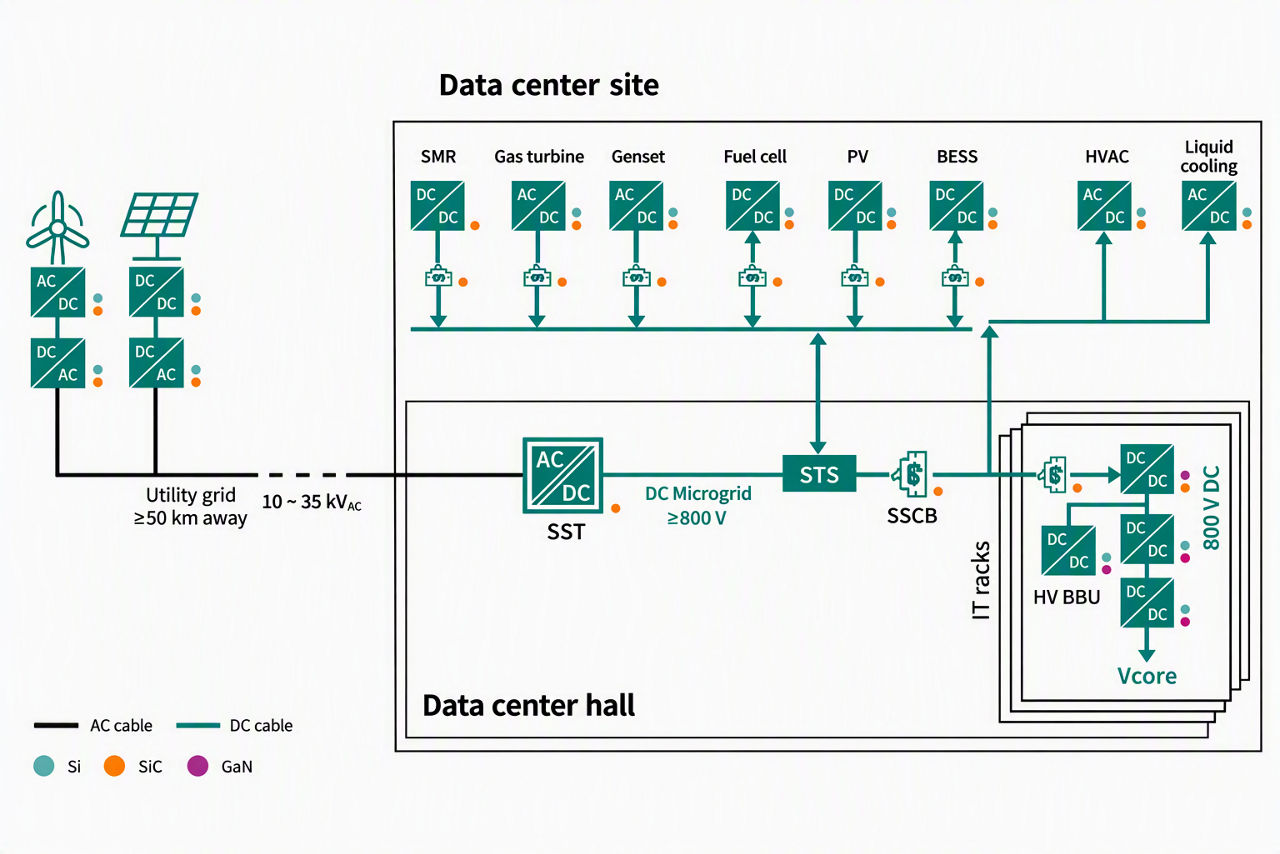
DC microgrid as the central infrastructure of a GW-scale data center (source: Infineon whitepaper "The Future of Powering AI," Figure 17, p. 19) — shows how a DC microgrid fed from the MV AC grid, coupled to renewables, batteries (BESS) and IT racks, reduces conversion losses across the whole facility.
Much of the efficiency gain in modern data centers comes down to power semiconductor technology.
Wide-bandgap devices — such as silicon carbide (SiC) and gallium nitride (GaN) — switch faster and lose less energy as heat than traditional silicon at the same voltage and current levels, across every stage of the power chain from the grid down to the processor.
Solid-State Transformers (SSTs) are one example of this shift: instead of a traditional, bulky medium-voltage transformer, an SST built from power semiconductors can take power directly from a 10–35 kV AC grid and convert it into regulated high-voltage DC, while being smaller, lighter, and installable closer to the racks it serves — reducing transmission losses along the way. Solid-state circuit breakers, built on similar technology, add fast, reliable protection to these DC architectures.
Explore Infineon's solid-state transformer and solid-state circuit breaker solutions for high-voltage DC data center architectures
Individual technologies like wide-bandgap semiconductors or solid-state transformers only deliver their full benefit when they're combined into a coherent system-level strategy. In practice, that strategy rests on a few consistent levers:
- Optimized power architectures — rethinking the entire energy flow from grid to core rather than optimizing individual components in isolation, so gains at one conversion stage aren't offset by losses at another.
- Advanced packaging techniques — approaches like chip embedding and integrated magnetics that shrink the physical space power components need, improving both thermal performance and efficiency around the semiconductors themselves.
- Smart control and monitoring — intelligent systems that dynamically match power delivery to actual workload demand, directly improving Power Usage Effectiveness (PUE) rather than over-provisioning for worst-case load.
Beyond individual components, some of the biggest gains come from rethinking the overall power distribution architecture. Moving from AC to high-voltage DC distribution removes redundant AC-DC and DC-AC conversion steps throughout the facility, letting racks do simple DC-to-DC conversion only. A DC microgrid architecture takes this further by:
- providing a single, flexible connection point for whatever energy sources a facility adds over time, without a dedicated conversion stage for each one
- scaling IT rack power to meet next-generation GPU demand without being constrained by physical space
- delivering end-to-end efficiency that minimizes both energy delivery waste and the cooling effort needed to remove that waste
- reducing the overall CO₂ footprint of the facility
Facility-level Battery Energy Storage Systems (BESS) add another lever: they buffer the highly variable, bursty load patterns created by large GPU clusters during training, keeping the load the facility presents to the utility grid closer to constant.
Explore Infineon's battery energy storage, photovoltaic, and wind power solutions that support renewable integration at data center scale
Even the most efficient power architecture cannot eliminate the need for enormous amounts of electricity — it can only reduce how much is wasted along the way. That makes the source of that electricity increasingly important for meeting data center energy needs sustainably.
There is no AI without power — and increasingly, that power needs to come from clean energy sources. On a global scale, close to half of data center energy is already attributed to renewables, but as AI drives demand sharply higher, simply maintaining that share won't be enough.
Looking ahead, operators of hyperscale data centers are expected to keep investing in both on-site renewable generation and long-term power purchase agreements (PPAs), with solar, wind, and fuel cells leading the way this decade — a single 1 GW data center, for example, could require a solar farm of roughly 8 km² to supply it.
Nuclear power, including small modular reactors, is also being developed as a steady, carbon-free complement to renewables, though renewables are expected to scale faster in the near term. Non-renewable sources like natural gas will likely continue to play a bridging role, but the clear direction of travel is toward decarbonizing the energy that powers AI.
Explore Infineon's battery energy storage, photovoltaic, and wind power solutions that support renewable integration at data center scale
Share in WeChat
Scan the QR code with your WeChat App to share this page.
Are countries and institutions, e.g. the EU, doing anything to prevent AI data centers from draining the grid?
Yes — several countries and regions have started implementing measures to manage the impact of data centers on local grids, ranging from stricter connection requirements to caps on new data center capacity in areas where total data center electricity use is already straining the grid.
The EU and national governments are also pushing energy efficiency reporting and sustainability requirements as part of broader climate policy, though specific rules vary significantly by country and region.
What is Power Usage Effectiveness (PUE)?
PUE is the ratio of total facility power to the power delivered to IT equipment — the closer to 1.0, the less overhead. Typical data centers today run in the 1.5–2.0 range; best-in-class hyperscale facilities can get closer to 1.1–1.2, though AI's higher cooling and power-density demands make hitting those numbers harder than ever.
How can data centers become more sustainable?
Sustainability comes from a combination of measures: improving power conversion efficiency to reduce waste at every stage, adopting more efficient architectures like high-voltage DC distribution, drawing on renewable energy sources (see below), and using intelligent monitoring to match power delivery to actual demand rather than over-provisioning for worst-case scenarios.
What are renewable energy sources, and how can data centers leverage them?
Renewable energy sources — primarily solar, wind, and in some cases geothermal or fuel cells — generate electricity without depleting finite resources or directly emitting CO₂. Data centers can leverage them either through on-site generation (such as an adjacent solar farm) or through long-term power purchase agreements (PPAs) that secure renewable capacity from the grid, often paired with battery storage to smooth out the variability of renewable generation.
How do battery energy storage systems (BESS) support data center operations?
BESS installations buffer the highly variable, bursty power demand created by large GPU clusters during training, absorbing sudden spikes and smoothing the load the facility presents to the utility grid. They can also provide backup power during outages and help data centers make better use of intermittent renewable generation by storing excess energy for later use.
What are the main challenges in scaling data center power infrastructure for AI?
The core challenges are physical space, current-carrying capacity, and heat: as rack and facility power climb toward gigawatt scale, conventional low-voltage AC infrastructure becomes impractical, requiring a shift to high-voltage DC distribution and eventually DC microgrids. On top of the infrastructure itself, operators also have to secure enough clean, reliable electricity supply and navigate increasingly strict regional regulations on data center growth.