
- ASIC
- Battery management ICs
- Clocks and timing solutions
- ESD and surge protection devices
- Automotive Ethernet
- Evaluation Boards
- High reliability
- Isolation
- Memories
- Microcontroller
- Power
- RF
- Security and smart card solutions
- Sensor technology
- Small signal transistors and diodes
- Transceivers
- Universal Serial Bus (USB)
- Wireless connectivity
- Search Tools
- Technology
- Packages
- Product Information
- Ordering
- Overview
- Automotive Ethernet PHY for in-vehicle networking
- Automotive Ethernet Switches for in-vehicle networking
- Overview
- Embedded flash IP solutions
- Flash+RAM MCP solutions
- F-RAM (Ferroelectric RAM)
- NOR flash
- nvSRAM (non-volatile SRAM)
- PSRAM – Pseudostatic RAM
- Radiation hardened and high-reliability memories
- SRAMs (Static Random Access Memory)
- Wafer and die memory solutions
- Overview
- AURIX™ TriCore™ MCUs
- PSOC™ MCUs
- TRAVEO™ T2G MCUs
- XMC™ MCUs
- Legacy MCUs
- MOTIX™ motor control SoCs/SIPs
- Overview
- AC-DC power conversion
- Automotive conventional powertrain ICs
- Class D audio amplifier ICs
- Contactless power and sensing ICs
- DC-DC converters
- Diodes and thyristors (Si/SiC)
- eFuses
- Gallium nitride (GaN)
- Gate Driver ICs
- IGBTs – Insulated gate bipolar transistors
- Intelligent power modules (IPM)
- JFETs
- LED driver ICs
- Motor drivers
- MOSFETs
- Power modules
- Power supply ICs
- Protection and monitoring ICs
- Silicon carbide (SiC)
- Smart power switches
- Solid state relays and isolators
- Wireless charging ICs
- Overview
- Antenna cross switches
- Antenna tuners
- Bias and control
- Coupler
- Driver amplifiers
- Rad hard microwave and RF
- Low noise amplifiers (LNAs)
- RF diode
- RF switches
- RF transistors
- Wireless control receiver
- Overview
- Calypso® products
- CIPURSE™ products
- Contactless memories
- OPTIGA™ embedded security solutions
- SECORA™ security solutions
- Security controllers
- Smart card modules
- Smart solutions for government ID
- Overview
- ToF 3D image sensors
- Current sensors
- Gas sensors
- Inductive position sensors
- MEMS microphones
- Pressure sensors
- Radar sensors
- Magnetic position sensors
- Magnetic speed sensors
- Capacitive sensors
- Temperature sensors
- Battery sensors
- Digital X-ray
- Computed tomography
- Sensor interface ASICs
- Overview
- Bipolar transistors
- Diodes
- Small signal/small power MOSFET
- Overview
- Automotive transceivers
- Control communication
- Powerline communications
- Overview
- USB 2.0 peripheral controllers
- USB 3.2 peripheral controllers
- USB hub controllers
- USB PD high-voltage microcontrollers
- USB-C AC-DC and DC-DC charging solutions
- USB-C charging port controllers
- USB-C Power Delivery controllers
- Overview
- AIROC™ Automotive wireless
- AIROC™ Bluetooth® and multiprotocol
- AIROC™ connected MCU
- AIROC™ Wi-Fi + Bluetooth® combos
- AIROC™ Ultra-Wide Band Solutions
- Overview
- Commercial off-the-shelf (COTs) memory portfolio
- Defense memory portfolio
- High-reliability power conversion and management
- Overview
- Rad hard microwave and RF
- Radiation hardened power
- Space memory portfolio
- Overview
- Parallel NOR flash
- SEMPER™ NOR flash family
- SEMPER™ X1 LPDDR flash
- Serial NOR flash
- Overview
-
32-bit TriCore™ AURIX™ – TC2x
- Overview
- AURIX™ family – TC21xL
- AURIX™ family – TC21xSC (wireless charging)
- AURIX™ family – TC22xL
- AURIX™ family – TC23xL
- AURIX™ family – TC23xLA (ADAS)
- AURIX™ family – TC23xLX
- AURIX™ family – TC264DA (ADAS)
- AURIX™ family – TC26xD
- AURIX™ family – TC27xT
- AURIX™ family – TC297TA (ADAS)
- AURIX™ family – TC29xT
- AURIX™ family – TC29xTT (ADAS)
- AURIX™ family – TC29xTX
- AURIX™ TC2x emulation devices
-
32-bit TriCore™ AURIX™ – TC3x
- Overview
- AURIX™ family - TC32xLP
- AURIX™ family – TC33xDA
- AURIX™ family - TC33xLP
- AURIX™ family – TC35xTA (ADAS)
- AURIX™ family – TC36xDP
- AURIX™ family – TC37xTP
- AURIX™ family – TC37xTX
- AURIX™ family – TC38xQP
- AURIX™ family – TC39xXA (ADAS)
- AURIX™ family - TC39xXX/XP
- AURIX™ family – TC3Ex
- AURIX™ TC37xTE (emulation devices)
- AURIX™ TC39xXE (emulation devices)
- 32-bit TriCore™ AURIX™ – TC4x
- Overview
- PSOC™ 4 HV Arm® Cortex®-M0+
- PSOC™ 5 LP Arm® Cortex®-M3
- PSOC™ 6 Arm® Cortex®-M4/M0+
- PSOC™ Multitouch Touchscreen Controller
- PSOC™ Control C3 Arm® Cortex®-M33
- PSOC™ Automotive 4: Arm® Cortex®-M0/M0+
- PSOC™ Edge Arm® Cortex® M55/M33
- PSOC™ Control C1 Arm® Cortex®-M0
- Overview
- 32-bit TRAVEO™ T2G Arm® Cortex® for body
- 32-bit TRAVEO™ T2G Arm® Cortex® for cluster
- Overview
- 32-bit XMC1000 industrial microcontroller Arm® Cortex®-M0
- 32-bit XMC4000 industrial microcontroller Arm® Cortex®-M4
- XMC5000 Industrial Microcontroller Arm® Cortex®-M4F
- 32-bit XMC7000 Industrial Microcontroller Arm® Cortex®-M7
- Overview
- Legacy 32-bit MCU
- Legacy 8-bit/16-bit microcontroller
- Other legacy MCUs
- 32-bit FM Arm® Cortex® Microcontroller
- Sensing controllers
- Overview
- AC-DC integrated power stage - CoolSET™
- AC-DC PWM and PFC controller
- Overview
- Bridge rectifiers & AC switches
- CoolSiC™ Schottky diodes
- Diode bare dies
- Silicon diodes
- Thyristor / Diode Power Modules
- Thyristor soft starter modules
- Thyristor/diode discs
- Overview
- GaN bidirectional switches
- GaN smart
- GaN transistors (GaN HEMTs)
- GaN with integrated driver
- GaN bare dies
- Overview
- Automotive gate driver ICs
- Gate Driver ICs for GaN HEMTs
- Gate Driver ICs for SiC MOSFETs
- Half-Bridge Gate Driver ICs
- High-Side Gate Driver ICs
- Isolated Gate Driver ICs
- Level-Shift Gate Driver ICs
- Low-Side Gate Driver ICs
- Three-Phase Gate Driver ICs
- Transformer Driver ICs
- Overview
- AC-DC LED driver ICs
- Ballast IC
- DC-DC LED driver IC
- LED dimming interface IC
- Linear LED driver IC
- LITIX™ - Automotive LED Driver IC
- NFC wireless configuration IC with PWM output
- VCSEL driver
- Overview
- BLDC motor drivers
- BDC motor drivers
- Stepper & servo motor drivers
- Motor drivers with MCU
- Bridge drivers with MOSFETs
- Gate Driver ICs
- Overview
- Automotive MOSFET: 30 V to 800 V
- Dual MOSFETs
- MOSFET (Si & SiC) Modules
- N-channel depletion mode MOSFET
- N-channel MOSFETs
- P-channel MOSFETs
-
Silicon carbide CoolSiC™ MOSFETs
- Overview
- Silicon Carbide MOSFET modules
- Silicon carbide MOSFET discretes
- Silicon carbide MOSFETs bare dies
- 400 V / 440 V Silicon Carbide MOSFETs
- 650 V Silicon Carbide MOSFETs
- 750 V Silicon Carbide MOSFETs
- 1200 V Silicon Carbide MOSFETs
- 2000 V Silicon Carbide MOSFETs
- 2300 V Silicon Carbide MOSFETs
- 3300 V Silicon Carbide MOSFETs
- 1700 V Silicon Carbide MOSFETs
- Silicon Carbide Bidirectional Switches
- Small signal/small power MOSFET
- Overview
- IGBT modules
- MOSFET (Si & SiC) Modules
- Intelligent power modules (IPM)
- Diodes and thyristors (Si/SiC)
- Automotive IGBT and CoolSiC™ MOSFET modules
- High density power modules
- Overview
- Automotive transceivers
- Linear voltage regulators
- Power management ICs (PMIC)
- Automotive switching regulators
- System Basis Chips (SBC)
- Overview
- High-side switches
- Low-side switches
- Multichannel SPI Switches & Controller
- Automotive eFuses
- Overview
- Radar sensors for automotive
- Radar sensors for IoT
- Overview
- EZ-USB™ CX3 MIPI CSI2 to USB 3.0 camera controller
- EZ-USB™ FX10 & FX5N USB 10Gbps peripheral controller
- EZ-USB™ FX20 USB 20 Gbps peripheral controller
- EZ-USB™ FX3 USB 5 Gbps peripheral controller
- EZ-USB™ FX3S USB 5 Gbps peripheral controller with storage interface
- EZ-USB™ FX5 USB 5 Gbps peripheral controller
- EZ-USB™ SD3 USB 5 Gbps storage controller
- EZ-USB™ SX3 FIFO to USB 5 Gbps peripheral controller
- Overview
- EZ-PD™ PMG1-B1 Battery Charge Controller with USB-C PD MCU
- EZ-PD™ PMG1-S0 high-voltage MCU with USB-C and PD
- EZ-PD™ PMG1-S1 high-voltage MCU with USB-C and PD
- EZ-PD™ PMG1-S2 high-voltage MCU with USB PD
- EZ-PD™ PMG1-S3 high-voltage MCU with USB-C & PD
- EZ-PD™ PMG1-B2 Battery Charge Controller with USB-C PD MCU
- Overview
- EZ-PD™ CCG3 USB type-C port controller PD
- EZ-PD™ CCG3PA USB-C and PD
- EZ-PD™ CCG3PA-NFET USB-C PD controller
- EZ-PD™ CCG7x consumer USB-C Power Delivery & DC-DC controller
- EZ-PD™ PAG1: power adapter generation 1
- EZ-PD™ PAG2: Power Adapter Generation 2
- EZ-PD™ PAG2-PD USB-C PD Controller
- Overview
- EZ-PD™ ACG1F one-port USB-C controller
- EZ-PD™ CCG2 USB Type-C port controller
- EZ-PD™ CCG3PA Automotive USB-C and Power Delivery controller
- EZ-PD™ CCG4 two-port USB-C and PD
- EZ-PD™ CCG5 dual-port and CCG5C single-port USB-C PD controllers
- EZ-PD™ CCG6 one-port USB-C & PD controller
- EZ-PD™ CCG6_CFP and EZ-PD™ CCG8_CFP Dual-Single-Port USB-C PD
- EZ-PD™ CCG6DF dual-port and CCG6SF single-port USB-C PD controllers
- EZ-PD™ CCG7D Automotive dual-port USB-C PD + DC-DC controller
- EZ-PD™ CCG7S Automotive single-port USB-C PD solution with a DC-DC controller + FETs
- EZ-PD™ CCG8 dual-single-port USB-C PD
- EZ-PD™ CMG1 USB-C EMCA controller
- EZ-PD™ CMG2 USB-C EMCA controller with EPR
Browse by core architecture
Browse by key technologies
Browse by design resources & partners
- LATEST IN
- Aerospace and defense
- AI and data center
- Automotive
- Communications
- Consumer electronics
- Industrial
- Security solutions
- Smart home and building
- Solutions
- Overview
- Defense applications
- Space applications
- Overview
- Data center power solutions
- Edge computing
- Machine Learning Edge AI
- Overview
- ADAS & autonomous driving
- Automotive body electronics
- Automotive LED lighting systems
- Automotive zonal architecture
- Chassis control & safety
- Electric vehicle drivetrain system
- EV thermal management system
- In-vehicle infotainment & HMI
- Light electric vehicle solutions
- Overview
- Satellite communications
- Telecommunications infrastructure
- Overview
- AR and smart glasses
- Complete system solutions for smart TVs
- Consumer Wearables
- Drones
- Home appliances
- Mobile device and smartphone solutions
- Photovoltaic
- Power adapters and chargers
- Semiconductor solutions for home entertainment applications
- Smart conference systems
- Overview
- Asset Tracking
- Battery energy storage (BESS)
- Battery formation and testing
- Digital health
- Electric forklifts
- EV charging
- High voltage solid-state power distribution
- Hydrogen electrolysis
- Industrial & Medical SMPS
- Industrial automation
- Industrial motor drives and controls
- Industrial robots
- LED lighting system design
- Light electric vehicle solutions
- Photovoltaic
- Power adapters and chargers
- Power tools
- Power transmission and distribution
- Robotics
- Traction
- Uninterruptible power supplies (UPS)
- Wind power
- Overview
- Access control and ticketing
- Device authentication and brand protection
- Embedded security for the Internet of Things (IoT)
- eSIM applications
- Government identification
- Mobile security
- Payment solutions
- Overview
- Domestic robots
- Heating ventilation and air conditioning (HVAC)
- Home and building automation
- PC accessories
- Semiconductor solutions for home entertainment applications
- Overview
- Battery management systems (BMS)
- Connectivity
- Human Machine Interface
- Machine Learning Edge AI
- Motor control
- Power conversion
- Security
- Sensor solutions
- System diagnostics and analytics
- Overview
- Data center power distribution
- FPGAs in datacenter applications
- Power system reliability modeling
-
Server rack power management
- Overview
- AI accelerator cards
- AMD CPU voltage regulator Ics
- Ampere CPU voltage regulator Ics
- Intel CPU voltage regulator Ics
- Intermediate Bus Converter (IBC)
- Network switches for AI data centers and server racks
- Server battery backup units (BBU)
- Server power path protection
- Server power supply units (PSU)
- SmartNIC cards
- Overview
- Automotive animated LED lighting system
- Automotive LED front single light functions
- Automotive LED rear single light functions
- Full LED headlight system - multi-channel LED driver
- LED driver solutions for electric two- and three-wheelers
- LED pixel light controller - supply & communication
- Static interior ambient LED light
- Overview
- Active suspension control
- Automotive braking solutions
- Automotive steering solutions
- Chassis domain control
- Overview
-
Automotive battery management system
- Overview
- Automotive battery cell monitoring & balancing
- Automotive battery control unit (BCU)
- Automotive battery isolated communication
- Automotive battery management system (BMS) - 12 V to 24 V
- Automotive battery management system (BMS) - 48 V
- Automotive battery management system (BMS) - high-voltage
- Automotive battery pack monitoring
- Automotive battery passport & event logging
- Automotive battery protection & disconnection
- Automotive current sensing & coulomb counting
- BMS (electric two- & three-wheelers)
- Auxiliary inverter
- Auxiliary inverter - high-voltage (commercial vehicles)
- DC-DC converter high-voltage
- DC-DC converter high-voltage (commercial vehicles)
- EV charging
- EV traction inverter
- FCEV powertrain solutions
- On-board charging (electric commercial vehicles)
- On-board charging (OBC)
- On-board charging (OBC) solutions for electric two- and three-wheelers
- Traction inverter (electric commercial vehicles)
- Traction inverter (electric two- & three-wheelers)
- Overview
- Audio amplifier solutions
- Complete system solutions for smart TVs
- Distribution audio amplifier unit solutions
- Home theater installation speaker system solutions
- Party speaker solutions
- PoE audio amplifier unit solutions
- Portable speaker solutions
- Powered active speaker systems
- Remote control
- Smart speaker designs
- Soundbar solutions
- Overview
- Disposable healthcare equipment
- Durable healthcare equipment
- Healthcare wearables
- Overview
- Data center power solutions
- Digital input/output (I/O) modules
- DIN rail power supply solutions
- Home and building automation
- Industrial HMI Monitors and Panels
- Industrial motor drives and controls
- Industrial PC
- Industrial robots
- Machine vision
- Mobile robots (AGV, AMR)
- Programmable logic controller (PLC)
- Solid-state circuit breaker (SSCB)
- Uninterruptible power supplies (UPS)
- Overview
- Automotive battery management system
- Industrial and consumer BMS
- Overview
- AC-DC power conversion
- DC-DC power conversion
- Overview
- Power supply health monitoring
- LATEST IN
- Digital documentation
- Boards & Kits
- Finder & selection tools
- Platforms
- Services
- Simulation & Modeling
- Software
- Tools
- Partners
- Infineon for Makers
- University Alliance Program
- Overview
- Bipolar Discs Finder
- Bipolar Module Finder
- Connected Secure Systems Finder
- Diode Rectifier Finder
- ESD Protection Finder
- Evaluation Board Finder
- Gate Driver Finder
- IGBT Discrete Finder
- IGBT Module Finder
- IPM Finder
- Microcontroller Finder
- MOSFET Finder
- PMIC Finder
- PSOC™ and FMx MCU Board & Kit Finder
- Radar Finder
- Reference Design Finder
- Simulation Model Finder
- Smart Power Switch Finder
- Transceiver Finder
- Voltage Regulator Finder
- Wireless Connectivity Board & Kit Finder
- Infineon Gate Driver Recommendation Tool
- Overview
- AIROC™ software & tools
- AURIX™ software & tools
- DRIVECORE™ for automotive software development
- iMOTION™ software & tools
- Infineon Smart Power Switches & Gate Driver Tool Suite
- MOTIX™ software & tools
- OPTIGA™ software & tools
- PSOC™ software & tools
- TRAVEO™ software & tools
- XENSIV™ software & tools
- XMC™ software & tools
- Overview
- HiRel Fit Rate Tool
- Infineon Designer
- Interactive product sheet
- IPOSIM Online Power Simulation Platform
- InfineonSpice Offline Simulation Tool
- OPTIREG™ automotive power supply ICs Simulation Tool (PLECS)
- Power MOSFET Simulation Models
- PowerEsim Switch Mode Power Supply Design Tool
- Solution Finder
- XENSIV™ Magnetic Sensor Simulation Tool
- Overview
- Configuration
- Hardware Development
- Programming & Testing
- SDK
- Tools Archive
- Utilities
- Overview
- AURIX™ certifications
- AURIX™ development tools
-
AURIX™ Embedded Software
- Overview
- AURIX™ Applications software
- AURIX™ Artificial Intelligence
- AURIX™ Gateway
- AURIX™ iLLD Drivers
- Infineon safety
- AURIX™ Security
- AURIX™ TC3xx Motor Control Application Kit
- AURIX™ TC4x SW application architecture
- Infineon AUTOSAR
- Communication and Connectivity
- Middleware
- Non AUTOSAR OS/RTOS
- OTA
- AURIX™ Microcontroller Kits
- Overview
- TRAVEO™ Development Tools
- TRAVEO™ Embedded Software
- Overview
- XENSIV™ Development Tools
- XENSIV™ Embedded Software
- XENSIV™ evaluation boards
- Overview
- CAPSENSE™ Controllers Code Examples
- Memories for Embedded Systems Code Examples
- PSOC™ 1 Code Examples for PSOC™ Designer
- PSOC™ 3 Code Examples for PSOC™ Creator
- PSOC™ 3/4/5 Code Examples
- PSOC™ 4 Code Examples for PSOC™ Creator
- PSOC™ 6 Code Examples for PSOC™ Creator
- PSOC™ 63 Code Examples
- USB Controllers Code Examples
- Overview
- AIROC™ Wi-Fi & Bluetooth EZ-Serial Module Firmware Platform
- AIROC™ Wi-Fi & Bluetooth Linux and Android Drivers
- emWin Graphics Library and GUI for PSOC™
- Infineon Complex Device Driver for Battery Management Systems
- Memory Solutions Hub
- PSOC™ 6 Peripheral Driver Library (PDL) for PSOC™ Creator
- USB Controllers EZ-USB™ GX3 Software and Drivers
- Overview
- CAPSENSE™ Controllers Configuration Tools EZ-Click
- DC-DC Integrated POL Voltage Regulators Configuration Tool – PowIRCenter
- EZ-USB™ SX3 Configuration Utility
- FM+ Configuration Tools
- FMx Configuration Tools
- Tranceiver IC Configuration Tool
- USB EZ-PD™ Configuration Utility
- USB EZ-PD™ Dock Configuration Utility
- USB EZ-USB™ HX3C Blaster Plus Configuration Utility
- USB UART Config Utility
- XENSIV™ Tire Pressure Sensor Programming
- Overview
- EZ-PD™ CCGx Dock Software Development Kit
-
FMx Softune IDE
- Overview
- RealOS™ Real-Time Operating System
- Softune IDE Language tools
- Softune Workbench
- Tool Lineup for F2MC-16 Family SOFTUNE V3
- Tool Lineup for F2MC-8FX Family SOFTUNE V3
- Tool Lineup for FR Family SOFTUNE V6
- Virtual Starter Kit
- Windows 10 operation of released SOFTUNE product
- Windows 7 operation of released SOFTUNE product
- Windows 8 operation of released SOFTUNE product
- Infineon GUI Designer
- ModusToolbox™ Software
- PSOC™ Creator Software
- Radar Development Kit
- RUST
- USB Controllers SDK
- Wireless Connectivity Bluetooth Mesh Helper Applications
- XMC™ DAVE™ Software
- Overview
- AIROC™ Bluetooth® Connect App Archive
- Cypress™ Programmer Archive
- EZ-PD™ CCGx Power Software Development Kit Archive
- ModusToolbox™ Software Archive
- PSOC™ Creator Archive
- PSOC™ Designer Archive
- PSOC™ Programmer Archive
- USB EZ-PD™ Configuration Utility Archives
- USB EZ-PD™ Host SDK Archives
- USB EZ-USB™ FX3 Archive
- USB EZ-USB™ HX3PD Configuration Utility Archive
- WICED™ Smart SDK Archive
- WICED™ Studio Archive
- Overview
- Infineon Developer Center Launcher
- Infineon Register Viewer
- Pin and Code Wizard
- Timing Solutions
- Wireless Connectivity
- LATEST IN
- Support
- Training
- Developer Community
- News
Business & Financial Press
Oct 01, 2026
Business & Financial Press
Sep 29, 2026
Business & Financial Press
Sep 23, 2026
Business & Financial Press
Sep 16, 2026
- Company
- Our stories
- Events
- Press
- Investor
- Careers
- Quality
- Latest news
Business & Financial Press
Oct 01, 2026
Business & Financial Press
Sep 29, 2026
Business & Financial Press
Sep 23, 2026
Business & Financial Press
Sep 16, 2026
How to Secure AI Deployments from Edge to Cloud
Anchoring protection in silicon creates a verifiable chain of trust across device, model and data.

Artificial Intelligence (AI) is rapidly becoming embedded in everyday life, powering applications across surveillance systems, smart cities, industrial automation, autonomous robots, connected vehicles, healthcare devices and intelligent assistants.
As AI moves from centralized cloud environments to distributed edge devices, models, data, and decision-making capabilities are increasingly deployed closer to where actions occur. This widespread adoption creates tremendous opportunities for real-time intelligence, but it also significantly expands the attack surface, making trust, integrity, and security fundamental requirements across the entire AI lifecycle — from edge to cloud.
A trained AI model is a company’s intellectual property. As it is updated over the air, replicated across distributed nodes, and orchestrated from the cloud, AI model protection has to hold across the entire workflow, not just at the edge where the data is captured. That means proving three things continuously:
● that the device is genuine,
● that the model running on it is unmodified and authentic, and
● that the data feeding it has not been tampered with.
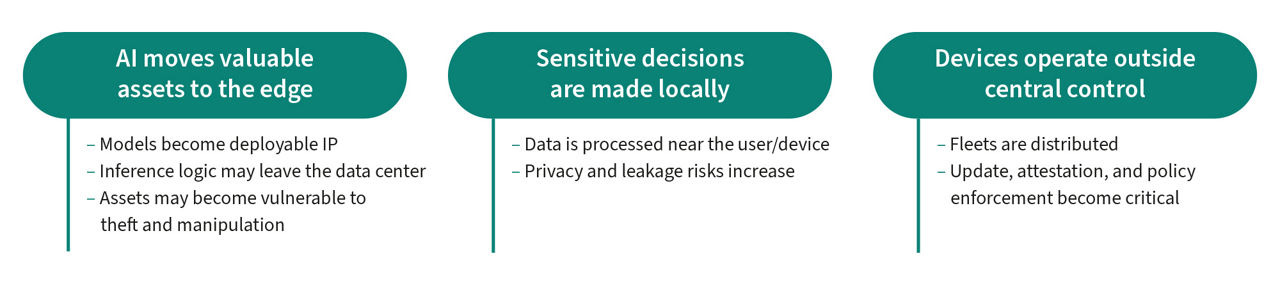
Securing Edge AI is fundamentally more challenging than traditional embedded systems because AI shifts high-value assets such as trained models, inference logic, and decision-making capabilities from protected cloud environments to distributed edge devices.
As AI models have become deployable intellectual property, they become attractive targets for theft, tampering, and reverse engineering. At the same time, sensitive data is increasingly processed locally on devices, raising privacy, data leakage, and compliance risks.
Unlike centrally managed cloud infrastructures, Edge AI deployments often consist of large, geographically distributed fleets of devices operating outside direct organizational control, making secured updates, remote attestation, device integrity verification, and policy enforcement significantly more difficult. As a result, security must extend beyond traditional device protection and provide an integrated trust architecture that simultaneously protects the device and the AI models that drive its decisions.
The result is that AI model integrity has to be enforced at three layers at once, and a gap at any one of them undermines the other two:
● Device trust — is this a genuine device, or a cloned one presenting a copied identity?
● Model trust — is the model that is about to execute the one the manufacturer signed, or a modified or substituted one?
● Data trust — did the sensor input and the training data actually originate where they claim to have originated?
Each stage of the workflow — data capture at the edge, aggregation, training, model packaging and distribution, inference, and cloud orchestration — is a trust boundary. Every unverified node in that chain is a place where model IP can leak, training data can be poisoned, or a compromised device can be admitted into a distributed deployment.
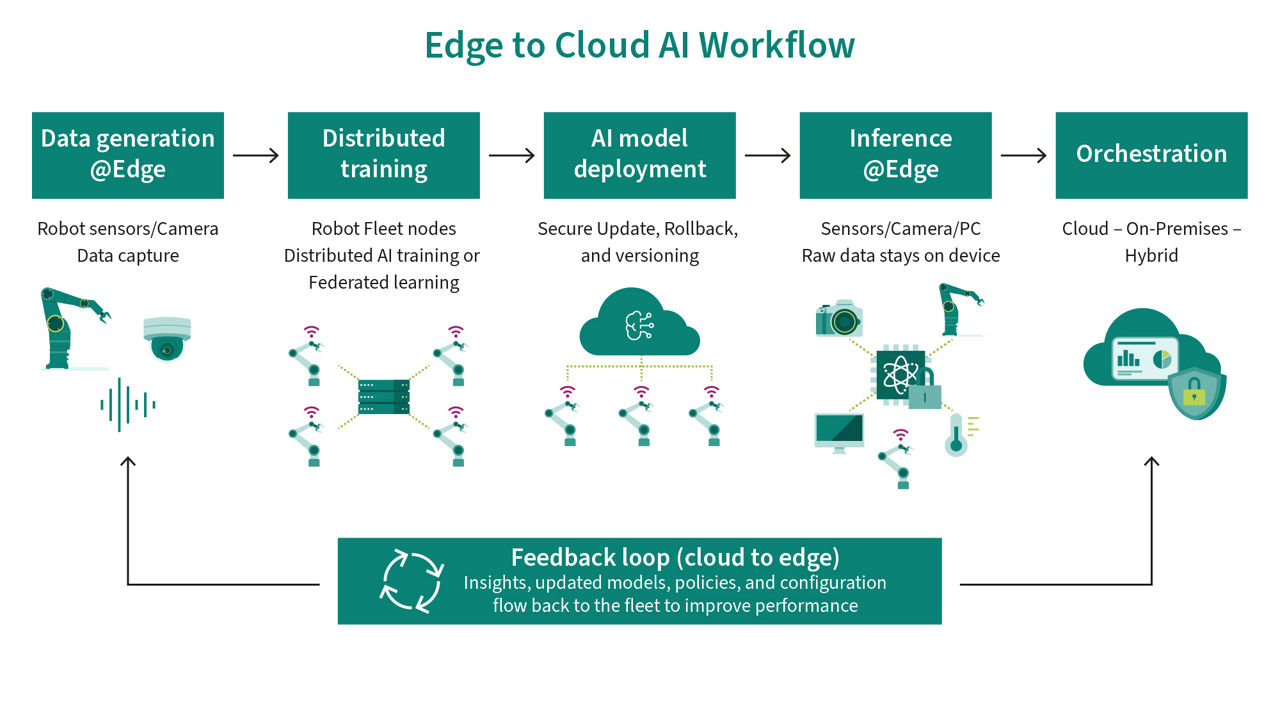
The approach that closes the gap is to move the keys — and the operations that use them — into a discrete, tamper-resistant security controller. Keys are generated and used inside that boundary. Encryption and decryption happen inside it. The host processor asks the security controller for a result; for this operation it does not need to see the key that produced the result.
Applied to an AI model, that gives a verifiable sequence rather than an assumed one. The model ships in encrypted form. Before it executes, the host computes a cryptographic hash of the model image and asks the security controller to verify it against a stored signature. Only if integrity and authenticity checks are OK, the controller unlocks the decryption key. The model is decrypted into memory and inference starts. If verification fails, the key is not unlocked, so the model is not decrypted, and execution is blocked. Trust becomes something the system proves and is verifiable, not something it assumes.
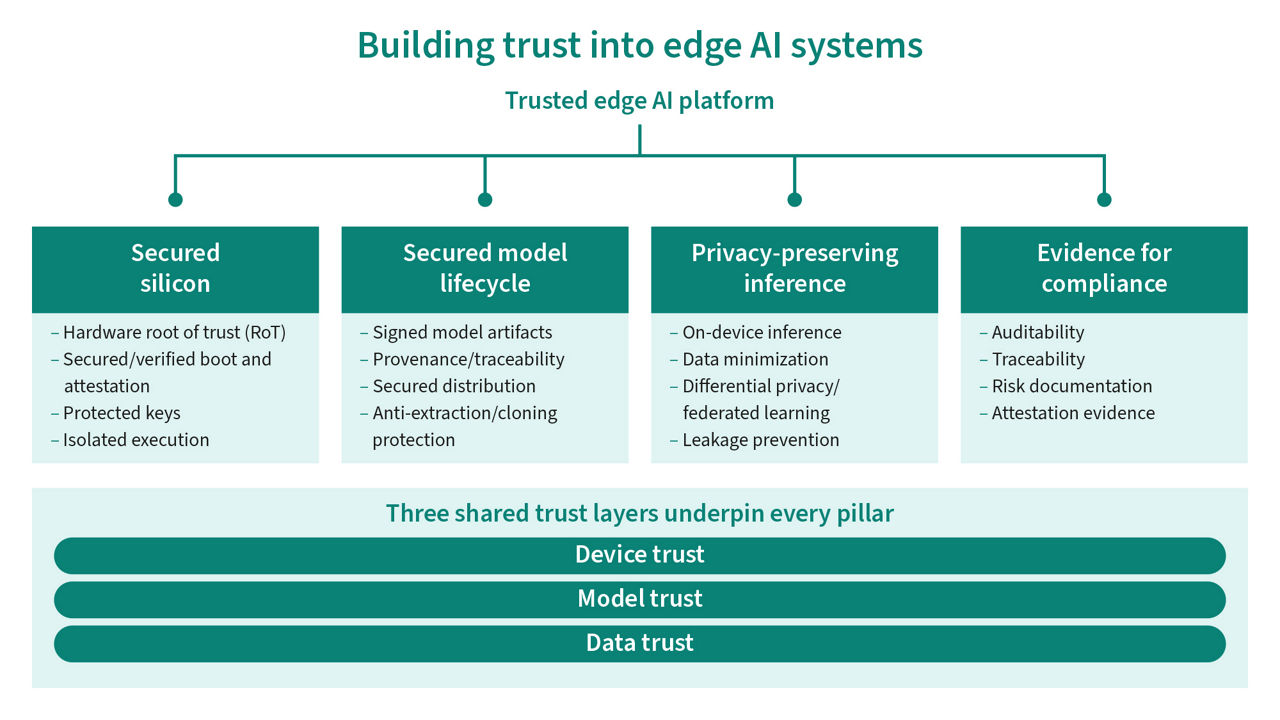
On platforms running a full operating system, the same principle extends upward through measured boot and device attestation: each stage of the boot chain is measured into the security controller before the next stage runs, producing signed evidence of the platform state that a remote service can verify before it admits the device or releases a model to it. That is what carries device identity from the edge into the cloud — and what allows a distributed or federated deployment to admit only nodes whose state it can check.
Infineon implements this approach with two hardware roots of trust that address complementary parts of the workflow. Which one fits — a secure element for edge AI, or a TPM for edge AI — is determined by the host architecture and the security requirement, not by a general ranking of one against the other.
OPTIGA™ Trust M is a turnkey security controller certified to PSA Certified Level 3. It anchors device identity, stores keys in tamper-resistant non-volatile memory, and performs signing and decryption inside its own isolated boundary — which is what makes it suitable as a Secure Element (SE) for edge AI where the model itself is the asset being protected. It connects over I²C with a shielded, encrypted connection, occupies a 3 × 3 mm USON-10 package, and is specified to work with any MCU or MPU, so it can be added to an existing design without changing the host processor.
Cryptographic support covers ECC on NIST curves up to P-521 and Brainpool r1 up to 512, RSA up to 2048, AES keys up to 256 bit, and HMAC up to SHA-512. Certificates and key pairs can be pre-provisioned at an Infineon facility, so a device arrives on the production line already carrying a unique identity.
OPTIGA™ TPMs provide a hardware-based root of trust that helps secure AI devices from the edge to the cloud. They protect cryptographic keys, verify platform integrity with measured boot and attestation, safeguard AI models and devices, and enable secured, authenticated communication with cloud services. By establishing end-to-end trust, OPTIGA™ TPMs help organizations deploy AI systems with stronger security, compliance, and resilience against threats.
OPTIGA™ TPM SLB 9672 (SPI) and SLB 9673 (I²C) are ready-to-use Trusted Platform Modules compliant with the TCG TPM 2.0 Library Specification revision 1.59, carrying Common Criteria EAL4+ and FIPS 140-2 Level 2 certification, with 51 kB of extended non-volatile memory.
They provide measured boot and attestation, so AI workloads run only on a platform whose state has been verified against a known-good baseline, and they extend that identity outward: OPTIGA™ TPM and OPTIGA™ Trust M support automatic device onboarding to AWS IoT Greengrass and Azure IoT Edge, which is what makes edge-to-cloud device identity cryptographically verifiable rather than asserted. In distributed and federated deployments, the same attestation evidence is what allows an orchestrator to admit only trusted nodes. Firmware updates are protected by a post-quantum XMSS signature scheme, and firmware recovery follows the NIST SP 800-193 platform firmware resiliency guidelines.
Each device stores a unique AES 256-bit key inside OPTIGA™ Trust M, and that key secures the AI model encryption key. Encryption and decryption take place inside OPTIGA™ Trust M. Thereby, the manufacturer’s IP embedded in the model can stay protected even if the device is lost, decommissioned or physically disassembled.
OPTIGA™ TPM SLB 9672 and OPTIGA™ TPM SLB 9673 carry Common Criteria EAL4+ and FIPS 140-2 Level 2. Where a software-only or virtualized root of trust offers no equivalent independently evaluated assurance level, these figures are the comparison an evaluator can check.
Three application areas concentrate the risk: they combine high-value models, physical accessibility, and fleets that operate outside direct organizational control.
Security cameras, video analytics, smart city surveillance and video doorbells run inference on models that took significant investment to train, on hardware mounted in publicly accessible locations. The model is the product differentiator, and the device is within reach of anyone with a ladder.
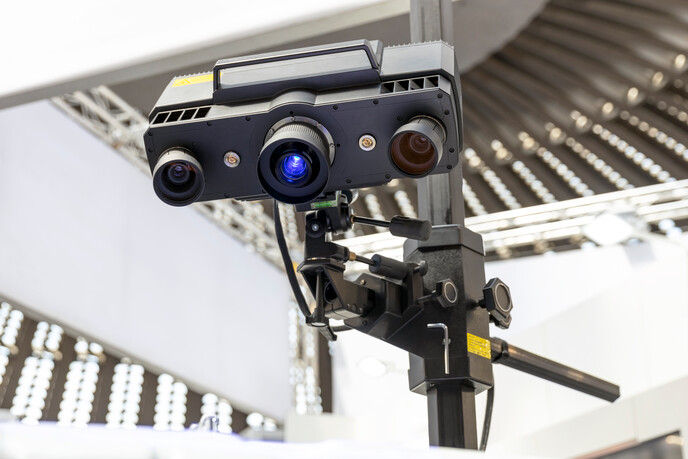
Industrial gateways, routers, switches, edge compute nodes and PLC controllers make decisions that move machinery. Here the integrity question outweighs the confidentiality one: a substituted model does not just leak IP, it changes what the equipment does. Long service lifetimes make cryptographic agility a design requirement rather than an afterthought.

Humanoids and robotics combine distributed training across fleets with autonomous action in shared human spaces. Every node that contributes to training and every node that acts on a deployed model has to be verifiable, which makes device attestation the gating mechanism for fleet participation.

1. Encryption at rest prevents unauthorized access to stored models
2. Attestation-based key provisioning allows keys to reach only verified devices
3. Platform integrity verification prevents compromised devices from deceiving cloud services
4. Mandatory access control restricts unauthorized model access
5. Kernel hardening reduces privilege escalation attack surface
6. Runtime protections minimize plaintext exposure during execution
7. Comprehensive monitoring enables threat detection and incident response
Organizations deploying AI models on edge should view this architecture as an essential security foundation rather than an optional feature.
The investment in implementing these controls protects against millions of dollars in potential intellectual property theft while establishing processes and infrastructure for future hardware-based security enhancements. By adopting this framework, organizations gain:
● IP Protection: Multi-layered defenses against model theft and unauthorized access
● Compliance Ready: Alignable with regulatory requirements and industry security standards
● Future Ready: Architecture prepared for hardware confidential computing when available
● Operational Resilience: Monitoring and response capabilities for incident handling
● Risk Reduction: Quantifiable reduction in attack surface and privilege escalation vectors
The combination of cryptographic protection, platform integrity, access control, and runtime safeguards creates a security posture appropriate for high-value AI intellectual property on edge devices. Implementation requires coordination across cloud services, device configuration, and operational practices, but the result is a robust framework protecting critical AI assets.
Can I add hardware-based AI model protection to an existing edge design?
Yes — hardware-based AI model protection can be added to an existing design without changing the host processor. OPTIGA™ Trust M is specified to work with any MCU or MPU and connects over a single I²C interface with a shielded, encrypted connection. It ships in a USON-10 package measuring 3 × 3 mm, so the board impact is one small component and one bus. In addition, multiple host software libraries are available for OPTIGA™ Trust M, including C libraries for bare-metal microcontrollers, libraries for Linux-based systems, and Python libraries. This enables straightforward integration across a wide range of MCU and MPU platforms and is a key reason why the solution remains processor independent. OPTIGA™ TPM SLB 9672 uses SPI and OPTIGA™ TPM SLB 9673 uses I²C, both in a UQFN-32 package, and integrate with standard Linux and Windows TPM software stacks. Because the security controller is discrete rather than integrated into the application processor, the host architecture and the AI runtime do not have to change.
What algorithms and key sizes protect an AI model encryption key?
A cryptographic key securely stored inside OPTIGA™ Trust M protects the AI model encryption key. Depending on the application, both symmetric and asymmetric cryptographic mechanisms can be used, while all cryptographic operations are executed within the protected boundary of OPTIGA™ Trust M. The device supports a broad range of algorithms, including AES-256, ECC on NIST curves up to P-521 and Brainpool r1 curves up to 512, RSA up to 2048, and HMAC up to SHA-512. The choice of algorithm and key size depends on the security architecture; however, the security architecture remains the same: cryptographic keys are used in the security controller’s isolated boundary and are therefore not exposed to the host processor, even during cryptographic operations.
What security properties can be realized using OPTIGA™ Trust M?
OPTIGA™ Trust M helps to establish key security properties for edge AI deployments by protecting confidentiality, integrity and authenticity of the AI models. AI models can be stored in encrypted form at rest, keeping model architectures and parameters protected against unauthorized access or extraction. By validating a model’s hash and signature before use, the device verifies that the model originates from a trusted source and has not been modified or tampered with, for example replaced by a malicious version.
Is the performance of a Secure Element good enough for AI model decryption?
AI models are often several KB, MB in size. Secure Elements are optimized for secured key storage and cryptographic services, not for processing large amounts of application data. Therefore, typically the process of envelope encryption is used, which separates responsibilities. OPTIGA™ Trust M secures and manages cryptographic keys. The MCU performs bulk decryption using a data encryption key. With that concept, the solution scales easily to larger AI models without requiring changes to the Secure Element.
How does device binding protect an AI model?
Device binding cryptographically links an AI model to a specific device during provisioning. During manufacturing or onboarding, the model encryption key is protected using a device-specific cryptographic identity stored inside OPTIGA™ Trust M. As a result, only the intended device can recover the key required to decrypt the model. Even if an attacker copies the encrypted model, application software, and storage content, the model remains unusable on other hardware because the necessary credentials are bound to the original device. This approach helps to prevent model cloning and protects valuable AI model IP.
Does hardware AI model protection work across industrial temperature ranges?
Yes — hardware AI model protection is available across industrial temperature ranges. OPTIGA™ Trust M is offered in standard and extended temperature versions, with the extended range covering −40°C to +105°C and carries a 20-year lifetime rating for industrial automation and infrastructure applications. OPTIGA™ TPM SLB 9672 is likewise available with an extended range of −40°C to +105°C for industrial use cases. For edge AI deployed in outdoor surveillance, industrial gateways or building infrastructure, the security controller’s temperature and lifetime ratings should be matched to the enclosure specification, not to the ambience rating of the AI processor alone.
When should an AI Edge design use OPTIGA™ TPM instead of only a Secure Element?
Use OPTIGA™ TPM when the design needs platform-level trust, operating-system-aware integration, secured boot measurement, device health attestation, or standards-based onboarding into cloud and IoT infrastructure. This is common for Linux- or Windows-based gateways, industrial edge computers, PLCs, routers, switches, and other connected systems that must prove both device identity and software state. OPTIGA™ TPM SLB 9672 and OPTIGA™ TPM SLB 9673 are ready-to-use TPM 2.0 security solutions with SPI or I²C interface options, Common Criteria EAL4+ and FIPS 140-2 Level 2 certifications, extended non-volatile memory, and support for stronger cryptographic algorithms. A Secure Element such as OPTIGA™ Trust M remains the fit for processor-independent key protection and model encryption-key handling, while OPTIGA™ TPM is the fit when the full platform state must be measured, attested, and trusted from edge to cloud.
How does OPTIGA™ TPM help prove that an Edge AI device is trustworthy before it receives or runs a model?
OPTIGA™ TPM provides a hardware-based root of trust for platforms that need measured boot and remote attestation. During startup, each relevant boot stage and software component can be measured into the TPM’s platform configuration registers. A remote service can then verify signed attestation evidence before it admits the device, provisions secrets, or releases an AI model. For Edge AI, this means the cloud does not have to trust a device identity claim on its own; it can check whether the platform state matches a known good baseline before allowing the node to participate in inference, fleet orchestration, or federated workflows. OPTIGA™ TPM devices are based on TCG TPM 2.0 specifications and are designed to help identify and authenticate connected devices while protecting data integrity and confidentiality.