
- ASIC
- Battery management ICs
- Clocks and timing solutions
- ESD and surge protection devices
- Automotive Ethernet
- Evaluation Boards
- High reliability
- Isolation
- Memories
- Microcontroller
- Power
- RF
- Security and smart card solutions
- Sensor technology
- Small signal transistors and diodes
- Transceivers
- Universal Serial Bus (USB)
- Wireless connectivity
- Suchwerkzeuge
- Technologie
- Packages
- Produktinformationen
- Bezugsquellen
- Überblick
- Automotive Ethernet PHY for in-vehicle networking
- Automotive Ethernet Switches for in-vehicle networking
- Überblick
- Embedded flash IP solutions
- Flash+RAM MCP solutions
- F-RAM (Ferroelectric RAM)
- NOR flash
- nvSRAM (non-volatile SRAM)
- PSRAM – Pseudostatic RAM
- Radiation hardened and high-reliability memories
- SRAMs (Static Random Access Memory)
- Wafer and die memory solutions
- Überblick
- AURIX™ TriCore™ MCUs
- PSOC™ MCUs
- TRAVEO™ T2G MCUs
- XMC™ MCUs
- Legacy MCUs
- MOTIX™ motor control SoCs/SIPs
- Überblick
- AC-DC power conversion
- Automotive conventional powertrain ICs
- Class D audio amplifier ICs
- Contactless power and sensing ICs
- DC-DC converters
- Diodes and thyristors (Si/SiC)
- eFuses
- Gallium nitride (GaN)
- Gate Driver ICs
- IGBTs – Insulated gate bipolar transistors
- Intelligent power modules (IPM)
- JFETs
- LED driver ICs
- Motor drivers
- MOSFETs
- Power modules
- Power supply ICs
- Protection and monitoring ICs
- Silicon carbide (SiC)
- Smart power switches
- Solid state relays and isolators
- Wireless charging ICs
- Überblick
- Antenna cross switches
- Antenna tuners
- Bias and control
- Coupler
- Driver amplifiers
- Rad hard microwave and RF
- Low noise amplifiers (LNAs)
- RF diode
- RF switches
- RF transistors
- Wireless control receiver
- Überblick
- Calypso® products
- CIPURSE™ products
- Contactless memories
- OPTIGA™ embedded security solutions
- SECORA™ security solutions
- Security controllers
- Smart card modules
- Smart solutions for government ID
- Überblick
- ToF 3D image sensors
- Current sensors
- Gas sensors
- Inductive position sensors
- MEMS microphones
- Pressure sensors
- Radar sensors
- Magnetic position sensors
- Magnetic speed sensors
- Capacitive sensors
- Temperature sensors
- Battery sensors
- Digital X-ray
- Computed tomography
- Sensor interface ASICs
- Überblick
- Bipolar transistors
- Diodes
- Small signal/small power MOSFET
- Überblick
- Automotive transceivers
- Control communication
- Powerline communications
- Überblick
- USB 2.0 peripheral controllers
- USB 3.2 peripheral controllers
- USB hub controllers
- USB PD high-voltage microcontrollers
- USB-C AC-DC and DC-DC charging solutions
- USB-C charging port controllers
- USB-C Power Delivery controllers
- Überblick
- AIROC™ Automotive wireless
- AIROC™ Bluetooth® and multiprotocol
- AIROC™ connected MCU
- AIROC™ Wi-Fi + Bluetooth® combos
- AIROC™ Ultra-Wide Band Solutions
- Überblick
- Commercial off-the-shelf (COTs) memory portfolio
- Defense memory portfolio
- High-reliability power conversion and management
- Überblick
- NewSpace memory portfolio
- Radiation tolerant power
- Überblick
- Rad hard microwave and RF
- Radiation hardened power
- Space memory portfolio
- Überblick
- Parallel NOR flash memory
- SEMPER™ NOR flash family
- SEMPER™ X1 LPDDR flash
- Serial NOR flash
- Überblick
-
AURIX™ TC2x - 32-bit TriCore™
- Überblick
- AURIX™ family – TC21xL
- AURIX™ family – TC21xSC (wireless charging)
- AURIX™ family – TC22xL
- AURIX™ family – TC23xL
- AURIX™ family – TC23xLA (ADAS)
- AURIX™ family – TC23xLX
- AURIX™ family – TC264DA (ADAS)
- AURIX™ family – TC26xD
- AURIX™ family – TC27xT
- AURIX™ family – TC297TA (ADAS)
- AURIX™ family – TC29xT
- AURIX™ family – TC29xTT (ADAS)
- AURIX™ family – TC29xTX
- AURIX™ TC2x emulation devices
-
AURIX™ TC3x - 32-bit TriCore™
- Überblick
- AURIX™ family - TC32xLP
- AURIX™ family – TC33xDA
- AURIX™ family - TC33xLP
- AURIX™ family – TC35xTA (ADAS)
- AURIX™ family – TC36xDP
- AURIX™ family – TC37xTP
- AURIX™ family – TC37xTX
- AURIX™ family – TC38xQP
- AURIX™ family – TC39xXA (ADAS)
- AURIX™ family - TC39xXX/XP
- AURIX™ family – TC3Ex
- AURIX™ TC37xTE (emulation devices)
- AURIX™ TC39xXE (emulation devices)
- AURIX™ TC4x - 32-bit TriCore™
- Überblick
- PSOC™ 4 Microcontroller: Arm® Cortex®-M0/M0+
- PSOC™ 4 HV Arm® Cortex®-M0+
- PSOC™ 5 LP Arm® Cortex®-M3
- PSOC™ 6 Arm® Cortex®-M4/M0+
- PSOC™ Multitouch Touchscreen Controller
- PSOC™ Control C3 Arm® Cortex®-M33
- PSOC™ Automotive 4: Arm® Cortex®-M0/M0+
- PSOC™ Edge Arm® Cortex® M55/M33
- PSOC™ Control C1 Arm® Cortex®-M0
- Überblick
- 32-bit TRAVEO™ T2G Arm® Cortex® for body
- 32-bit TRAVEO™ T2G Arm® Cortex® for cluster
- Überblick
- 32-bit XMC1000 industrial microcontroller Arm® Cortex®-M0
- 32-bit XMC4000 industrial microcontroller Arm® Cortex®-M4
- XMC5000 Industrial Microcontroller Arm® Cortex®-M4F
- 32-bit XMC7000 Industrial Microcontroller Arm® Cortex®-M7
- Überblick
- Legacy 32-bit MCU
- Legacy 8-bit/16-bit microcontroller
- Other legacy MCUs
- 32-bit FM Arm® Cortex® Microcontroller
- Sensing controllers
- Überblick
- AC-DC integrated power stage - CoolSET™
- AC-DC PWM and PFC controller
- Überblick
- Bridge rectifiers & AC switches
- CoolSiC™ Schottky diodes
- Diode bare dies
- Power stacks
- Silicon diodes
- Thyristor / Diode Power Modules
- Thyristor soft starter modules
- Thyristor/diode discs
- Überblick
- GaN bidirectional switches
- GaN smart
- GaN transistors (GaN HEMTs)
- GaN with integrated driver
- GaN bare dies
- Überblick
- Automotive gate driver ICs
- Gate Driver ICs for GaN HEMTs
- Gate Driver ICs for SiC MOSFETs
- Half-Bridge Gate Driver ICs
- High-Side Gate Driver ICs
- Isolated Gate Driver ICs
- Level-Shift Gate Driver ICs
- Low-Side Gate Driver ICs
- Three-Phase Gate Driver ICs
- Transformer Driver ICs
- Überblick
- AC-DC LED driver ICs
- Ballast IC
- DC-DC LED driver IC
- LED dimming interface IC
- Linear LED driver IC
- LITIX™ - Automotive LED Driver IC
- NFC wireless configuration IC with PWM output
- VCSEL driver
- Überblick
- BLDC motor drivers
- BDC motor drivers
- Stepper & servo motor drivers
- Motor drivers with MCU
- Bridge drivers with MOSFETs
- Gate Driver ICs
- Überblick
- Automotive MOSFET: 30 V to 800 V
- Dual MOSFETs
- MOSFET (Si & SiC) Modules
- N-channel depletion mode MOSFET
- N-channel MOSFETs
- P-channel MOSFETs
-
Silicon carbide CoolSiC™ MOSFETs
- Überblick
- Silicon Carbide MOSFET modules
- Silicon carbide MOSFET discretes
- Silicon carbide MOSFETs bare dies
- Silicon Carbide Bidirectional Switches
- 400 V / 440 V Silicon Carbide MOSFETs
- 650 V Silicon Carbide MOSFETs
- 750 V Silicon Carbide MOSFETs
- 1200 V Silicon Carbide MOSFETs
- 1700 V Silicon Carbide MOSFETs
- 2000 V Silicon Carbide MOSFETs
- 2300 V Silicon Carbide MOSFETs
- 3300 V Silicon Carbide MOSFETs
- Small signal/small power MOSFET
- Überblick
- IGBT modules
- MOSFET (Si & SiC) Modules
- Intelligent power modules (IPM)
- Diodes and thyristors (Si/SiC)
- Automotive IGBT and CoolSiC™ MOSFET modules
- High density power modules
- Überblick
- Automotive transceivers
- Linear voltage regulators
- Power management ICs (PMIC)
- Automotive switching regulators
- System Basis Chips (SBC)
- Überblick
- High-side switches
- Low-side switches
- Multichannel SPI Switches & Controller
- Automotive eFuses
- Überblick
- Radar sensors for automotive
- Radar sensors for IoT
- Überblick
- EZ-USB™ CX3 MIPI CSI2 to USB 3.0 camera controller
- EZ-USB™ FX10 & FX5N USB 10Gbps peripheral controller
- EZ-USB™ FX20 USB 20 Gbps peripheral controller
- EZ-USB™ FX3 USB 5 Gbps peripheral controller
- EZ-USB™ FX3S USB 5 Gbps peripheral controller with storage interface
- EZ-USB™ FX5 USB 5 Gbps peripheral controller
- EZ-USB™ SD3 USB 5 Gbps storage controller
- EZ-USB™ SX3 FIFO to USB 5 Gbps peripheral controller
- Überblick
- EZ-PD™ PMG1-B1 Battery Charge Controller with USB-C PD MCU
- EZ-PD™ PMG1-S0 high-voltage MCU with USB-C and PD
- EZ-PD™ PMG1-S1 high-voltage MCU with USB-C and PD
- EZ-PD™ PMG1-S2 high-voltage MCU with USB PD
- EZ-PD™ PMG1-S3 high-voltage MCU with USB-C & PD
- EZ-PD™ PMG1-B2 Battery Charge Controller with USB-C PD MCU
- Überblick
- EZ-PD™ CCG3 USB type-C port controller PD
- EZ-PD™ CCG3PA USB-C and PD
- EZ-PD™ CCG3PA-NFET USB-C PD controller
- EZ-PD™ CCG7x consumer USB-C Power Delivery & DC-DC controller
- EZ-PD™ PAG1: power adapter generation 1
- EZ-PD™ PAG2: Power Adapter Generation 2
- EZ-PD™ PAG2-PD USB-C PD Controller
- Überblick
- EZ-PD™ ACG1F one-port USB-C controller
- EZ-PD™ CCG2 USB Type-C port controller
- EZ-PD™ CCG3PA Automotive USB-C and Power Delivery controller
- EZ-PD™ CCG4 two-port USB-C and PD
- EZ-PD™ CCG5 dual-port and CCG5C single-port USB-C PD controllers
- EZ-PD™ CCG6 one-port USB-C & PD controller
- EZ-PD™ CCG6_CFP and EZ-PD™ CCG8_CFP Dual-Single-Port USB-C PD
- EZ-PD™ CCG6DF dual-port and CCG6SF single-port USB-C PD controllers
- EZ-PD™ CCG7D Automotive dual-port USB-C PD + DC-DC controller
- EZ-PD™ CCG7S Automotive single-port USB-C PD solution with a DC-DC controller + FETs
- EZ-PD™ CCG8 dual-single-port USB-C PD
- EZ-PD™ CMG1 USB-C EMCA controller
- EZ-PD™ CMG2 USB-C EMCA controller with EPR
Nach Architektur durchsuchen
Nach Technologien durchsuchen
- AKTUELLES IN
- Aerospace and defense
- AI and data center
- Automotive
- Communications
- Consumer electronics
- Industrial
- Security solutions
- Smart home and building
- Solutions
- Überblick
- Defense applications
- Space applications
- Überblick
- Data center power solutions
- Edge computing
- Machine Learning Edge AI
- Überblick
- ADAS & autonomous driving
- Automotive body electronics
- Automotive LED lighting systems
- Automotive zonal architecture
- Chassis control & safety
- Electric vehicle drivetrain system
- EV thermal management system
- In-vehicle infotainment & HMI
- Light electric vehicle solutions
- Überblick
- Satellite communications
- Telecommunications infrastructure
- Überblick
- PC accessories
- AR and smart glasses
- Complete system solutions for smart TVs
- Consumer wearables
- Drones
- Home appliances
- Mobile device and smartphone solutions
- Photovoltaic
- Power adapters and chargers
- Semiconductor solutions for home entertainment applications
- Smart conference systems
- Überblick
- Asset Tracking
- Battery energy storage (BESS)
- Battery formation and testing
- Digital health
- Electric forklifts
- EV charging
- High voltage solid-state power distribution
- Hydrogen electrolysis
- Industrial & Medical SMPS
- Industrial automation
- Industrial motor drives and controls
- Industrial robots
- LED lighting system design
- Light electric vehicle solutions
- Photovoltaic
- Power adapters and chargers
- Power tools
- Power transmission and distribution
- Robotics
- Traction
- Uninterruptible power supplies (UPS)
- Wind power
- Überblick
- Access control and ticketing
- Device authentication and brand protection
- Embedded security for the Internet of Things (IoT)
- eSIM applications
- Government identification
- Mobile security
- Payment solutions
- Überblick
- Heating ventilation and air conditioning (HVAC)
- Home and building automation
- Überblick
- Battery management systems (BMS)
- Connectivity
- Human Machine Interface
- Machine Learning Edge AI
- Motor control
- Power conversion
- Security
- Sensor solutions
- System diagnostics and analytics
- Überblick
- Data center power distribution
- FPGAs in datacenter applications
- Power system reliability modeling
-
Server rack power management
- Überblick
- AI accelerator cards
- AMD CPU voltage regulator ICs
- Ampere CPU voltage regulator ICs
- Intel CPU voltage regulator ICs
- Intermediate Bus Converter (IBC)
- Network switches for AI data centers and server racks
- Server battery backup units (BBU)
- Server power path protection
- Server power supply units (PSU)
- SmartNIC cards
- Überblick
- Automotive animated LED lighting system
- Automotive LED front single light functions
- Automotive LED rear single light functions
- Full LED headlight system - multi-channel LED driver
- LED driver solutions for electric two- and three-wheelers
- LED pixel light controller - supply & communication
- Static interior ambient LED light
- Überblick
- Active suspension control
- Automotive braking solutions
- Automotive steering solutions
- Chassis domain control
- Überblick
-
Automotive battery management system
- Überblick
- Automotive battery cell monitoring & balancing
- Automotive battery control unit (BCU)
- Automotive battery isolated communication
- Automotive battery management system (BMS) - 12 V to 24 V
- Automotive battery management system (BMS) - 48 V
- Automotive battery management system (BMS) - high-voltage
- Automotive battery pack monitoring
- Automotive battery passport & event logging
- Automotive battery protection & disconnection
- Automotive current sensing & coulomb counting
- BMS (electric two- & three-wheelers)
- Auxiliary inverter
- Auxiliary inverter - high-voltage (commercial vehicles)
- REEV engine & HV starter‑generator control
- DC-DC converter high-voltage
- DC-DC converter high-voltage (commercial vehicles)
- EV charging
- EV traction inverter
- FCEV powertrain solutions
- On-board charging (electric commercial vehicles)
- On-board charging (OBC)
- On-board charging (OBC) solutions for electric two- and three-wheelers
- Traction inverter (electric commercial vehicles)
- Traction inverter (electric two- & three-wheelers)
- Überblick
- Audio amplifier solutions
- Complete system solutions for smart TVs
- Distribution audio amplifier unit solutions
- Home theater installation speaker system solutions
- Party speaker solutions
- PoE audio amplifier unit solutions
- Portable speaker solutions
- Powered active speaker systems
- Remote control
- Smart speaker designs
- Soundbar solutions
- Überblick
- Data center power solutions
- Digital input/output (I/O) modules
- DIN rail power supply solutions
- Home and building automation
- Industrial HMI Monitors and Panels
- Industrial motor drives and controls
- Industrial PC
- Industrial robots
- Machine vision
- Mobile robots (AGV, AMR)
- Solid-state circuit breaker (SSCB)
- Uninterruptible power supplies (UPS)
- Überblick
- AC-DC power conversion
- DC-DC power conversion
- Überblick
- Power supply health monitoring
- AKTUELLES IN
- Digital documentation
- Boards & Kits
- Finder & selection tools
- Platforms
- Services
- Simulation & Modeling
- Software
- Tools
- Partners
- Maker
- University Alliance Program
- Überblick
- Bipolar Discs Finder
- Bipolar Module Finder
- Connected Secure Systems Finder
- Diode Rectifier Finder
- ESD Protection Finder
- Evaluation Board Finder
- Gate Driver Finder
- IGBT Discrete Finder
- IGBT Module Finder
- IPM Finder
- Microcontroller Finder
- MOSFET Finder
- PMIC Finder
- Product Finder
- PSOC™ and FMx MCU Board & Kit Finder
- Radar Finder
- Reference Design Finder
- Simulation Model Finder
- Smart Power Switch Finder
- Transceiver Finder
- Voltage Regulator Finder
- Wireless Connectivity Board & Kit Finder
- Infineon Gate Driver Recommendation Tool
- Überblick
- AIROC™ software & tools
- AURIX™ software & tools
- DRIVECORE™ for automotive software development
- iMOTION™ software & tools
- Infineon Smart Power Switches & Gate Driver Tool Suite
- MOTIX™ software & tools
- OPTIGA™ software & tools
- PSOC™ software & tools
- TRAVEO™ software & tools
- XENSIV™ software & tools
- XMC™ software & tools
- Überblick
- HiRel Fit Rate Tool
- Infineon Designer
- Interactive product sheet
- IPOSIM Online Power Simulation Platform
- InfineonSpice Offline Simulation Tool
- OPTIREG™ automotive power supply ICs Simulation Tool (PLECS)
- Power MOSFET Simulation Models
- PowerEsim Switch Mode Power Supply Design Tool
- Solution Finder
- XENSIV™ Magnetic Sensor Simulation Tool
- Überblick
- Configuration
- Hardware Development
- Programming & Testing
- SDK
- Tools Archive
- Utilities
- Überblick
- AURIX™ certifications
- AURIX™ development tools
-
AURIX™ Embedded Software
- Überblick
- AURIX™ Applications software
- AURIX™ Artificial Intelligence
- AURIX™ Gateway
- AURIX™ iLLD Drivers
- Infineon safety
- AURIX™ Security
- AURIX™ TC3xx Motor Control Application Kit
- AURIX™ TC4x SW application architecture
- Infineon AUTOSAR
- Communication and Connectivity
- Middleware
- Non AUTOSAR OS/RTOS
- OTA
- AURIX™ Microcontroller Kits
- Überblick
- TRAVEO™ Development Tools
- TRAVEO™ Embedded Software
- Überblick
- XENSIV™ Development Tools
- XENSIV™ Embedded Software
- XENSIV™ evaluation boards
- Überblick
- CAPSENSE™ Controllers Code Examples
- Memories for Embedded Systems Code Examples
- PSOC™ 1 Code Examples for PSOC™ Designer
- PSOC™ 3 Code Examples for PSOC™ Creator
- PSOC™ 3/4/5 Code Examples
- PSOC™ 4 Code Examples for PSOC™ Creator
- PSOC™ 6 Code Examples for PSOC™ Creator
- PSOC™ 63 Code Examples
- USB Controllers Code Examples
- Überblick
- AIROC™ Wi-Fi & Bluetooth EZ-Serial Module Firmware Platform
- AIROC™ Wi-Fi & Bluetooth Linux and Android Drivers
- emWin Graphics Library and GUI for PSOC™
- Infineon Complex Device Driver for Battery Management Systems
- Memory Solutions Hub
- PSOC™ 6 Peripheral Driver Library (PDL) for PSOC™ Creator
- USB Controllers EZ-USB™ GX3 Software and Drivers
- Überblick
- CAPSENSE™ Controllers Configuration Tools EZ-Click
- DC-DC Integrated POL Voltage Regulators Configuration Tool – PowIRCenter
- EZ-USB™ SX3 Configuration Utility
- FM+ Configuration Tools
- FMx Configuration Tools
- Tranceiver IC Configuration Tool
- USB EZ-PD™ Configuration Utility
- USB EZ-PD™ Dock Configuration Utility
- USB EZ-USB™ HX3C Blaster Plus Configuration Utility
- USB UART Config Utility
- XENSIV™ Tire Pressure Sensor Programming
- Überblick
- EZ-PD™ CCGx Dock Software Development Kit
-
FMx Softune IDE
- Überblick
- RealOS™ Real-Time Operating System
- Softune IDE Language tools
- Softune Workbench
- Tool Lineup for F2MC-16 Family SOFTUNE V3
- Tool Lineup for F2MC-8FX Family SOFTUNE V3
- Tool Lineup for FR Family SOFTUNE V6
- Virtual Starter Kit
- Windows 10 operation of released SOFTUNE product
- Windows 7 operation of released SOFTUNE product
- Windows 8 operation of released SOFTUNE product
- Infineon GUI Designer
- ModusToolbox™ Software
- PSOC™ Creator Software
- Radar Development Kit
- RUST
- USB Controllers SDK
- Wireless Connectivity Bluetooth Mesh Helper Applications
- XMC™ DAVE™ Software
- Überblick
- AIROC™ Bluetooth® Connect App Archive
- Cypress™ Programmer Archive
- EZ-PD™ CCGx Power Software Development Kit Archive
- ModusToolbox™ Software Archive
- PSOC™ Creator Archive
- PSOC™ Designer Archive
- PSOC™ Programmer Archive
- USB EZ-PD™ Configuration Utility Archives
- USB EZ-PD™ Host SDK Archives
- USB EZ-USB™ FX3 Archive
- USB EZ-USB™ HX3PD Configuration Utility Archive
- WICED™ Smart SDK Archive
- WICED™ Studio Archive
- Überblick
- Infineon Developer Center Launcher
- Infineon Register Viewer
- Pin and Code Wizard
- Timing Solutions
- Wireless Connectivity
- AKTUELLES IN
- Support
- Training
- Infineon Developer Community
- Neueste Nachrichten
Wirtschaftspresse
Okt. 28, 2026
Wirtschaftspresse
Okt. 27, 2026
Wirtschaftspresse
Okt. 22, 2026
Wirtschaftspresse
Okt. 21, 2026
- Unternehmen
- Unsere Geschichten
- Events
- Presse
- Investor
- Karriere
- Qualität
- Neueste Nachrichten
Wirtschaftspresse
Okt. 28, 2026
Wirtschaftspresse
Okt. 27, 2026
Wirtschaftspresse
Okt. 22, 2026
Wirtschaftspresse
Okt. 21, 2026
Share in WeChat
Scan the QR code with your WeChat App to share this page.

Wir versorgen KI mit Strom: vom Stromnetz bis zum Prozessor
Wir versorgen KI mit Strom und schaffen die Voraussetzungen für energieeffiziente KI-Rechenzentren der heutigen und kommenden Generationen. Mit unserem umfassenden Portfolio an Halbleiterlösungen und unserer Systemkompetenz unterstützen wir unsere Kunden dabei, Leistung, Zuverlässigkeit und Effizienz entlang der gesamten Energiekette zu optimieren: vom Stromnetz bis zum Prozessor.
Okt. 29, 2026
Künstliche Intelligenz lässt den Bedarf an Rechenleistung in bislang ungekanntem Ausmaß steigen. Damit KI ihr volles Potenzial entfalten kann, muss die zugrunde liegende Infrastruktur hohe Leistung mit Effizienz und Zuverlässigkeit verbinden. Von der Energieinfrastruktur über das Rechenzentrum bis zum KI-Prozessor werden innovative Leistungstechnologien damit zu einem entscheidenden Wegbereiter für die nächste Generation der KI.
Diese Herausforderung zu meistern, erfordert mehr als schrittweise Verbesserungen. Wir müssen grundlegend neu denken, wie elektrische Energie erzeugt, übertragen, gespeichert, verteilt und bereitgestellt wird. Moderne Halbleitertechnologien spielen dabei eine entscheidende Rolle.

Kennzahlen zum Energiebedarf von KI
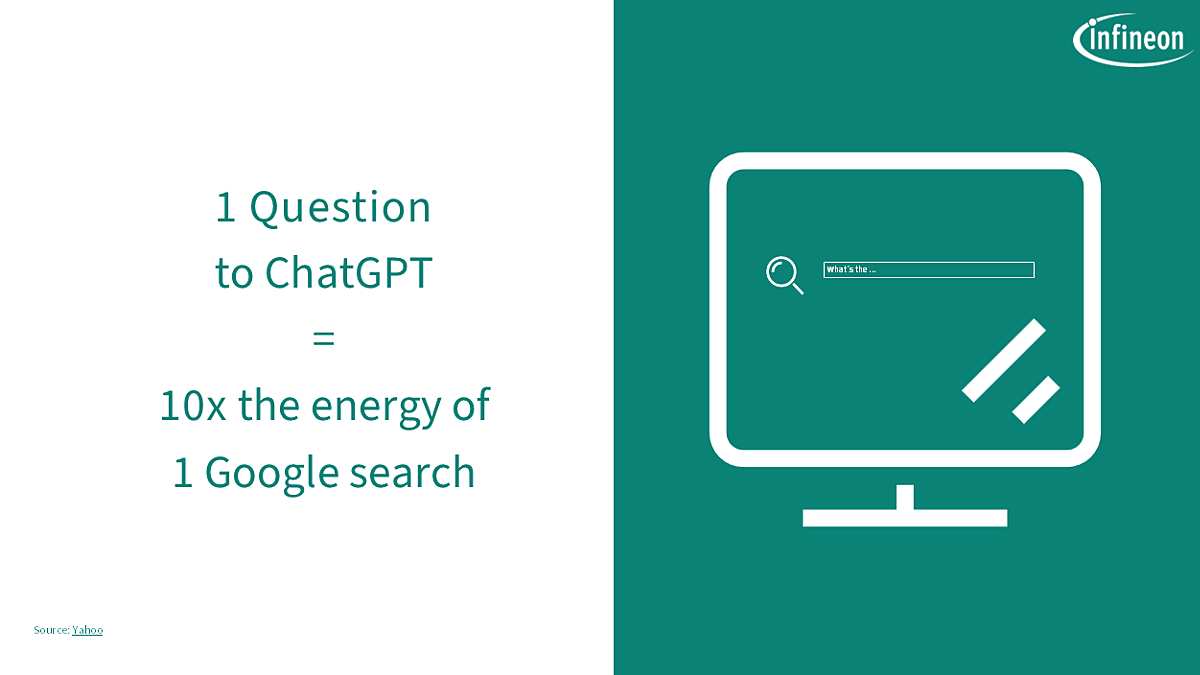
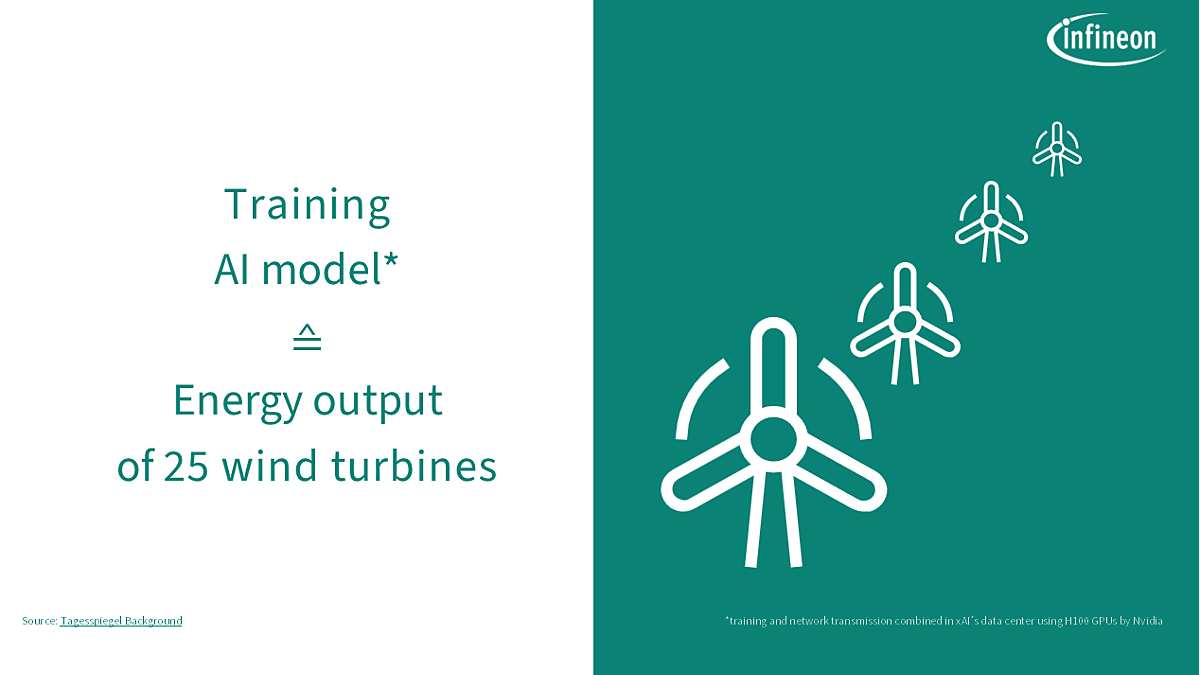

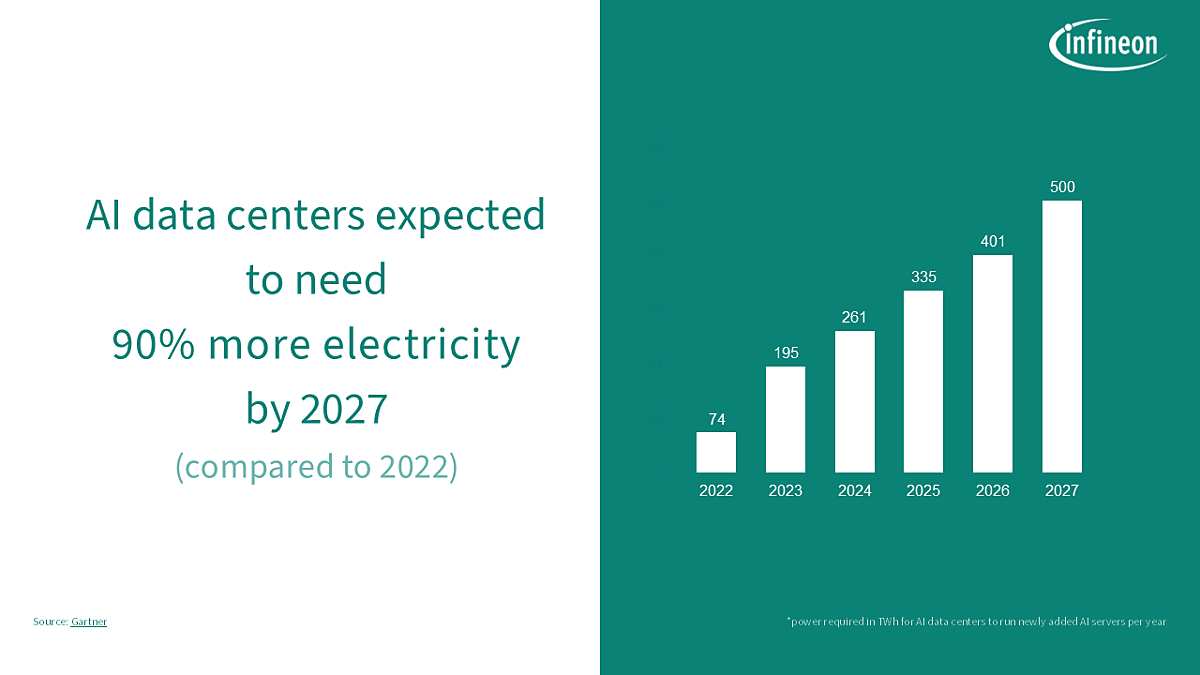
Das Training immer größerer KI-Modelle in riesigen Rechenzentren erfordert immer mehr Rechenleistung. Dafür werden bis zu 100.000 Prozessoren zu einer virtuellen Maschine gebündelt. Daraus entstehen Herausforderungen auf drei Ebenen:
- Die Stromversorgung moderner Prozessoren: Immer höhere Lastströme und starke, kurzfristige Lastschwankungen stellen neue Anforderungen. Wir erwarten innerhalb dieses Jahrzehnts Ströme von bis zu 10.000 Ampere pro Prozessor. Das entspricht dem Zehnfachen der heutigen Anforderungen.
- Die Stromversorgung von KI-Server-Racks: Der Leistungsbedarf wird auf mehr als 1 MW pro Rack steigen. Auch das entspricht etwa dem Zehnfachen des heutigen Niveaus.
- Die Stromversorgung ganzer Rechenzentren: Leistungsanforderungen im Gigawatt-Bereich erfordern eine andere Infrastruktur und neue Ansätze für die Energieverteilung im Rechenzentrum. Da Rechenzentren zu bedeutenden Stromverbrauchern werden, gewinnen zudem die Pufferung von Lastprofilen und die Bereitstellung netzstützender Dienstleistungen an Bedeutung.
In unserem Whitepaper „The Future of Powering AI“ geben wir Einblicke in mögliche Szenarien für die zukünftige Energieversorgung von KI. Wir untersuchen, wie Veränderungen bei Architektur, Qualität, Effizienz, thermischen Anforderungen und Energieverfügbarkeit die weitere Entwicklung beeinflussen werden. Unsere Analyse gibt einen Überblick über die entscheidenden Trends in diesem dynamischen Umfeld.
KI lässt den Bedarf an Rechenleistung in bislang ungekanntem Ausmaß steigen. Mit immer leistungsfähigeren Prozessoren, Server-Racks und Rechenzentren steigen zugleich die Anforderungen an eine effiziente und zuverlässige KI-Infrastruktur.
Herausforderung
KI-Prozessoren benötigen extrem hohe Stromstärken und müssen sehr schnell auf Laständerungen reagieren können. Eine herkömmliche seitliche Stromversorgung beansprucht viel Platz auf der Leiterplatte und führt bei sehr hohen Stromstärken zu höheren Verlusten bei der Stromversorgung.
Lösung
Bei der vertikalen Stromversorgung wird der Strom durch die Leiterplatte zur Rückseite des Prozessors geführt. Infineon unterstützt diesen Wandel mit low-voltage silicon MOSFETs, discrete power stages und vertikalen Leistungsmodulen, die für eine hohe Stromdichte und Effizienz ausgelegt sind.

Herausforderung
Der Leistungsbedarf von KI-Racks steigt rasant, weil immer mehr GPUs und Beschleuniger in hochverdichteten Systemen zusammenarbeiten. Etablierte 48-Volt-Architekturen und einphasige Stromversorgungen lassen sich bei diesen Leistungsanforderungen zunehmend schwieriger skalieren.
Lösung
DC-Architekturen mit höheren Spannungen, disaggregierte Power Shelves, hocheffiziente Netzteile (PSUs), Battery Backup Units (BBUs) und Schutzfunktionen ermöglichen die weitere Skalierung von KI-Racks. Gleichzeitig können sie Umwandlungsverluste reduzieren und die Leistungsdichte erhöhen.

Herausforderung
KI-Rechenzentren entwickeln sich zunehmend zu großen Stromverbrauchern. Schnell wechselnde GPU-Workloads können die Energieinfrastruktur stark beanspruchen. Gleichzeitig müssen Betreiber eine hohe Verfügbarkeit und Netzstabilität gewährleisten und den Energieverbrauch möglichst effizient gestalten.
Lösung
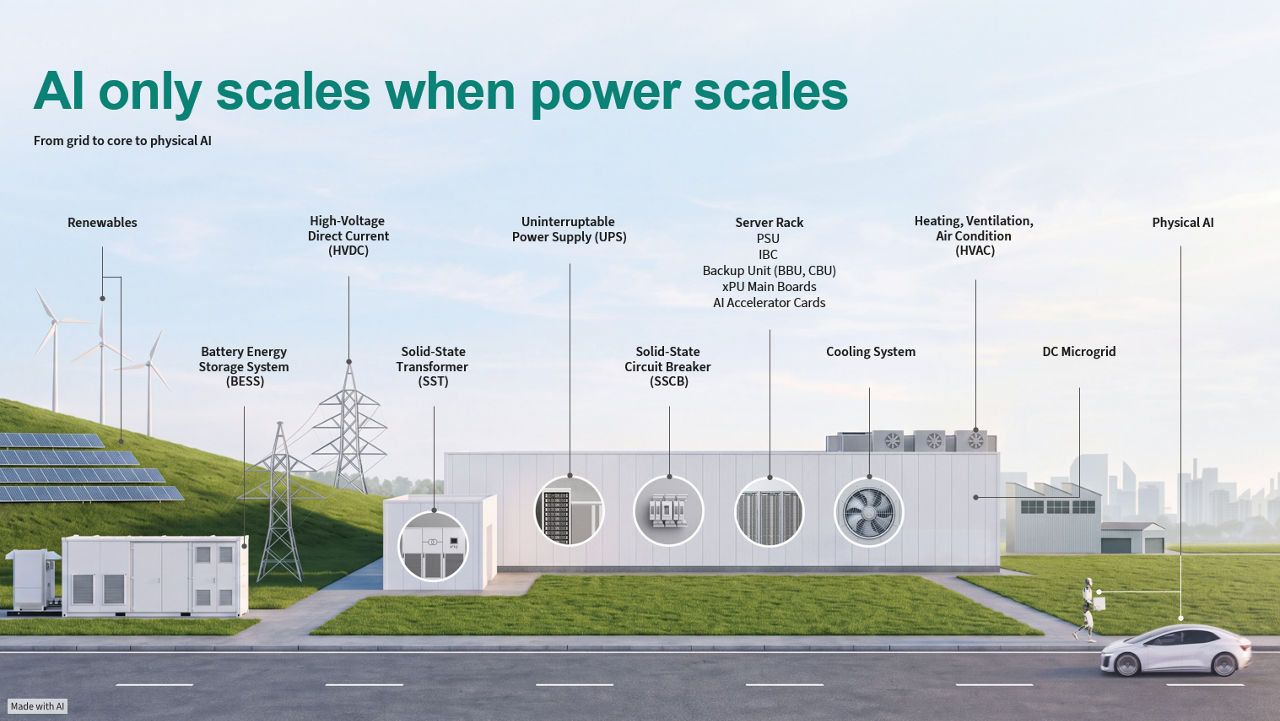
Das „Grid-to-Core“-Portfolio von Infineon umfasst Lösungen für Umwandlung, Schutz, Überwachung und Pufferung entlang der Energiekette. Dazu gehören unter anderem Solid-State-Transformatoren (SSTs), Solid-State-Leistungsschalter (SSCBs), Batterie-Energiespeichersysteme (BESS), Netzteile (PSUs), Intermediate Bus Converter (IBCs) sowie Modelle zur Bewertung der Zuverlässigkeit der Stromversorgung.

Herausforderung
KI-Anwendungen benötigen enorme Rechenleistung und damit auch Energie für Kühlung und unterstützende Infrastruktur. Ohne Effizienzsteigerungen kann die Skalierung von KI zu einem höheren Energieverbrauch und steigenden Emissionen führen.
Lösung
Moderne Leistungshalbleiter können Verluste in mehreren Stufen der Energieumwandlung reduzieren. In Kombination mit erneuerbaren Energien, effizienten Architekturen und einer Echtzeitüberwachung der Stromversorgung können sie dazu beitragen, den Energiebedarf der KI-Infrastruktur effizienter zu decken.
KI-Rechenzentren benötigen entlang der gesamten Energiekette eine zuverlässige und effiziente Stromversorgung. Elektrische Energie aus erneuerbaren Energien kann mithilfe von Batterie-Energiespeichersystemen (BESS) gespeichert und bedarfsgerecht bereitgestellt werden. Solid-State-Transformatoren (SSTs) übernehmen die Umwandlung und Steuerung, während Solid-State-Leistungsschalter (SSCBs) Schutzfunktionen in der Energieinfrastruktur übernehmen.
Im Rechenzentrum sorgen Lösungen für die Umwandlung und Verteilung elektrischer Energie dafür, dass der Strom zuverlässig zu den Server-Racks und schließlich zu den KI-Prozessoren gelangt.
Hinter den Möglichkeiten künstlicher Intelligenz steckt ein hoher Rechen- und Energieaufwand. Mit zunehmender Leistungsfähigkeit und Verbreitung von KI rückt deshalb auch der Energieverbrauch von KI-Rechenzentren stärker in den Fokus.

Durch den Einsatz verschiedener moderner Leistungshalbleiter von Infineon könnten weltweit rund 48 TWh Energie eingespart werden. Laut einer Analyse von Infineon entspricht dies mehr als 22 Millionen Tonnen CO₂-Emissionen.
*Quelle: CNBC
Mit Blick in die Zukunft stehen wir vor zahlreichen technologischen Herausforderungen. Sie gilt es zu lösen und gleichzeitig Energieeffizienz und Leistungsfähigkeit kontinuierlich zu verbessern. Dazu gehört auch, erneuerbare Energien in die Stromversorgung von KI-Rechenzentren zu integrieren und eine zuverlässige Energieversorgung sicherzustellen.
Es geht darum, die Voraussetzungen dafür zu schaffen, dass KI-Technologien weiterwachsen können und gleichzeitig der dafür erforderliche Energiebedarf möglichst effizient gedeckt wird.
Denn ohne Strom keine KI. Diese Erkenntnis treibt uns an, unsere Technologien kontinuierlich weiterzuentwickeln. Mit den Möglichkeiten der KI entwickeln sich auch die Anforderungen an ihre effiziente und zuverlässige Stromversorgung weiter.
Warum benötigt KI so viel Strom?
KI-Modelle verarbeiten große Datenmengen und führen komplexe Berechnungen durch. Das Training und der Betrieb moderner Modelle erfordern zahlreiche Prozessoren, schnelle Netzwerke, Kühlung und die entsprechende Energieinfrastruktur. Mit zunehmenden Workloads muss deshalb die gesamte Energiekette vom Stromnetz bis zum Prozessor effizienter und besser skalierbar werden.
Was bedeutet „vom Stromnetz bis zum Prozessor“?
„Vom Stromnetz bis zum Prozessor“ beschreibt den gesamten Weg der Stromversorgung eines KI-Rechenzentrums: vom Netzanschluss über Umwandlung, Schutz und Backup bis zur Energieverteilung auf Rack-Ebene, Zwischenwandlung und abschließenden Spannungsregelung unmittelbar am KI-Prozessorkern. Verbesserungen in jeder einzelnen Stufe können Verluste reduzieren und die Zuverlässigkeit erhöhen.
Welche Technologien von Infineon unterstützen die Stromversorgung von KI-Rechenzentren?
Dazu gehören Leistungshalbleiter auf Basis von Silizium, Siliziumkarbid und Galliumnitrid sowie Leistungsstufen, vertikale Leistungsmodule, Netzteile (PSUs), Battery Backup Units (BBUs), Intermediate Bus Converter (IBCs), Hot-Swap- und Schutzlösungen, Solid-State-Transformatoren, Solid-State-Leistungsschalter und Modelle zur Bewertung der Zuverlässigkeit der Stromversorgung.
Wie können Halbleiter die Energieeffizienz von KI-Rechenzentren verbessern?
Bei jedem AC/DC- und DC/DC-Umwandlungsschritt können Verluste entstehen. Moderne Leistungshalbleiter können Leitungs- und Schaltverluste reduzieren, höhere Schaltfrequenzen ermöglichen, das thermische Verhalten verbessern und die Leistungsdichte erhöhen. Dadurch lassen sich der Energiebedarf für die Stromversorgung und Kühlung sowie die benötigte Systemgröße reduzieren.
Wie können KI-Rechenzentren ihren Energiebedarf effizienter decken?
Ansatzpunkte sind eine effiziente Energieumwandlung, hohe Systemzuverlässigkeit, die Überwachung der Stromversorgung, die Integration erneuerbarer Energien sowie Architekturen, die unnötige Umwandlungsschritte vermeiden. Leistungshalbleiter spielen dabei eine zentrale Rolle entlang der Energiekette vom Stromnetz bis zum KI-Prozessor.
Mit unserem umfassenden Portfolio an Leistungshalbleitern und unserer Expertise in Silizium-, Siliziumkarbid- und Galliumnitrid-Technologien unterstützen wir die Entwicklung effizienter, zuverlässiger und skalierbarer KI-Infrastrukturen. Unsere Lösungen decken die verschiedenen Stufen der Energiekette ab: vom Stromnetz bis zum Prozessor.