
- ASIC
- Battery management ICs
- Clocks and timing solutions
- ESD and surge protection devices
- Automotive Ethernet
- Evaluation Boards
- High reliability
- Isolation
- Memories
- Microcontroller
- Power
- RF
- Security and smart card solutions
- Sensor technology
- Small signal transistors and diodes
- Transceivers
- Universal Serial Bus (USB)
- Wireless connectivity
- Suchwerkzeuge
- Technologie
- Packages
- Produktinformationen
- Bezugsquellen
- Überblick
- Automotive Ethernet PHY for in-vehicle networking
- Automotive Ethernet Switches for in-vehicle networking
- Überblick
- Embedded flash IP solutions
- Flash+RAM MCP solutions
- F-RAM (Ferroelectric RAM)
- NOR flash
- nvSRAM (non-volatile SRAM)
- PSRAM – Pseudostatic RAM
- Radiation hardened and high-reliability memories
- SRAMs (Static Random Access Memory)
- Wafer and die memory solutions
- Überblick
- AURIX™ TriCore™ MCUs
- PSOC™ MCUs
- TRAVEO™ T2G MCUs
- XMC™ MCUs
- Legacy MCUs
- MOTIX™ motor control SoCs/SIPs
- Überblick
- AC-DC power conversion
- Automotive conventional powertrain ICs
- Class D audio amplifier ICs
- Contactless power and sensing ICs
- DC-DC converters
- Diodes and thyristors (Si/SiC)
- eFuses
- Gallium nitride (GaN)
- Gate Driver ICs
- IGBTs – Insulated gate bipolar transistors
- Intelligent power modules (IPM)
- JFETs
- LED driver ICs
- Motor drivers
- MOSFETs
- Power modules
- Power supply ICs
- Protection and monitoring ICs
- Silicon carbide (SiC)
- Smart power switches
- Solid state relays and isolators
- Wireless charging ICs
- Überblick
- Antenna cross switches
- Antenna tuners
- Bias and control
- Coupler
- Driver amplifiers
- Rad hard microwave and RF
- Low noise amplifiers (LNAs)
- RF diode
- RF switches
- RF transistors
- Wireless control receiver
- Überblick
- Calypso® products
- CIPURSE™ products
- Contactless memories
- OPTIGA™ embedded security solutions
- SECORA™ security solutions
- Security controllers
- Smart card modules
- Smart solutions for government ID
- Überblick
- ToF 3D image sensors
- Current sensors
- Gas sensors
- Inductive position sensors
- MEMS microphones
- Pressure sensors
- Radar sensors
- Magnetic position sensors
- Magnetic speed sensors
- Capacitive sensors
- Temperature sensors
- Battery sensors
- Digital X-ray
- Computed tomography
- Sensor interface ASICs
- Überblick
- Bipolar transistors
- Diodes
- Small signal/small power MOSFET
- Überblick
- Automotive transceivers
- Control communication
- Powerline communications
- Überblick
- USB 2.0 peripheral controllers
- USB 3.2 peripheral controllers
- USB hub controllers
- USB PD high-voltage microcontrollers
- USB-C AC-DC and DC-DC charging solutions
- USB-C charging port controllers
- USB-C Power Delivery controllers
- Überblick
- AIROC™ Automotive wireless
- AIROC™ Bluetooth® and multiprotocol
- AIROC™ connected MCU
- AIROC™ Wi-Fi + Bluetooth® combos
- AIROC™ Ultra-Wide Band Solutions
- Überblick
- Commercial off-the-shelf (COTs) memory portfolio
- Defense memory portfolio
- High-reliability power conversion and management
- Überblick
- NewSpace memory portfolio
- Radiation tolerant power
- Überblick
- Rad hard microwave and RF
- Radiation hardened power
- Space memory portfolio
- Überblick
- Parallel NOR flash
- SEMPER™ NOR flash family
- SEMPER™ X1 LPDDR flash
- Serial NOR flash
- Überblick
-
32-bit TriCore™ AURIX™ – TC2x
- Überblick
- AURIX™ family – TC21xL
- AURIX™ family – TC21xSC (wireless charging)
- AURIX™ family – TC22xL
- AURIX™ family – TC23xL
- AURIX™ family – TC23xLA (ADAS)
- AURIX™ family – TC23xLX
- AURIX™ family – TC264DA (ADAS)
- AURIX™ family – TC26xD
- AURIX™ family – TC27xT
- AURIX™ family – TC297TA (ADAS)
- AURIX™ family – TC29xT
- AURIX™ family – TC29xTT (ADAS)
- AURIX™ family – TC29xTX
- AURIX™ TC2x emulation devices
-
32-bit TriCore™ AURIX™ – TC3x
- Überblick
- AURIX™ family - TC32xLP
- AURIX™ family – TC33xDA
- AURIX™ family - TC33xLP
- AURIX™ family – TC35xTA (ADAS)
- AURIX™ family – TC36xDP
- AURIX™ family – TC37xTP
- AURIX™ family – TC37xTX
- AURIX™ family – TC38xQP
- AURIX™ family – TC39xXA (ADAS)
- AURIX™ family - TC39xXX/XP
- AURIX™ family – TC3Ex
- AURIX™ TC37xTE (emulation devices)
- AURIX™ TC39xXE (emulation devices)
- 32-bit TriCore™ AURIX™ – TC4x
- Überblick
- PSOC™ 4 Microcontroller: Arm® Cortex®-M0/M0+
- PSOC™ 4 HV Arm® Cortex®-M0+
- PSOC™ 5 LP Arm® Cortex®-M3
- PSOC™ 6 Arm® Cortex®-M4/M0+
- PSOC™ Multitouch Touchscreen Controller
- PSOC™ Control C3 Arm® Cortex®-M33
- PSOC™ Automotive 4: Arm® Cortex®-M0/M0+
- PSOC™ Edge Arm® Cortex® M55/M33
- PSOC™ Control C1 Arm® Cortex®-M0
- Überblick
- 32-bit TRAVEO™ T2G Arm® Cortex® for body
- 32-bit TRAVEO™ T2G Arm® Cortex® for cluster
- Überblick
- 32-bit XMC1000 industrial microcontroller Arm® Cortex®-M0
- 32-bit XMC4000 industrial microcontroller Arm® Cortex®-M4
- XMC5000 Industrial Microcontroller Arm® Cortex®-M4F
- 32-bit XMC7000 Industrial Microcontroller Arm® Cortex®-M7
- Überblick
- Legacy 32-bit MCU
- Legacy 8-bit/16-bit microcontroller
- Other legacy MCUs
- 32-bit FM Arm® Cortex® Microcontroller
- Sensing controllers
- Überblick
- AC-DC integrated power stage - CoolSET™
- AC-DC PWM and PFC controller
- Überblick
- Bridge rectifiers & AC switches
- CoolSiC™ Schottky diodes
- Diode bare dies
- Power stacks
- Silicon diodes
- Thyristor / Diode Power Modules
- Thyristor soft starter modules
- Thyristor/diode discs
- Überblick
- GaN bidirectional switches
- GaN smart
- GaN transistors (GaN HEMTs)
- GaN with integrated driver
- GaN bare dies
- Überblick
- Automotive gate driver ICs
- Gate Driver ICs for GaN HEMTs
- Gate Driver ICs for SiC MOSFETs
- Half-Bridge Gate Driver ICs
- High-Side Gate Driver ICs
- Isolated Gate Driver ICs
- Level-Shift Gate Driver ICs
- Low-Side Gate Driver ICs
- Three-Phase Gate Driver ICs
- Transformer Driver ICs
- Überblick
- AC-DC LED driver ICs
- Ballast IC
- DC-DC LED driver IC
- LED dimming interface IC
- Linear LED driver IC
- LITIX™ - Automotive LED Driver IC
- NFC wireless configuration IC with PWM output
- VCSEL driver
- Überblick
- BLDC motor drivers
- BDC motor drivers
- Stepper & servo motor drivers
- Motor drivers with MCU
- Bridge drivers with MOSFETs
- Gate Driver ICs
- Überblick
- Automotive MOSFET: 30 V to 800 V
- Dual MOSFETs
- MOSFET (Si & SiC) Modules
- N-channel depletion mode MOSFET
- N-channel MOSFETs
- P-channel MOSFETs
-
Silicon carbide CoolSiC™ MOSFETs
- Überblick
- Silicon Carbide MOSFET modules
- Silicon carbide MOSFET discretes
- Silicon carbide MOSFETs bare dies
- Silicon Carbide Bidirectional Switches
- 400 V / 440 V Silicon Carbide MOSFETs
- 650 V Silicon Carbide MOSFETs
- 750 V Silicon Carbide MOSFETs
- 1200 V Silicon Carbide MOSFETs
- 1700 V Silicon Carbide MOSFETs
- 2000 V Silicon Carbide MOSFETs
- 2300 V Silicon Carbide MOSFETs
- 3300 V Silicon Carbide MOSFETs
- Small signal/small power MOSFET
- Überblick
- IGBT modules
- MOSFET (Si & SiC) Modules
- Intelligent power modules (IPM)
- Diodes and thyristors (Si/SiC)
- Automotive IGBT and CoolSiC™ MOSFET modules
- High density power modules
- Überblick
- Automotive transceivers
- Linear voltage regulators
- Power management ICs (PMIC)
- Automotive switching regulators
- System Basis Chips (SBC)
- Überblick
- High-side switches
- Low-side switches
- Multichannel SPI Switches & Controller
- Automotive eFuses
- Überblick
- Radar sensors for automotive
- Radar sensors for IoT
- Überblick
- EZ-USB™ CX3 MIPI CSI2 to USB 3.0 camera controller
- EZ-USB™ FX10 & FX5N USB 10Gbps peripheral controller
- EZ-USB™ FX20 USB 20 Gbps peripheral controller
- EZ-USB™ FX3 USB 5 Gbps peripheral controller
- EZ-USB™ FX3S USB 5 Gbps peripheral controller with storage interface
- EZ-USB™ FX5 USB 5 Gbps peripheral controller
- EZ-USB™ SD3 USB 5 Gbps storage controller
- EZ-USB™ SX3 FIFO to USB 5 Gbps peripheral controller
- Überblick
- EZ-PD™ PMG1-B1 Battery Charge Controller with USB-C PD MCU
- EZ-PD™ PMG1-S0 high-voltage MCU with USB-C and PD
- EZ-PD™ PMG1-S1 high-voltage MCU with USB-C and PD
- EZ-PD™ PMG1-S2 high-voltage MCU with USB PD
- EZ-PD™ PMG1-S3 high-voltage MCU with USB-C & PD
- EZ-PD™ PMG1-B2 Battery Charge Controller with USB-C PD MCU
- Überblick
- EZ-PD™ CCG3 USB type-C port controller PD
- EZ-PD™ CCG3PA USB-C and PD
- EZ-PD™ CCG3PA-NFET USB-C PD controller
- EZ-PD™ CCG7x consumer USB-C Power Delivery & DC-DC controller
- EZ-PD™ PAG1: power adapter generation 1
- EZ-PD™ PAG2: Power Adapter Generation 2
- EZ-PD™ PAG2-PD USB-C PD Controller
- Überblick
- EZ-PD™ ACG1F one-port USB-C controller
- EZ-PD™ CCG2 USB Type-C port controller
- EZ-PD™ CCG3PA Automotive USB-C and Power Delivery controller
- EZ-PD™ CCG4 two-port USB-C and PD
- EZ-PD™ CCG5 dual-port and CCG5C single-port USB-C PD controllers
- EZ-PD™ CCG6 one-port USB-C & PD controller
- EZ-PD™ CCG6_CFP and EZ-PD™ CCG8_CFP Dual-Single-Port USB-C PD
- EZ-PD™ CCG6DF dual-port and CCG6SF single-port USB-C PD controllers
- EZ-PD™ CCG7D Automotive dual-port USB-C PD + DC-DC controller
- EZ-PD™ CCG7S Automotive single-port USB-C PD solution with a DC-DC controller + FETs
- EZ-PD™ CCG8 dual-single-port USB-C PD
- EZ-PD™ CMG1 USB-C EMCA controller
- EZ-PD™ CMG2 USB-C EMCA controller with EPR
Nach Architektur durchsuchen
Nach Technologien durchsuchen
- AKTUELLES IN
- Aerospace and defense
- AI and data center
- Automotive
- Communications
- Consumer electronics
- Industrial
- Security solutions
- Smart home and building
- Solutions
- Überblick
- Defense applications
- Space applications
- Überblick
- Data center power solutions
- Edge computing
- Machine Learning Edge AI
- Überblick
- ADAS & autonomous driving
- Automotive body electronics
- Automotive LED lighting systems
- Automotive zonal architecture
- Chassis control & safety
- Electric vehicle drivetrain system
- EV thermal management system
- In-vehicle infotainment & HMI
- Light electric vehicle solutions
- Überblick
- Satellite communications
- Telecommunications infrastructure
- Überblick
- AR and smart glasses
- Complete system solutions for smart TVs
- Digital health
- Drones
- Home appliances
- Mobile device and smartphone solutions
- Photovoltaic
- Power adapters and chargers
- Semiconductor solutions for home entertainment applications
- Smart conference systems
- Überblick
- Asset Tracking
- Battery energy storage (BESS)
- Battery formation and testing
- Digital health
- Electric forklifts
- EV charging
- High voltage solid-state power distribution
- Hydrogen electrolysis
- Industrial & Medical SMPS
- Industrial automation
- Industrial motor drives and controls
- Industrial robots
- LED lighting system design
- Light electric vehicle solutions
- Photovoltaic
- Power adapters and chargers
- Power tools
- Power transmission and distribution
- Robotics
- Traction
- Uninterruptible power supplies (UPS)
- Wind power
- Überblick
- Access control and ticketing
- Device authentication and brand protection
- Embedded security for the Internet of Things (IoT)
- eSIM applications
- Government identification
- Mobile security
- Payment solutions
- Überblick
- Domestic robots
- Heating ventilation and air conditioning (HVAC)
- Home and building automation
- PC accessories
- Semiconductor solutions for home entertainment applications
- Überblick
- Battery management systems (BMS)
- Connectivity
- Human Machine Interface
- Machine Learning Edge AI
- Motor control
- Power conversion
- Security
- Sensor solutions
- System diagnostics and analytics
- Überblick
- Data center power distribution
- FPGAs in datacenter applications
- Power system reliability modeling
-
Server rack power management
- Überblick
- AI accelerator cards
- AMD CPU voltage regulator ICs
- Ampere CPU voltage regulator ICs
- Intel CPU voltage regulator ICs
- Intermediate Bus Converter (IBC)
- Network switches for AI data centers and server racks
- Server battery backup units (BBU)
- Server power path protection
- Server power supply units (PSU)
- SmartNIC cards
- Überblick
- Automotive animated LED lighting system
- Automotive LED front single light functions
- Automotive LED rear single light functions
- Full LED headlight system - multi-channel LED driver
- LED driver solutions for electric two- and three-wheelers
- LED pixel light controller - supply & communication
- Static interior ambient LED light
- Überblick
- Active suspension control
- Automotive braking solutions
- Automotive steering solutions
- Chassis domain control
- Überblick
-
Automotive battery management system
- Überblick
- Automotive battery cell monitoring & balancing
- Automotive battery control unit (BCU)
- Automotive battery isolated communication
- Automotive battery management system (BMS) - 12 V to 24 V
- Automotive battery management system (BMS) - 48 V
- Automotive battery management system (BMS) - high-voltage
- Automotive battery pack monitoring
- Automotive battery passport & event logging
- Automotive battery protection & disconnection
- Automotive current sensing & coulomb counting
- BMS (electric two- & three-wheelers)
- Auxiliary inverter
- Auxiliary inverter - high-voltage (commercial vehicles)
- REEV engine & HV starter‑generator control
- DC-DC converter high-voltage
- DC-DC converter high-voltage (commercial vehicles)
- EV charging
- EV traction inverter
- FCEV powertrain solutions
- On-board charging (electric commercial vehicles)
- On-board charging (OBC)
- On-board charging (OBC) solutions for electric two- and three-wheelers
- Traction inverter (electric commercial vehicles)
- Traction inverter (electric two- & three-wheelers)
- Überblick
- Audio amplifier solutions
- Complete system solutions for smart TVs
- Distribution audio amplifier unit solutions
- Home theater installation speaker system solutions
- Party speaker solutions
- PoE audio amplifier unit solutions
- Portable speaker solutions
- Powered active speaker systems
- Remote control
- Smart speaker designs
- Soundbar solutions
- Überblick
- Disposable healthcare equipment
- Durable healthcare equipment
- Healthcare wearables
- Überblick
- Data center power solutions
- Digital input/output (I/O) modules
- DIN rail power supply solutions
- Home and building automation
- Industrial HMI Monitors and Panels
- Industrial motor drives and controls
- Industrial PC
- Industrial robots
- Machine vision
- Mobile robots (AGV, AMR)
- Programmable logic controller (PLC)
- Solid-state circuit breaker (SSCB)
- Uninterruptible power supplies (UPS)
- Überblick
- AC-DC power conversion
- DC-DC power conversion
- Überblick
- Power supply health monitoring
- AKTUELLES IN
- Digital documentation
- Boards & Kits
- Finder & selection tools
- Platforms
- Services
- Simulation & Modeling
- Software
- Tools
- Partners
- Maker
- University Alliance Program
- Überblick
- Bipolar Discs Finder
- Bipolar Module Finder
- Connected Secure Systems Finder
- Diode Rectifier Finder
- ESD Protection Finder
- Evaluation Board Finder
- Gate Driver Finder
- IGBT Discrete Finder
- IGBT Module Finder
- IPM Finder
- Microcontroller Finder
- MOSFET Finder
- PMIC Finder
- Product Finder
- PSOC™ and FMx MCU Board & Kit Finder
- Radar Finder
- Reference Design Finder
- Simulation Model Finder
- Smart Power Switch Finder
- Transceiver Finder
- Voltage Regulator Finder
- Wireless Connectivity Board & Kit Finder
- Infineon Gate Driver Recommendation Tool
- Überblick
- AIROC™ software & tools
- AURIX™ software & tools
- DRIVECORE™ for automotive software development
- iMOTION™ software & tools
- Infineon Smart Power Switches & Gate Driver Tool Suite
- MOTIX™ software & tools
- OPTIGA™ software & tools
- PSOC™ software & tools
- TRAVEO™ software & tools
- XENSIV™ software & tools
- XMC™ software & tools
- Überblick
- HiRel Fit Rate Tool
- Infineon Designer
- Interactive product sheet
- IPOSIM Online Power Simulation Platform
- InfineonSpice Offline Simulation Tool
- OPTIREG™ automotive power supply ICs Simulation Tool (PLECS)
- Power MOSFET Simulation Models
- PowerEsim Switch Mode Power Supply Design Tool
- Solution Finder
- XENSIV™ Magnetic Sensor Simulation Tool
- Überblick
- Configuration
- Hardware Development
- Programming & Testing
- SDK
- Tools Archive
- Utilities
- Überblick
- AURIX™ certifications
- AURIX™ development tools
-
AURIX™ Embedded Software
- Überblick
- AURIX™ Applications software
- AURIX™ Artificial Intelligence
- AURIX™ Gateway
- AURIX™ iLLD Drivers
- Infineon safety
- AURIX™ Security
- AURIX™ TC3xx Motor Control Application Kit
- AURIX™ TC4x SW application architecture
- Infineon AUTOSAR
- Communication and Connectivity
- Middleware
- Non AUTOSAR OS/RTOS
- OTA
- AURIX™ Microcontroller Kits
- Überblick
- TRAVEO™ Development Tools
- TRAVEO™ Embedded Software
- Überblick
- XENSIV™ Development Tools
- XENSIV™ Embedded Software
- XENSIV™ evaluation boards
- Überblick
- CAPSENSE™ Controllers Code Examples
- Memories for Embedded Systems Code Examples
- PSOC™ 1 Code Examples for PSOC™ Designer
- PSOC™ 3 Code Examples for PSOC™ Creator
- PSOC™ 3/4/5 Code Examples
- PSOC™ 4 Code Examples for PSOC™ Creator
- PSOC™ 6 Code Examples for PSOC™ Creator
- PSOC™ 63 Code Examples
- USB Controllers Code Examples
- Überblick
- AIROC™ Wi-Fi & Bluetooth EZ-Serial Module Firmware Platform
- AIROC™ Wi-Fi & Bluetooth Linux and Android Drivers
- emWin Graphics Library and GUI for PSOC™
- Infineon Complex Device Driver for Battery Management Systems
- Memory Solutions Hub
- PSOC™ 6 Peripheral Driver Library (PDL) for PSOC™ Creator
- USB Controllers EZ-USB™ GX3 Software and Drivers
- Überblick
- CAPSENSE™ Controllers Configuration Tools EZ-Click
- DC-DC Integrated POL Voltage Regulators Configuration Tool – PowIRCenter
- EZ-USB™ SX3 Configuration Utility
- FM+ Configuration Tools
- FMx Configuration Tools
- Tranceiver IC Configuration Tool
- USB EZ-PD™ Configuration Utility
- USB EZ-PD™ Dock Configuration Utility
- USB EZ-USB™ HX3C Blaster Plus Configuration Utility
- USB UART Config Utility
- XENSIV™ Tire Pressure Sensor Programming
- Überblick
- EZ-PD™ CCGx Dock Software Development Kit
-
FMx Softune IDE
- Überblick
- RealOS™ Real-Time Operating System
- Softune IDE Language tools
- Softune Workbench
- Tool Lineup for F2MC-16 Family SOFTUNE V3
- Tool Lineup for F2MC-8FX Family SOFTUNE V3
- Tool Lineup for FR Family SOFTUNE V6
- Virtual Starter Kit
- Windows 10 operation of released SOFTUNE product
- Windows 7 operation of released SOFTUNE product
- Windows 8 operation of released SOFTUNE product
- Infineon GUI Designer
- ModusToolbox™ Software
- PSOC™ Creator Software
- Radar Development Kit
- RUST
- USB Controllers SDK
- Wireless Connectivity Bluetooth Mesh Helper Applications
- XMC™ DAVE™ Software
- Überblick
- AIROC™ Bluetooth® Connect App Archive
- Cypress™ Programmer Archive
- EZ-PD™ CCGx Power Software Development Kit Archive
- ModusToolbox™ Software Archive
- PSOC™ Creator Archive
- PSOC™ Designer Archive
- PSOC™ Programmer Archive
- USB EZ-PD™ Configuration Utility Archives
- USB EZ-PD™ Host SDK Archives
- USB EZ-USB™ FX3 Archive
- USB EZ-USB™ HX3PD Configuration Utility Archive
- WICED™ Smart SDK Archive
- WICED™ Studio Archive
- Überblick
- Infineon Developer Center Launcher
- Infineon Register Viewer
- Pin and Code Wizard
- Timing Solutions
- Wireless Connectivity
- AKTUELLES IN
- Support
- Training
- Infineon Developer Community
- Neueste Nachrichten
Wirtschaftspresse
Okt. 27, 2026
Wirtschaftspresse
Okt. 22, 2026
Wirtschaftspresse
Okt. 21, 2026
Wirtschaftspresse
Okt. 19, 2026
- Unternehmen
- Unsere Geschichten
- Events
- Presse
- Investor
- Karriere
- Qualität
- Neueste Nachrichten
Wirtschaftspresse
Okt. 27, 2026
Wirtschaftspresse
Okt. 22, 2026
Wirtschaftspresse
Okt. 21, 2026
Wirtschaftspresse
Okt. 19, 2026
Share in WeChat
Scan the QR code with your WeChat App to share this page.

Das innovative Potenzial softwaredefinierter Fahrzeuge
Die Mobilität befindet sich in einem tiefgreifenden Wandel. Das softwaredefinierte Fahrzeug verspricht eine neue Ära von Flexibilität, Effizienz und Anpassungsfähigkeit. Doch wie lässt sich dieser Wandel gestalten, damit das SDV nicht nur innovativ, sondern auch sicher und zuverlässig ist? Und wie kann das SDV so in unser digitales Leben integriert werden, dass es unseren Erwartungen und Bedürfnissen gerecht wird?
Aug. 29, 2026
Smartphones haben uns gezeigt, dass Produkte auch nach dem Kauf kontinuierlich besser werden können. Nun folgen Fahrzeuge diesem Beispiel. Ein softwaredefiniertes Fahrzeug kann über seine gesamte Lebensdauer hinweg neue Funktionen, Sicherheitsmerkmale und digitale Dienste erhalten. Hinter jedem Update, jeder Verbindung und jeder automatisierten Funktion stehen jedoch Halbleiter, die dafür sorgen, dass das Fahrzeug sicher und zuverlässig funktioniert.
Die Neue Klasse beinhaltet mehr als 200 Infineon‑Produkte, darunter AURIX™‑ und TRAVEO™‑Mikrocontroller, BRIGHTLANE™‑Ethernet‑Konnektivitätslösungen, OPTIREG™‑Power‑Management‑ICs sowie PROFET™‑Smart‑Power‑Schalter und eFuses für softwaredefinierte Fahrzeuge.


Der Anteil von Elektrofahrzeugen wird voraussichtlich von 25 % im Jahr 2025 auf 45% im Jahr 2030 steigen. Dadurch wächst die Nachfrage nach Leistungshalbleitern, Batteriemanagementsystemen und Lösungen zur Energieverteilung kontinuierlich.

Bereits heute verfügen rund 10 % aller neu produzierten Fahrzeuge über eine gemischte Domain-/Zonenarchitektur. Bis 2030 könnte dieser Anteil auf etwa 40 % steigen.
Ein softwaredefiniertes Fahrzeug kann die Marktdurchdringung des automatisierten Fahrens erheblich beschleunigen. Derzeit sind rund 30 % aller Neufahrzeuge mit Fahrerassistenz- und automatisierten Fahrfunktionen ausgestattet. Bis 2030 könnte dieser Anteil auf ungefähr 55 % anwachsen.
Das softwaredefinierte Fahrzeug ermöglicht schnellere Innovationen und neue digitale Dienstleistungen. Um diese Potenziale sicher und skalierbar umzusetzen, sind moderne E/E-Architekturen, abgesicherte Konnektivität, effiziente Energieverteilung und Automotive-Halbleiter unerlässlich.

Herausforderung
Traditionelle E/E-Architekturen basieren auf 70 bis 110 Steuergeräten (ECUs), bis zu 5 km Kabelbaum und 10 bis 15 Fahrzeugmodellen. Mit zunehmender Zahl softwaredefinierter Funktionen werden Integration, Software-Updates und Systemvalidierung immer komplexer. Das erschwert die Skalierung, erhöht den Entwicklungsaufwand und verlangsamt Innovationen.
Lösung
Zonenarchitekturen reduzieren die Anzahl der Steuergeräte, indem Funktionen in Fahrzeugzonen zusammengefasst und mit zentralen Rechenplattformen verbunden werden. Dies vereinfacht das Softwaremanagement, beschleunigt Updates und schafft eine skalierbare Grundlage für das softwaredefinierte Fahrzeug.
Herausforderung
Ein softwaredefiniertes Fahrzeug ist auf Cloud-Konnektivität, Fahrzeugvernetzung und Over-the-Air-Updates angewiesen. Jede zusätzliche Verbindung erhöht die Anforderungen an den Schutz von Daten, Software und sicherheitskritischen Fahrzeugfunktionen über den gesamten Lebenszyklus hinweg.
Lösung
Ein mehrschichtiger Cybersecurity-Ansatz kombiniert hardwarebasierte Schutzmechanismen, sichere Kommunikation, Verschlüsselung und Echtzeitüberwachung. Infineon ermöglicht vertrauenswürdige Fahrzeugplattformen mit OPTIGA™ Sicherheitslösungen, sicherheitsfähigen Mikrocontrollern und sicheren Konnektivitätstechnologien.
Herausforderung
OTA-Updates ermöglichen neue Funktionen, Leistungsverbesserungen und Sicherheitsupdates auch nach der Fahrzeugproduktion. Um Sicherheit und Zuverlässigkeit zu gewährleisten, benötigen Fahrzeuge sichere Update-Mechanismen, zuverlässige Rechenleistung und geschützte Kommunikationskanäle.
Lösung
Infineon bietet die Halbleiterbasis für updatefähige Fahrzeugplattformen mit Mikrocontrollern, Speicher-, Konnektivitäts- und Sicherheitslösungen. Gemeinsam ermöglichen diese Technologien sichere, zuverlässige und skalierbare OTA-Implementierungen.
Herausforderung
Fahrerassistenzsysteme, zentrales Computing und softwarebasierte Dienste erzeugen enorme Datenmengen. Herkömmliche Fahrzeugnetzwerke stoßen dabei hinsichtlich Bandbreite und Skalierbarkeit zunehmend an ihre Grenzen.
Lösung
Automotive Ethernet ermöglicht eine skalierbare Hochgeschwindigkeitskommunikation zwischen Zonen, Sensoren und zentralen Recheneinheiten. Die BRIGHTLANE™ Ethernet-Lösungen von Infineon bilden das Kommunikationsrückgrat moderner SDV-Architekturen.
Herausforderung
Mehr Softwarefunktionen erhöhen die Komplexität von Verkabelung, Energiebedarf und Systeminteraktionen. Ohne eine optimierte Architektur können Fahrzeuggewicht, Energieeffizienz und die Gesamtrobustheit des Systems beeinträchtigt werden.
Lösung
Zonenarchitekturen reduzieren den Verkabelungsaufwand und unterstützen eine effizientere Energieverteilung. Die Power-Management-ICs, intelligenten Leistungsschalter, eFuses und MOSFETs von Infineon tragen dazu bei, Effizienz, Zuverlässigkeit und Systemschutz zu verbessern.

Herausforderung
Mit der zunehmenden Steuerung von Fahrzeugfunktionen durch Software steigen auch die Sicherheitsanforderungen. Kritische Systeme wie ADAS, Karosserieelektronik und Energiemanagement erfordern hochzuverlässige Rechenplattformen und fehlertolerante Betriebsabläufe.
Lösung
Die Mikrocontrollerfamilien AURIX™ und TRAVEO™ kombinieren hohe Leistungsfähigkeit mit Automotive-Sicherheitsfunktionen. Sie unterstützen Fahrzeughersteller dabei, zuverlässige SDV-Plattformen zu entwickeln, die anspruchsvolle Anforderungen an die funktionale Sicherheit erfüllen.
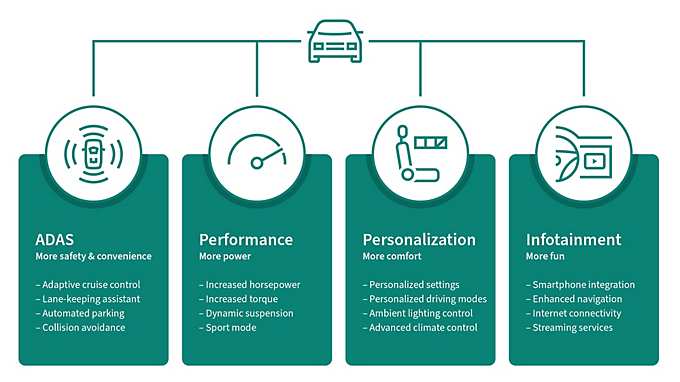
Für Automobilhersteller eröffnen softwaredefinierte Fahrzeuge neue Geschäftsmöglichkeiten. Anstatt sich ausschließlich auf einmalige Verkäufe zu konzentrieren, können OEMs durch softwaregestützte Dienste und Abonnements weitere Einnahmequellen generieren. Funktionen wie fortschrittliche Fahrerassistenzsysteme, Premium-Infotainment-Optionen oder sogar Leistungssteigerungen können als On-Demand-Käufe angeboten werden.
Dieser Ansatz fördert nicht nur die Kundenbindung, sondern liefert den Autoherstellern auch wertvolle Erkenntnisse zur Verbesserung von Produkten und Dienstleistungen und macht Fahrzeuge zu kundenorientierten Plattformen.
Die Umstellung auf softwaredefinierte Fahrzeuge führt zu einer erheblichen Komplexität, die herkömmliche elektrische und elektronische (E/E) Architekturen mit einer großen Anzahl verteilter Steuergeräte (ECUs) im Fahrzeug nicht mehr bewältigen können. Aus diesem Grund geht die Automobilindustrie zu einem zentraleren Ansatz über, der auf zonalen Architekturen basiert. Diese unterteilen das Fahrzeug in physische Zonen – beispielsweise Front, Heck, links und rechts –, die jeweils von einem leistungsfähigen lokalen Controller gesteuert werden. Darüber hinaus bilden ein oder mehrere zentrale Hochleistungscomputer das Herzstück der Architektur. Dieser Ansatz verringert die Komplexität der Verkabelung, verbessert die Kommunikationseffizienz und vereinfacht die Aktualisierungsmöglichkeiten. Zudem bietet er die Skalierbarkeit und Modularität, die für softwaredefinierte Fahrzeuge erforderlich sind.

Die wichtigsten Merkmale einer zonalen E/E-Architektur:
- Modularität: Zonale Architekturen erlauben eine höhere Modularität, da unterschiedliche Zonen unabhängig voneinander entwickelt und optimiert werden können. Dies erleichtert die Integration neuer Funktionen und Technologien.
- Flexibilität: Mit der neuen Architektur lassen sich die elektrischen Systeme eines Fahrzeugs flexibel gestalten und anpassen. Neue Komponenten und Funktionen können hinzugefügt oder verändert werden, ohne dass die gesamte Fahrzeugarchitektur davon betroffen ist.
- Skalierbarkeit: Angesichts der immer größeren Anzahl elektronischer Systeme werden Fahrzeuge immer komplexer. Dank der hohen Skalierbarkeit des zonalen Ansatzes lässt sich diese wachsende Komplexität effizienter bewältigen.
- Vereinfachung des Kabelbaums: Durch eine lokale Bündelung von Komponenten und Steuergeräten in ihren jeweiligen Zonen reduziert die zonale Architektur die Menge an Kabeln, die in einem Fahrzeug verbaut werden. Das Ergebnis ist ein leichteres, effizienteres Fahrzeugdesign.
- Schnellere Entwicklung und Updates: Eine zonale Architektur ermöglicht kürzere Entwicklungszyklen und einfachere Software-Updates, da Änderungen in einer Zone nicht zwangsläufig Anpassungen am gesamten System erfordern.
- Höhere Zuverlässigkeit und Redundanz: Kritische Funktionen können auf verschiedene Zonen verteilt werden. Dies reduziert nicht nur die Auswirkungen eines Single Point of Failure, sondern verbessert auch die Zuverlässigkeit und Redundanz des Systems.
Zonale Architekturen sind auf moderne Halbleiter angewiesen, um SDVs zum Leben zu erwecken. Sie benötigen leistungsstarke Mikrocontroller (MCUs) oder System-on-Chips (SoCs), um die gleichzeitige Verarbeitung mehrerer Fahrzeugfunktionen zu bewältigen und eine nahtlose Hochgeschwindigkeitskommunikation über Ethernet zu ermöglichen.
Während Software-definierte Fahrzeuge immer größere Datenmengen zwischen Sensoren, Zonencontrollern und zentralen Hochleistungsrechnern verarbeiten und austauschen, schaffen Weiterentwicklungen von Automotive Ethernet und IEEE-Netzwerkstandards die Grundlage für höhere Bandbreiten, bessere Skalierbarkeit und robustere Kommunikationsarchitekturen im Fahrzeug.
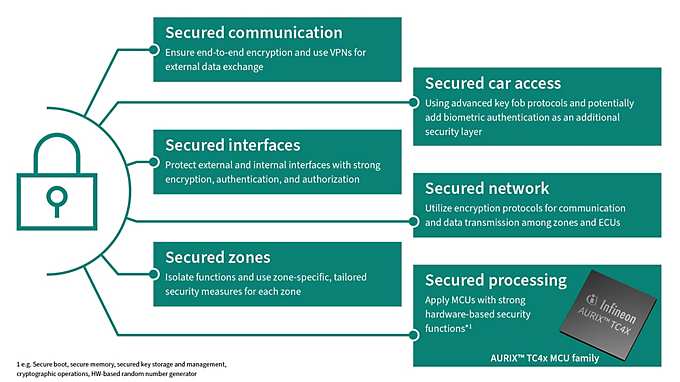
Funktionale Sicherheit und Cybersicherheit sind ebenfalls wichtige Aspekte. Da SDVs stark auf vernetzte Systeme und Cloud-Interaktionen angewiesen sind, haben der Schutz sensibler Daten und die Verhinderung von Cyberangriffen höchste Priorität. Zonale Architekturen erfordern Halbleiter mit integrierten Sicherheitsfunktionen, die Anomalien erkennen, vor Bedrohungen schützen und Fahrer/innen bei potenziellen Verstößen warnen können. Ein skalierbarer, mehrschichtiger Sicherheitsrahmen - einschließlich Verschlüsselung, Echtzeitüberwachung und Einhaltung globaler Cybersicherheitsstandards im Automobilbereich - ist unerlässlich, um zu gewährleisten, dass Fahrzeuge sicher bleiben, auch wenn sich die Software im Laufe der Zeit weiterentwickelt.
Darüber hinaus spielen zonale Architekturen eine wichtige Rolle bei der Optimierung der Energieeffizienz und der Stromverteilung. Durch die Konsolidierung lokaler Funktionen in jeder Zone reduzieren diese Systeme die Komplexität der Verdrahtung und sparen Gewicht und Energie. Die Halbleiter müssen diese Effizienz unterstützen, indem sie intelligente Power-Management-Funktionen integrieren, die eine präzise Steuerung der Energieverteilung auf die verschiedenen Komponenten ermöglichen. Da SDVs die Grenzen der Innovation immer weiter verschieben, sind Halbleiter von Infineon entscheidend für die Leistung, Sicherheit und Effizienz, die für diese neue Ära der Mobilität erforderlich sind.
Das softwaredefinierte Fahrzeug verwandelt das Auto in eine vernetzte und kontinuierlich erweiterbare Plattform. Der nächste Entwicklungsschritt ist Physical AI. Sie ermöglicht Fahrzeugen, ihre Umgebung wahrzunehmen, Situationen zu verstehen, Entscheidungen zu treffen und in Echtzeit zu handeln.
Stellen Sie sich ein Fahrzeug vor, das automatisierte Fahrfunktionen kontinuierlich verbessert, Verkehrssituationen vorausschauend erkennt, den Energieverbrauch optimiert und Fahrzeugfunktionen für mehr Sicherheit und Komfort intelligent koordiniert. Dies erfordert leistungsfähige Halbleitertechnologien.
Infineon vereint Hochleistungsrechnen, Sensorik, Konnektivität, Leistungselektronik und Cybersicherheit, um aus Daten intelligente Entscheidungen zu machen und Physical AI Wirklichkeit werden zu lassen.
Was ist ein softwaredefiniertes Fahrzeug?
Software steht im Mittelpunkt unseres modernen Lebens und prägt, wie wir arbeiten, kommunizieren und die Welt erleben. Von Smartphones bis zu intelligenten Haushaltsgeräten hat sie alltägliche Produkte in vernetzte Plattformen verwandelt, die sich per Over-the-Air-Updates kontinuierlich erweitern lassen. Diese Entwicklung verändert nun auch die Automobilindustrie. Fahrzeuge sind nicht länger nur mechanische Maschinen, sondern entwickeln sich zu intelligenten, vernetzten Plattformen – zu softwaredefinierten Fahrzeugen. Mit Software als zentralem Bestandteil versprechen diese Fahrzeuge eine neue Ära von Komfort, Personalisierung und Leistung. Stellen Sie sich vor, Ihr Auto wird über Nacht intelligenter: Neue Fahrfunktionen oder erweiterte Sicherheitsmerkmale können direkt auf das Fahrzeug aufgespielt werden, ohne dass ein Werkstatbesuch erforderlich ist. Genau das ermöglicht ein softwaredefiniertes Fahrzeug. Es macht aus Autos „Computer auf Rädern“. Zum Video
Ist das SDV wirklich eine Software-Revolution oder letztlich eine Halbleiter-Revolution?
Während die Software das Nutzungserlebnis und die Funktionen eines Fahrzeugs definiert, bilden Halbleiter die technologische Grundlage, die ein SDV überhaupt erst ermöglicht. Hochleistungsrechnen, Vernetzung, Cybersicherheit, Energieverteilung und Echtzeitsteuerung basieren auf modernen Halbleitertechnologien. Ohne die passende Hardware-Architektur kann Software allein nicht die Leistungsfähigkeit, Sicherheit und Skalierbarkeit bereitstellen, die zukünftige Fahrzeuge erfordern.
Welche Rolle spielen Speicherlösungen im softwaredefinierten Fahrzeug?
Speicherlösungen sind ein zentraler Baustein des SDV. Sie speichern Betriebssysteme, Fahrzeugsoftware, Sicherheitsfunktionen und Daten für Over-the-Air-Updates. Gleichzeitig müssen sie schnellen Datenzugriff, hohe Zuverlässigkeit und langfristige Datenintegrität gewährleisten. Ohne leistungsfähige Speichertechnologien könnten softwaredefinierte Fahrzeuge nicht kontinuierlich erweitert, aktualisiert und sicher betrieben werden. Ein softwaredefiniertes Fahrzeug ist nur so zuverlässig wie die Speichertechnologien, die seine Software und Daten speichern und schützen.
Ist das softwaredefinierte Fahrzeug die Grundlage für autonomes Fahren?
Autonomes Fahren erfordert die Echtzeitverarbeitung enormer Datenmengen, leistungsfähige KI-Algorithmen sowie die Fähigkeit, Fahrzeugfunktionen kontinuierlich weiterzuentwickeln. Ein softwaredefiniertes Fahrzeug (SDV) schafft dafür die technologische Basis durch zentralisierte Rechenarchitekturen, Hochgeschwindigkeits-Konnektivität und Over-the-Air-Updates. Diese Fähigkeiten ermöglichen es, automatisierte Fahrfunktionen über den gesamten Fahrzeuglebenszyklus hinweg bereitzustellen, kontinuierlich zu verbessern und sicher zu aktualisieren. Gleichzeitig ebnen sie den Weg für zukünftige KI-gestützte Mobilitätsanwendungen bis hin zum autonomen Fahren.
Warum ermöglichen softwaredefinierte Fahrzeuge abonnementbasierte Funktionen und Dienste?
Software erlaubt es, neue Funktionen und Dienste über die gesamte Lebensdauer eines Fahrzeugs hinweg bereitzustellen. Ein Abonnementmodell ermöglicht es Kunden, nur für die Funktionen zu bezahlen, die sie tatsächlich benötigen. Gleichzeitig können Automobilhersteller ihre Angebote kontinuierlich verbessern, aktualisieren und durch Software-Updates erweitern.
Warum gewinnt RISC-V im softwaredefinierten Fahrzeug an Bedeutung?
RISC-V ist eine offene und skalierbare Prozessorarchitektur, die flexible und zukunftssichere Plattformen für softwaredefinierte Fahrzeuge ermöglicht. Durch die Unterstützung offener Standards und die enge Zusammenarbeit innerhalb eines breiten Ökosystems erhalten Automobilhersteller mehr Gestaltungsfreiheit und Kontrolle über ihre Systeme. Gleichzeitig können die hohen Anforderungen an Sicherheit, Schutz und Zuverlässigkeit der nächsten Fahrzeuggeneration erfüllt werden. Infineon betrachtet RISC-V als einen zentralen Wegbereiter für die SDV-Ära.
Ein softwaredefiniertes Fahrzeug basiert auf Halbleitern.
Mit der zunehmenden Verbreitung softwaredefinierter Fahrzeuge wird die zugrunde liegende Hardware mehr denn je zum entscheidenden Erfolgsfaktor. Infineon vereint führende Technologien für Rechenleistung, Konnektivität, Sicherheit und Energieversorgung, um skalierbare, sichere und zuverlässige Fahrzeugarchitekturen zu ermöglichen. Von Automotive Ethernet und zonalen Architekturen über funktionale Sicherheit bis hin zur Cybersicherheit liefern wir die Bausteine, die Softwarepotenzial in reale Fahrzeugleistung verwandeln.