
Ultra-Wideband (UWB)
Infineon´s UWB solutions for secured and precise localization, spatial awareness and sensing

Welcome to Infineon´s UWB world. UWB is Infineon’s new category trademark for secured and precise localization, spatial awareness and sensing based on UWB technology.
Infineon’s UWB solutions provide a unique combination of security and precision, making it an ideal solution for a diverse range of applications.
UWB Widespread Adoption and Future Applications
In recent years, UWB technology has gained widespread adoption in smartphones and car access systems, thanks to its exceptional accuracy and security features. As the technology continues to evolve, we can expect to see even more applications leveraging UWB's unique capabilities for secured wireless localization and sensing.
Infineon´s UWB solutions are optimized for Automotive, IoT, Industrial and Mobile use case. They enable precise positioning and tracking of things and vehicles in real time, secure touchless access control to cars, homes and commercial locations, as well as enhanced spatial context awareness, presence detection, point & trigger control of Smart Home devices and high speed, low latency tech interaction for close ranges at high data rates.
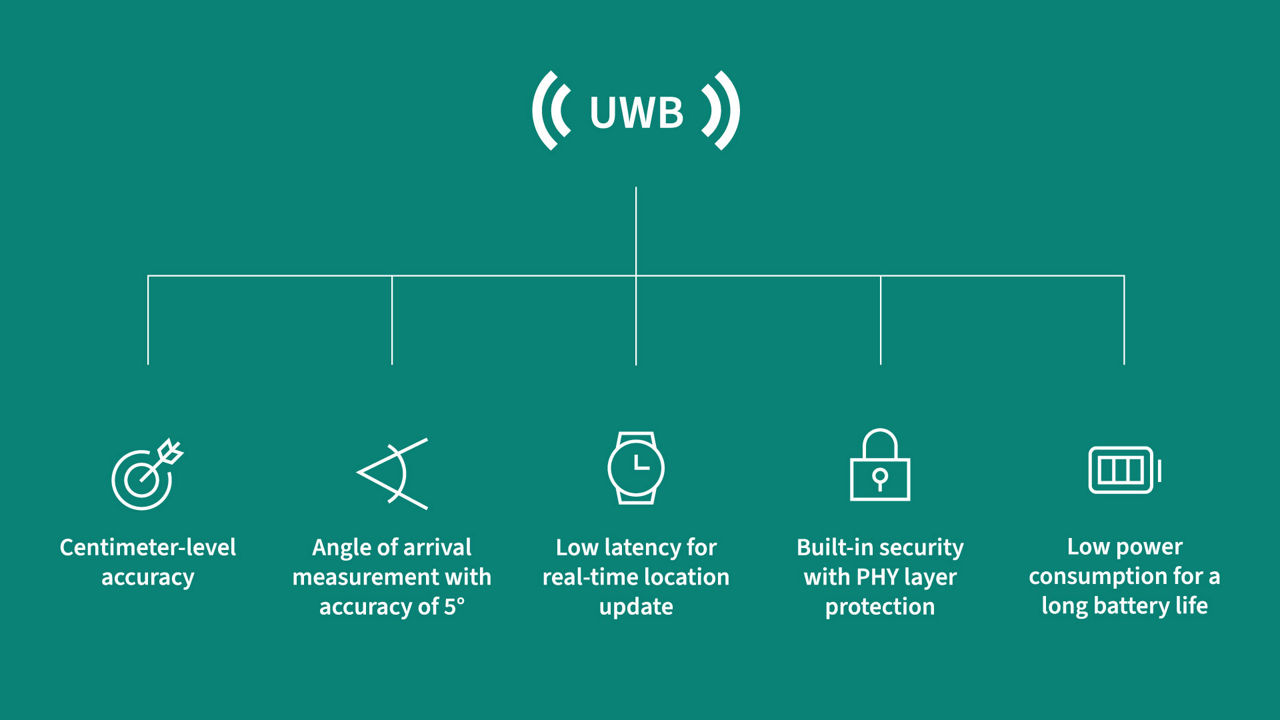
- Infineon´s UWB makes your smart devices highly secured
Infineon´s UWB SoCs enable you to prevent relay attacks. Make your UWB additionally secure with Infineon’s proven system security concepts providing you with scalable and certifiable security. - Unlock Precise Localization with Ultra-Wideband (UWB) Technology or / Infineon´s UWB makes your implementations highly precise
Infineon´s single chip real time RF-based ToF measurement technology enables you to realize highly precise ranging and fast positioning with pinpoint accuracy. Spot all your devices precisely even in the densest environments. - Infineon´s UWB makes your solutions highly efficient
Infineon´s UWB SoCs enable you to benefit from ultra-fast ranging with ultra-low power consumption. Increase the power efficiency of your solutions significantly and extend battery life with low-power UWB SoCs from Infineon. - Infineon´s UWB boosts your time to market
Infineon´s UWB SoCs enable you to jump-start your UWB designs based on mass-production IP and integrated ready-to-apply HW/SW.
Create a new dimension of spatial awareness for your devices with fast time to market at low total cost of ownership.
UWB Technology overview
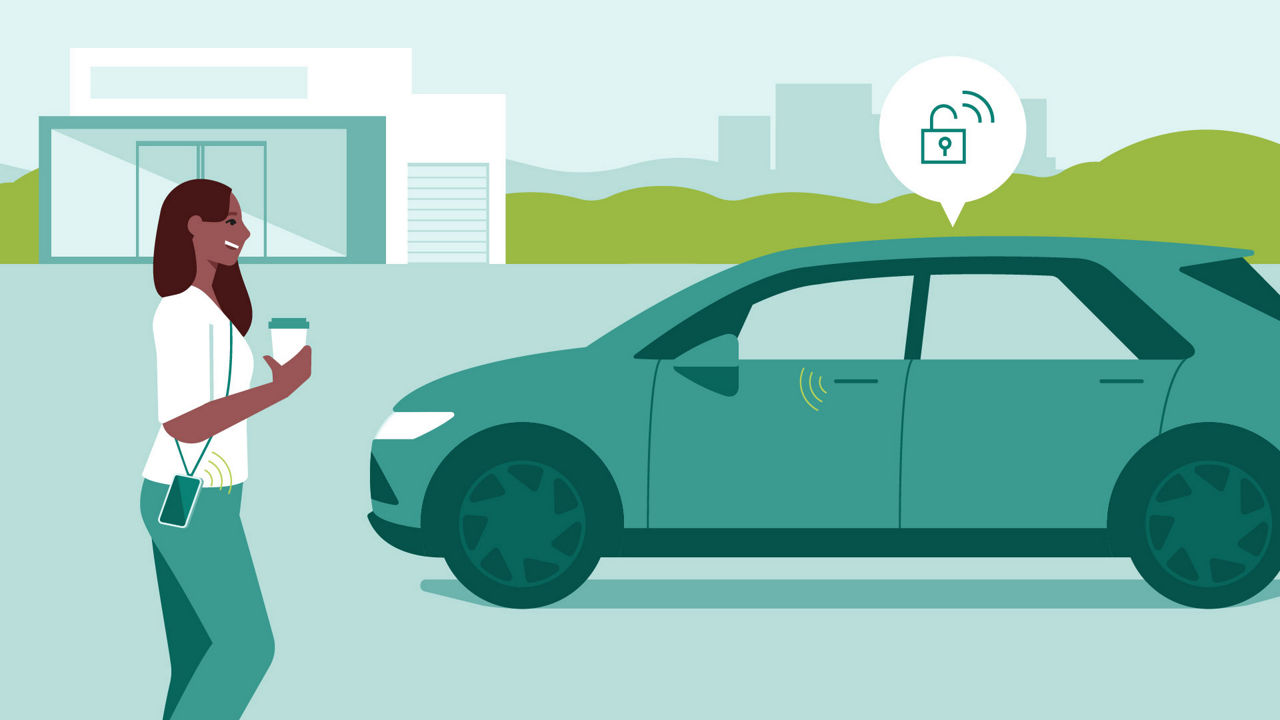
UWB-enabled car-access offers secure and hands-free keyless entry by precisely measuring the distance between a key fob or a phone and the vehicle. If a predefined distance threshold is crossed, the user is securely authenticated, and access is granted.
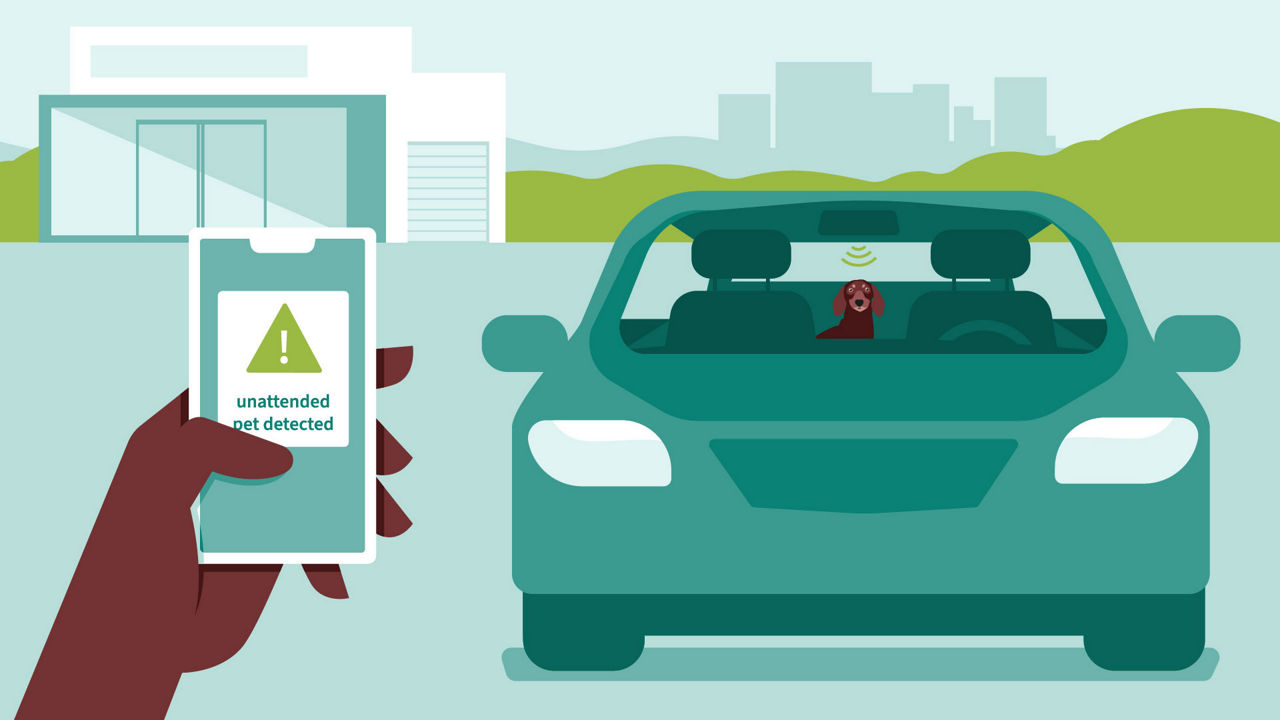
Utilizing UWB technology for in-vehicle monitoring significantly improves safety measures by precisely tracking passenger positions. This advanced system is capable of monitoring vital signs and providing alerts when children or pets are inadvertently left behind in locked vehicles.

Handsfree trunk-access enables users to effortlessly open their car's trunk with a gesture, as UWB accurately senses the user's presence and motion, providing a seamless and keyless method for trunk accessibility.
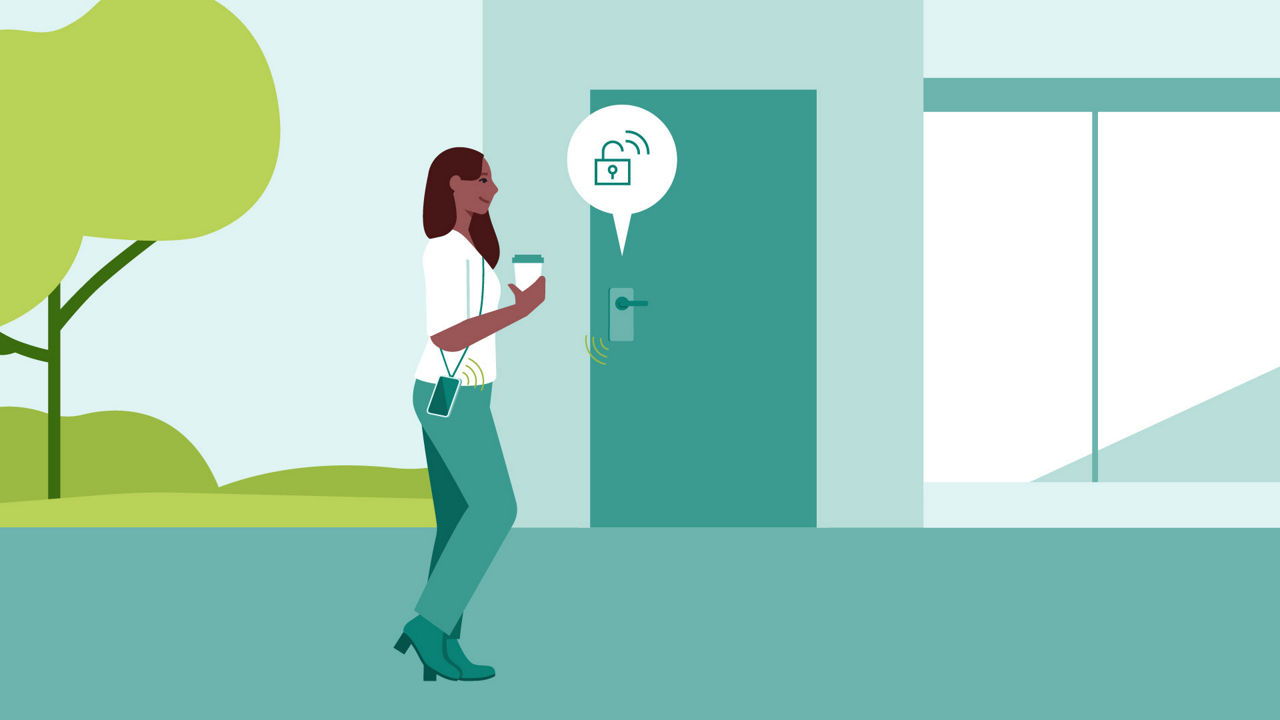
UWB-enabled physical access utilizes precise UWB distance-bounding between a UWB device and an access control reader to provide a secure, handsfree access experience to homes, offices, and public venues.

Logical-access utilizes UWB-localization to provide secure, handsfree access to personal electronic devices (for example, notebooks) by authenticating users based on the proximity of their smartphone or other UWB devices. UWB radars enhance security by sensing user-presence and autolocking the device when the user leaves the vicinity.

UWB-enabled point-and-trigger applications allow for effortless control of smart devices like air conditioners, TVs, and smart speakers from a smartphone by an automatic popup of a control panel when pointing. This creates a more seamless and intuitive user experience powered by UWB’s high-accuracy angle of arrival measurements.

Find someone or something with UWB enables users to pinpoint the location of a wide range of personal items, including personal electronics, keys, wallets, and even pets. This feature facilitates real-time monitoring of these items within the confines of their homes, offices, or any other given locations, providing peace of mind to users.
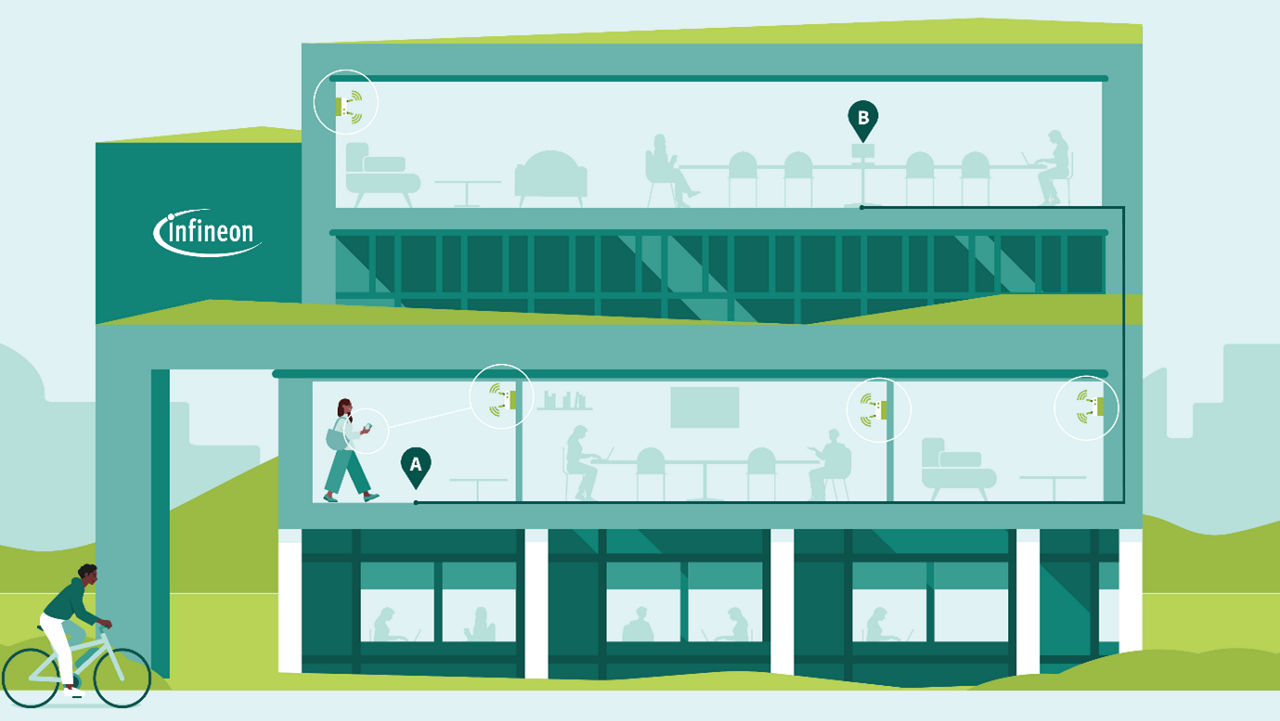
UWB technology in indoor navigation significantly enhances the ability to locate specific places within closed environments such as shopping malls, airports, and large office buildings. It enables seamless indoor-wayfinding, making it ideal for applications requiring precise location-based services.

At places such as grocery stores, toll stations, or parking areas, UWB anchors facilitate payment transactions by precisely detecting the user's presence. It allows customers to complete their purchases without the need to stop and tap a payment terminal. Customers can simply walk through a transit gate while entering the mean of transport.
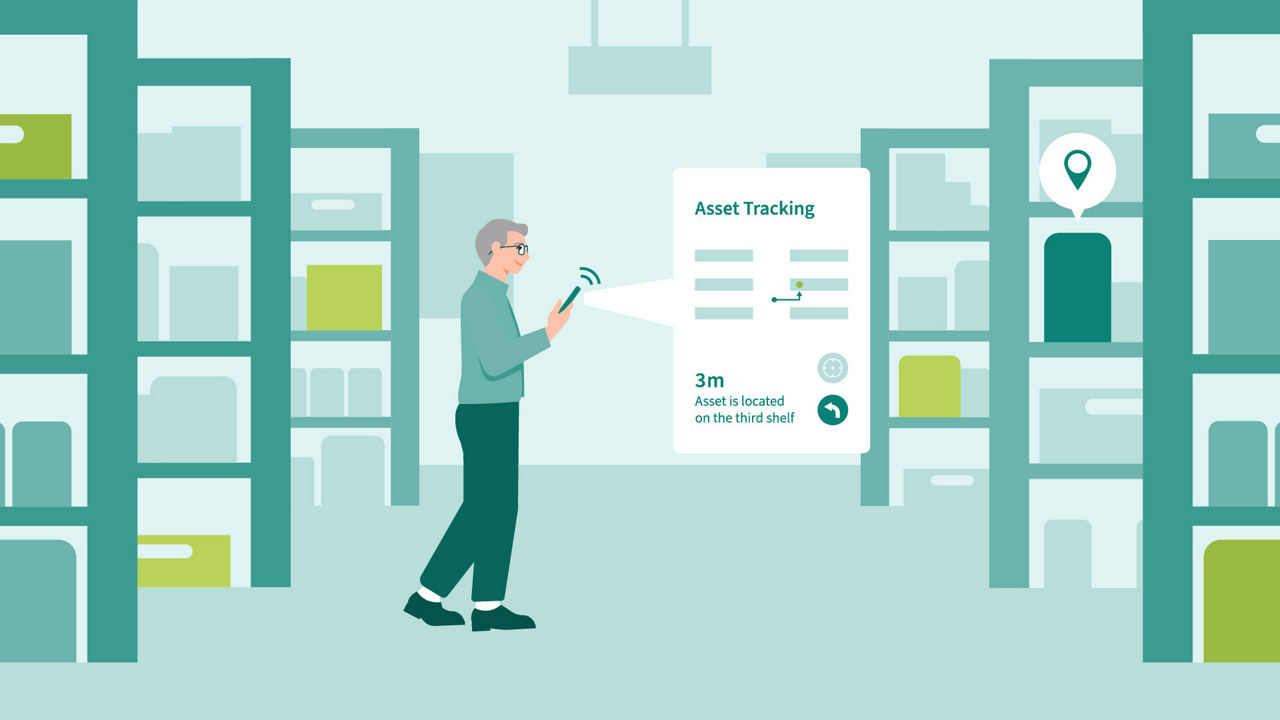
UWB-based Real-Time Location Systems (RTLS) leverages UWB-localization for diverse applications ranging from robotics to asset-tracking in demanding environments such as warehouses, hospitals, and industrial areas.
UWB-enabled car-access offers secure and hands-free keyless entry by precisely measuring the distance between a key fob or a phone and the vehicle. If a predefined distance threshold is crossed, the user is securely authenticated, and access is granted.
Utilizing UWB technology for in-vehicle monitoring significantly improves safety measures by precisely tracking passenger positions. This advanced system is capable of monitoring vital signs and providing alerts when children or pets are inadvertently left behind in locked vehicles.
Handsfree trunk-access enables users to effortlessly open their car's trunk with a gesture, as UWB accurately senses the user's presence and motion, providing a seamless and keyless method for trunk accessibility.
UWB-enabled physical access utilizes precise UWB distance-bounding between a UWB device and an access control reader to provide a secure, handsfree access experience to homes, offices, and public venues.
Logical-access utilizes UWB-localization to provide secure, handsfree access to personal electronic devices (for example, notebooks) by authenticating users based on the proximity of their smartphone or other UWB devices. UWB radars enhance security by sensing user-presence and autolocking the device when the user leaves the vicinity.
UWB-enabled point-and-trigger applications allow for effortless control of smart devices like air conditioners, TVs, and smart speakers from a smartphone by an automatic popup of a control panel when pointing. This creates a more seamless and intuitive user experience powered by UWB’s high-accuracy angle of arrival measurements.
Find someone or something with UWB enables users to pinpoint the location of a wide range of personal items, including personal electronics, keys, wallets, and even pets. This feature facilitates real-time monitoring of these items within the confines of their homes, offices, or any other given locations, providing peace of mind to users.
UWB technology in indoor navigation significantly enhances the ability to locate specific places within closed environments such as shopping malls, airports, and large office buildings. It enables seamless indoor-wayfinding, making it ideal for applications requiring precise location-based services.
At places such as grocery stores, toll stations, or parking areas, UWB anchors facilitate payment transactions by precisely detecting the user's presence. It allows customers to complete their purchases without the need to stop and tap a payment terminal. Customers can simply walk through a transit gate while entering the mean of transport.
UWB-based Real-Time Location Systems (RTLS) leverages UWB-localization for diverse applications ranging from robotics to asset-tracking in demanding environments such as warehouses, hospitals, and industrial areas.
How UWB works (Infineon UWB, 2024)
Ultra-wideband physics are the base for its unique localization capabilities.
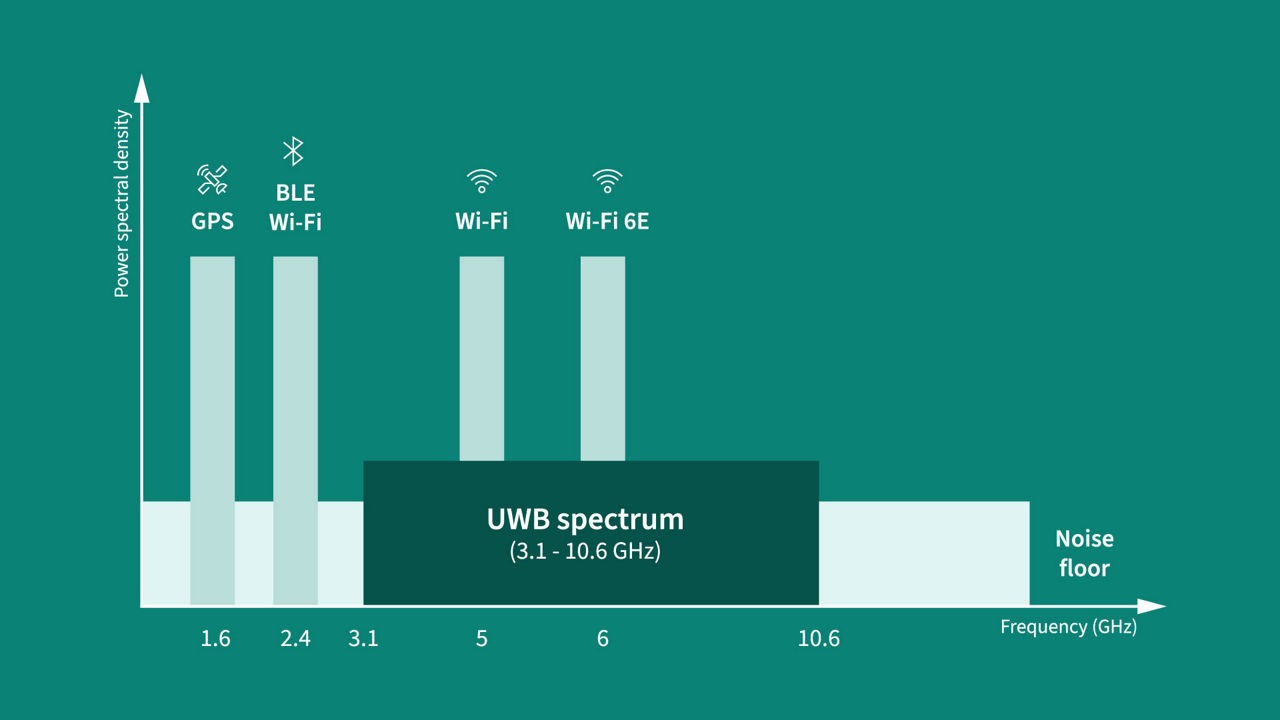
UWB operates across a wide frequency spectrum, spanning from 3.1 GHz to 10.6 GHz.
The ultra-wide frequency range of UWB enables it to operate in a radio spectrum away from the industrial, scientific, and medical radio bands. This way, it can co-exist with other popular wireless technologies such as BLE, GPS, or Wi-Fi.
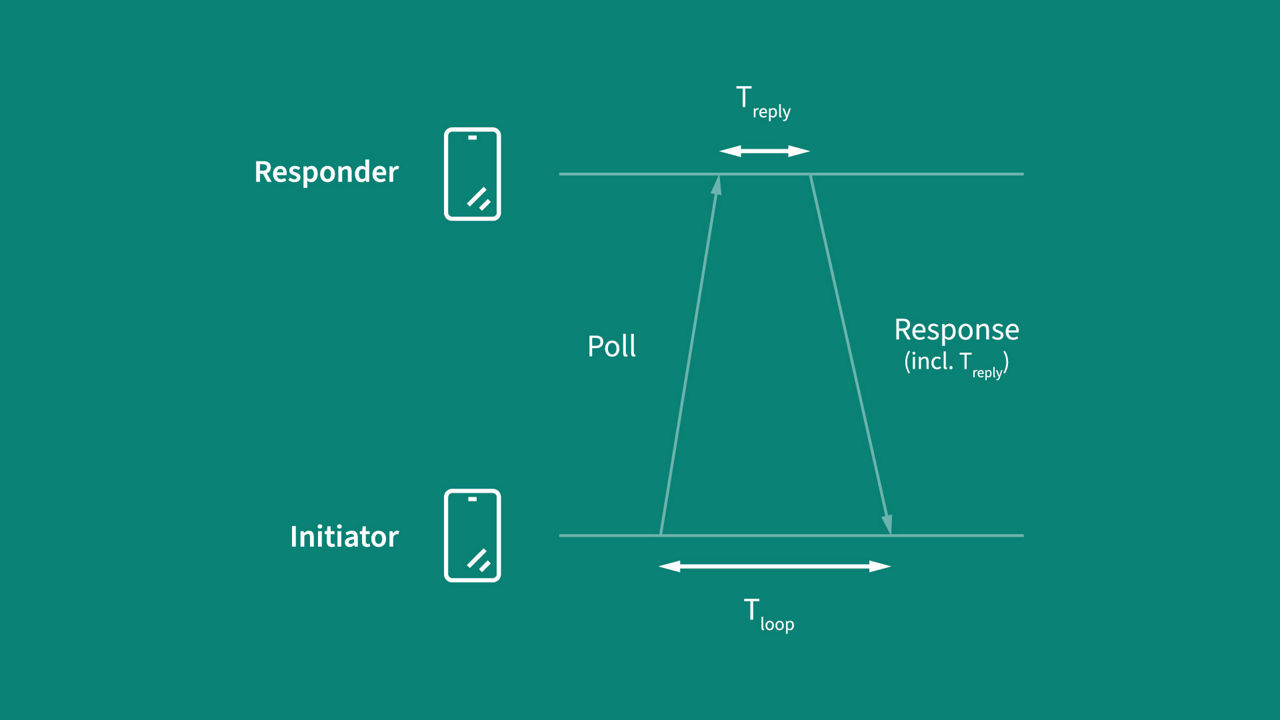
UWB uses a method known as Time-of-Flight(ToF), which calculates the distance by recording the time it takes for a radio signal to travel from one device to another, and then multiplying this duration by the speed of light.
Even though terms are not generally expanded after the first mention, here the expansion helps, since the text is describing the working of the term in question.
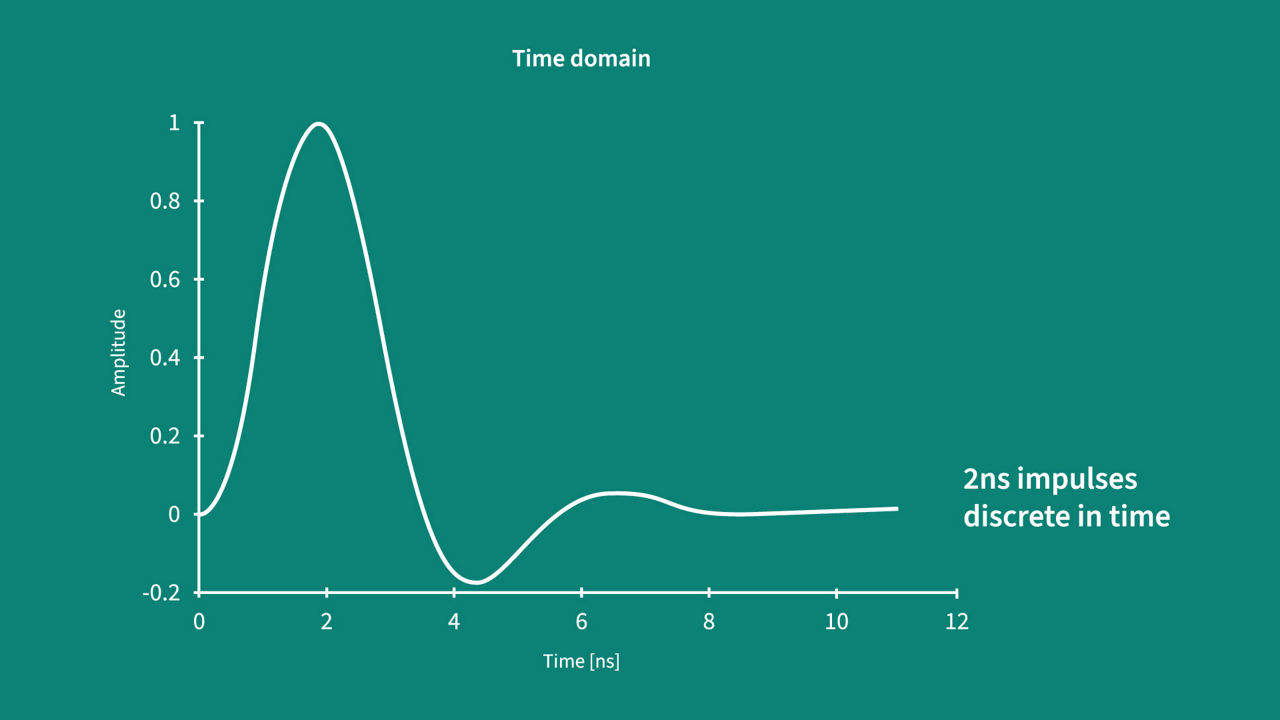
UWB modulation is based on the impulse-radio principle with 2 ns impulses transporting information with up to 1000 impulses are being sent per millisecond. The very discrete signal in the time domain supports high-accuracy ranging as it can be well deciphered on the receiver-side. Additionally, these impulses benefit UWB in overcoming multipath effects .
Multipath effects happen when a signal reflects off objects, creating multiple signal copies that reach the receiver at different times, causing distortion. UWB overcomes this by using short pulses and wide bandwidth to distinguish between direct and reflected signals, enabling accurate ranging and positioning.
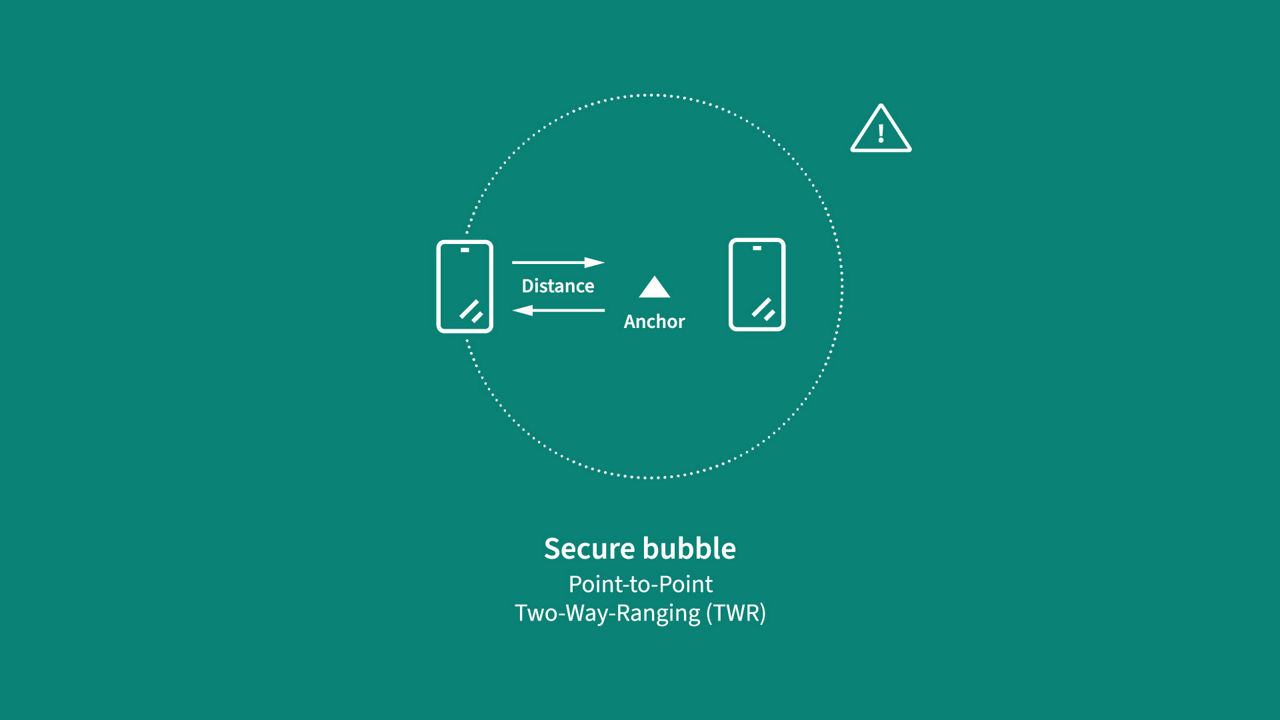
The Two-Way Ranging (TWR) technique involves bidirectional communication between a pair of devices, during which they measure the Time-of-Flight (ToF) for UWB radio frequency signals to traverse the distance between them.
The distance is calculated by taking the signal's round-trip time, multiplying it by the speed of light, and dividing the product by two to account for the return-journey. Employing TWR to measure distances between two points yields the separation distance, D. For spatial orientation like 2D or 3D positioning, triangulation is used, which computes locations by measuring distances from mobile tags to multiple fixed beacons.
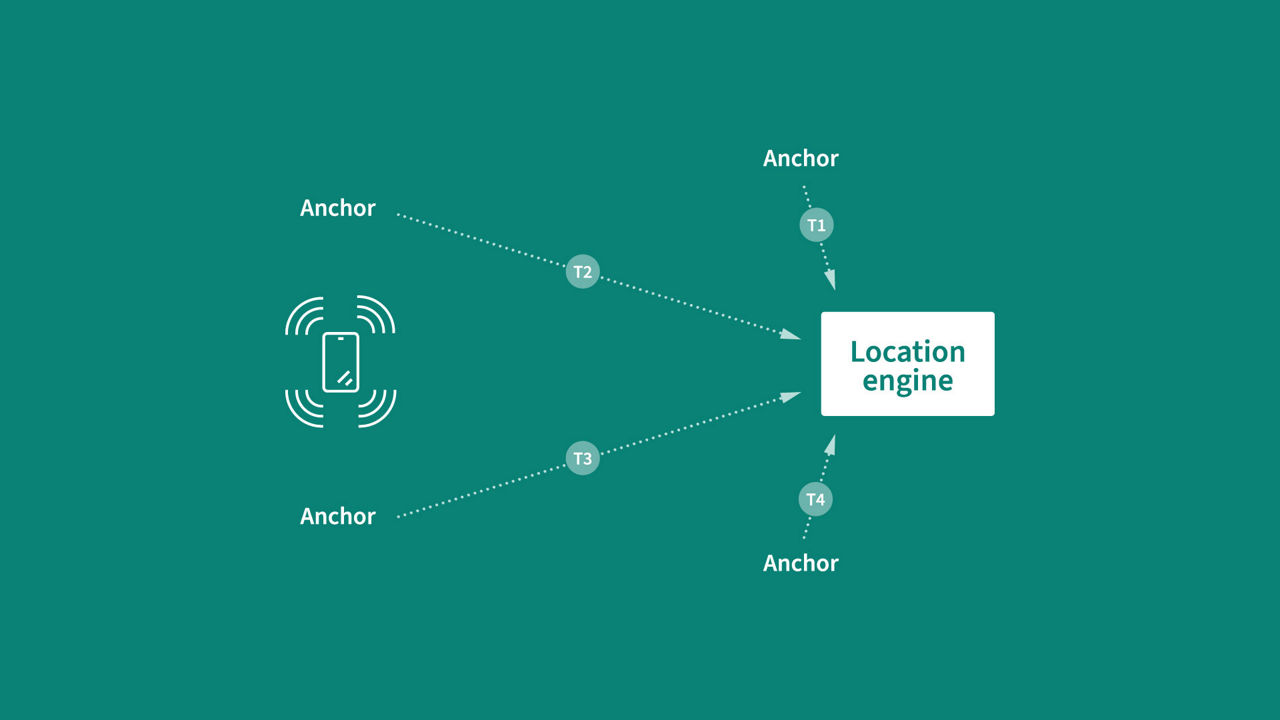
The Time-Difference of Arrival (TDoA) technique shares similarities with the Global Positioning System (GPS) approach. It involves setting up a network of time-synchronized anchors across a specific area.
In Uplink TDoA, a mobile device or tag emits beacon signals, and these signals are recorded with a timestamp by the anchors upon reception. The collected timestamps from various anchors are then relayed to a central computation unit to calculate the tag’s position.
Inversely, Downlink TDoA involves the anchors’ beaconing signals at regular intervals and a mobile device receives signals at different points in time. By recording the time at which each signal from different anchors is received, the mobile device can calculate the time difference. This mechanism can be used for indoor navigation.
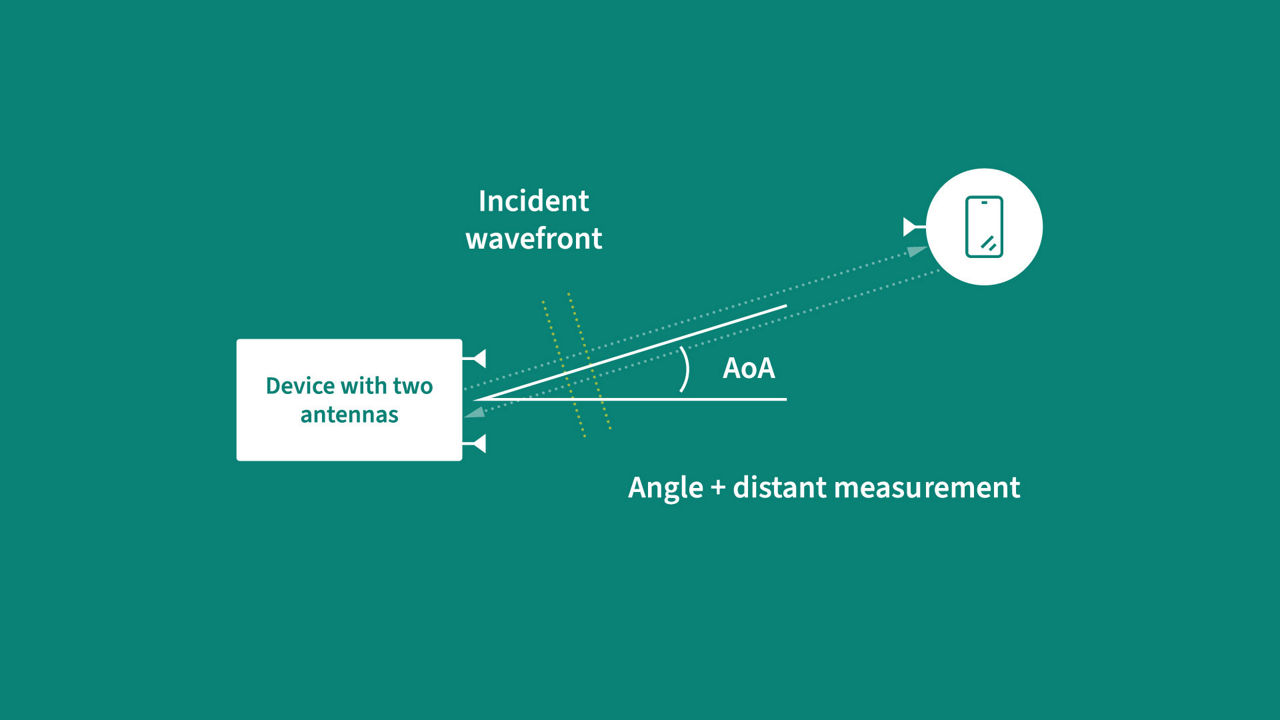
The methodology for UWB Angle of Arrival (AoA) estimation involves using an array of antennas to capture incoming UWB signals. By analyzing the phase and amplitude differences among the received signals, the system computes the angle of incidence of the UWB signal. Advanced signal processing techniques and algorithms further enhance the accuracy and reliability of the AoA estimation, enabling directional-location information for various applications.
UWB operates across a wide frequency spectrum, spanning from 3.1 GHz to 10.6 GHz.
The ultra-wide frequency range of UWB enables it to operate in a radio spectrum away from the industrial, scientific, and medical radio bands. This way, it can co-exist with other popular wireless technologies such as BLE, GPS, or Wi-Fi.
UWB uses a method known as Time-of-Flight(ToF), which calculates the distance by recording the time it takes for a radio signal to travel from one device to another, and then multiplying this duration by the speed of light.
Even though terms are not generally expanded after the first mention, here the expansion helps, since the text is describing the working of the term in question.
UWB modulation is based on the impulse-radio principle with 2 ns impulses transporting information with up to 1000 impulses are being sent per millisecond. The very discrete signal in the time domain supports high-accuracy ranging as it can be well deciphered on the receiver-side. Additionally, these impulses benefit UWB in overcoming multipath effects .
Multipath effects happen when a signal reflects off objects, creating multiple signal copies that reach the receiver at different times, causing distortion. UWB overcomes this by using short pulses and wide bandwidth to distinguish between direct and reflected signals, enabling accurate ranging and positioning.
The Two-Way Ranging (TWR) technique involves bidirectional communication between a pair of devices, during which they measure the Time-of-Flight (ToF) for UWB radio frequency signals to traverse the distance between them.
The distance is calculated by taking the signal's round-trip time, multiplying it by the speed of light, and dividing the product by two to account for the return-journey. Employing TWR to measure distances between two points yields the separation distance, D. For spatial orientation like 2D or 3D positioning, triangulation is used, which computes locations by measuring distances from mobile tags to multiple fixed beacons.
The Time-Difference of Arrival (TDoA) technique shares similarities with the Global Positioning System (GPS) approach. It involves setting up a network of time-synchronized anchors across a specific area.
In Uplink TDoA, a mobile device or tag emits beacon signals, and these signals are recorded with a timestamp by the anchors upon reception. The collected timestamps from various anchors are then relayed to a central computation unit to calculate the tag’s position.
Inversely, Downlink TDoA involves the anchors’ beaconing signals at regular intervals and a mobile device receives signals at different points in time. By recording the time at which each signal from different anchors is received, the mobile device can calculate the time difference. This mechanism can be used for indoor navigation.
The methodology for UWB Angle of Arrival (AoA) estimation involves using an array of antennas to capture incoming UWB signals. By analyzing the phase and amplitude differences among the received signals, the system computes the angle of incidence of the UWB signal. Advanced signal processing techniques and algorithms further enhance the accuracy and reliability of the AoA estimation, enabling directional-location information for various applications.
UWB operates in the unlicensed frequency spectrum and thus it has to follow strict regulations. There are two main rules:
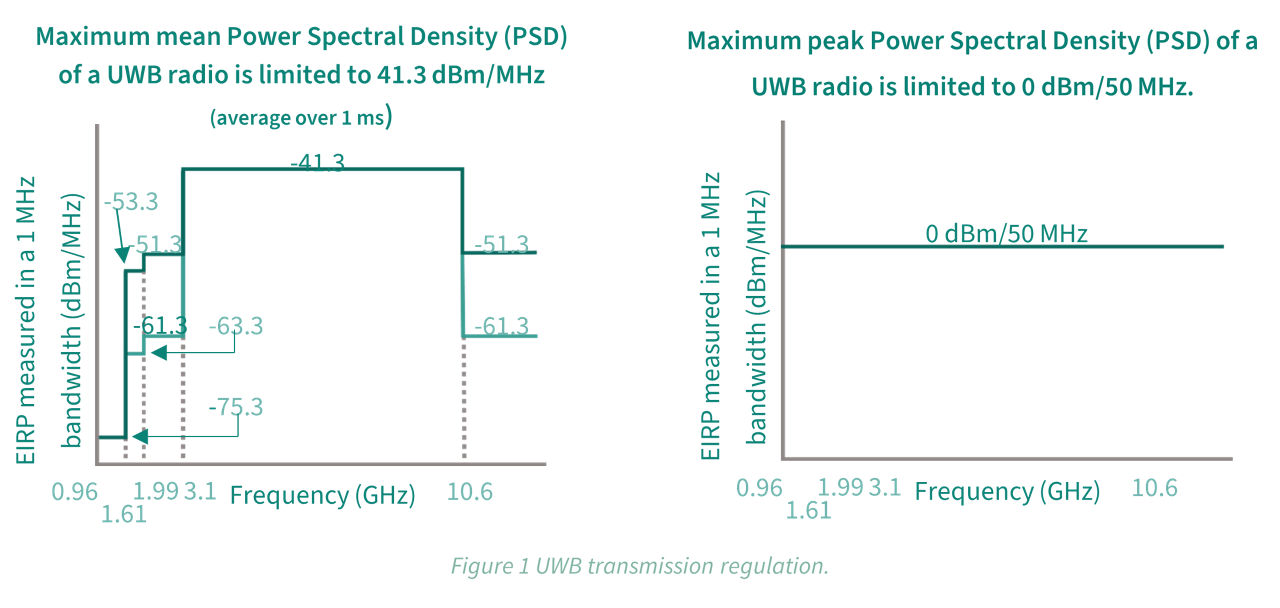
1. Mean Power Spectral Density (PSD) Limit:
This rule sets a ceiling on the average radiated power within a specified frequency range and is averaged over a time span of 1 millisecond (ms).
Max. mean PSD = -41.3 dBm/MHz (74 nW per MHz)
The maximum mean Power Spectral Density is capped at -41.3 dBm/MHz, which equals an energy output of 74 nW/MHz of bandwidth.
2. Peak Power Spectral Density (PSD) Ceiling:
The second regulation governs the intensity of a single pulse of UWB transmission. Essentially, it is a guideline for how powerful a UWB signal pulse can be.
Max. peak PSD = 0 dBm/50 MHz
The peak Power Spectral Density is restricted to a maximum of 0 dBm, with this measurement being taken through a 50 MHz bandwidth filter.
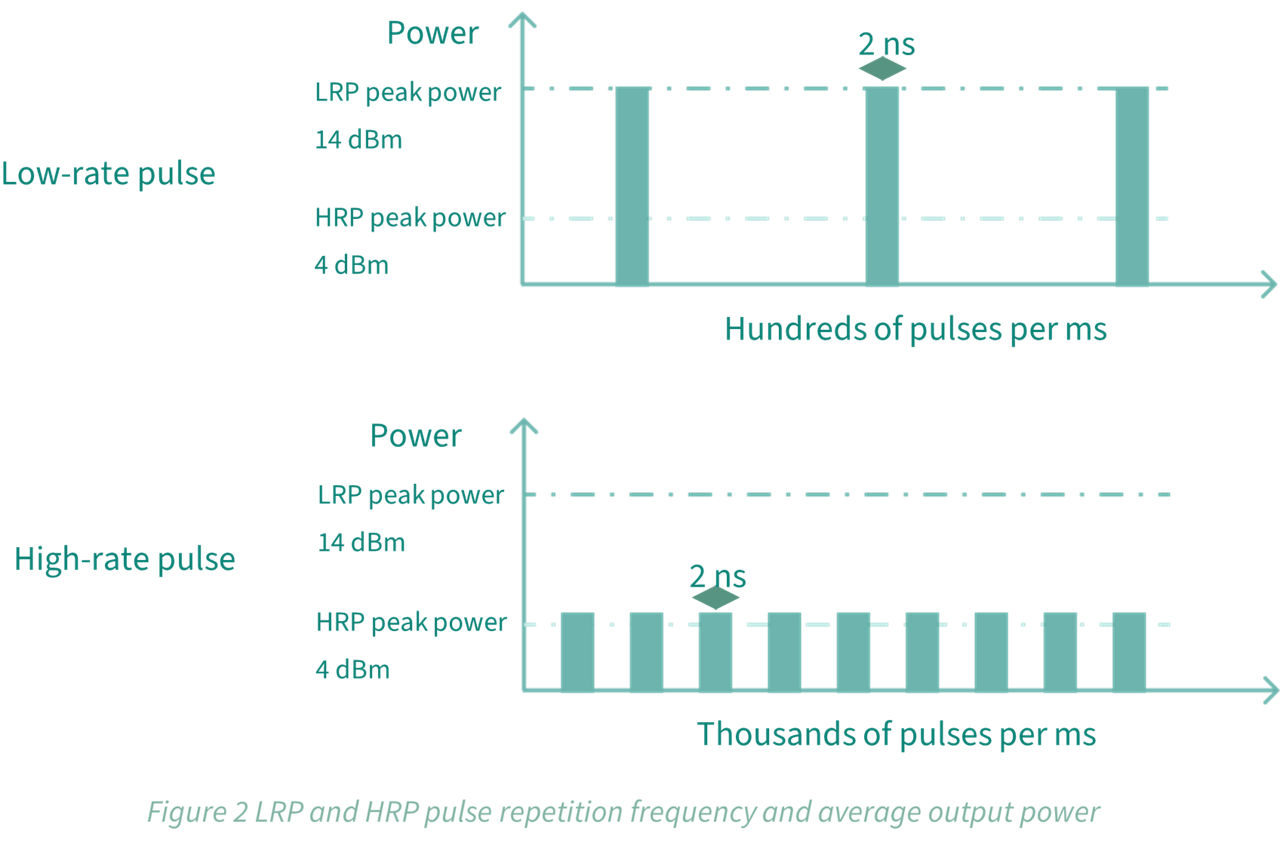
Both LRP and HRP use the same transmitted RF energy per ms. But due to the different operating principle, the individual pulse energy in HRP is typically about 10 times lower than in the case of LRP.
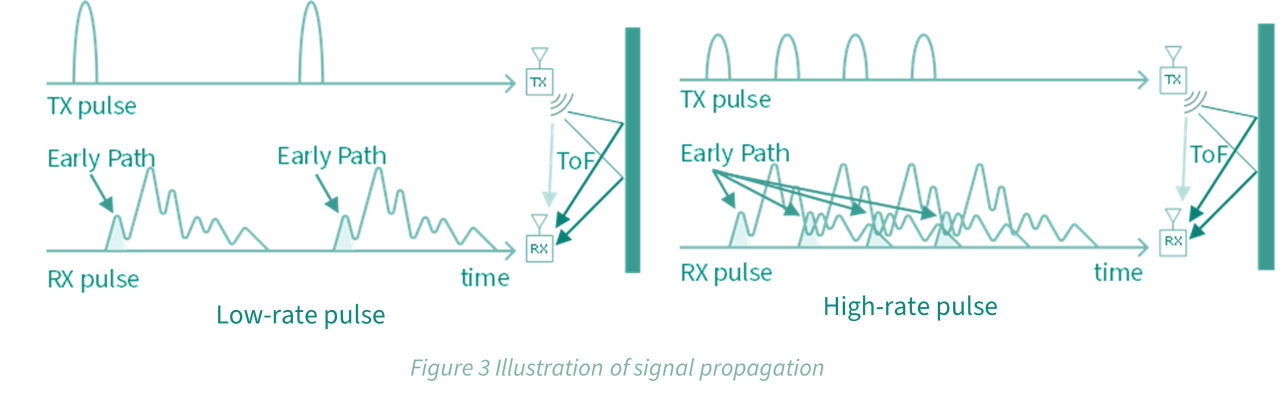
As shown in figure 3a, the signal propagation properties of LRP differ from those of HRP. In the LRP mode, one pulse arrives every 250 ns and travels a distance of ~75 m at the speed of light before the next pulse is sent. This gap allows for reflections to fade out before the next pulse arrives at the receiver. As a result, it enables a direct and extremely efficient digital processing of the incoming pulses to derive the Channel Impulse Response (CIR) needed for time-of-arrival values in ranging and data decoding.
In contrast, the high repetition rate of the HRP pulse transmission creates an Inter-Pulse Interference (IPI) at the receiver as shown in figure 3b. To resolve the interference and extract the correct CIR, HRP utilizes encoding with good correlation patterns and post‑processing of the received signal for ToF estimation.

The Connectivity Standards Alliance cultivates innovation and collaboration on the Internet of Things, advancing universal open standards to enable secure connections and interactions among diverse entities. CSA is driving the Aliro standard, which shall facilitate a globally accepted standard for physical access control.
The Car Connectivity Consortium serves as a collaborative platform that unites the automotive and consumer technology sectors, with the shared objective of fortifying vehicle access through the integration of intelligent devices, thereby ensuring their compatibility with evolving technological advancements.
The FiRa Consortium addresses the current market inflection by aiding established firms in creating UWB-based products. It offers a rapid solution to ecosystem and interoperability challenges, fostering collaborative success.
Omlox is the world's first open locating standard, which aims to implement flexible real-time locating solutions with elements from various manufacturers without requiring any project planning.
The IEEE (Institute of Electrical and Electronics Engineers) is a global professional association focused on advancing technology for the benefit of humanity. It develops standards, fosters innovation, and supports professionals in engineering and technology. The IEEE 802.15.4a standard serves as a global benchmark for the Impulse Radio-UWB physical layer (PHY Layer), prioritizing precise location accuracy and concurrent two-way communication at speeds of up to several Mbps. The standard was adopted in 2011 and in 2018, it underwent revision as 802.15.4z to bolster physical layer security, aligning with the evolving use of UWB in secure wireless communication in the automotive, IoT and mobile sectors.
UWB-enabled car-access offers secure and hands-free keyless entry by precisely measuring the distance between a key fob or a phone and the vehicle. If a predefined distance threshold is crossed, the user is securely authenticated, and access is granted.
Utilizing UWB technology for in-vehicle monitoring significantly improves safety measures by precisely tracking passenger positions. This advanced system is capable of monitoring vital signs and providing alerts when children or pets are inadvertently left behind in locked vehicles.
Handsfree trunk-access enables users to effortlessly open their car's trunk with a gesture, as UWB accurately senses the user's presence and motion, providing a seamless and keyless method for trunk accessibility.
UWB-enabled physical access utilizes precise UWB distance-bounding between a UWB device and an access control reader to provide a secure, handsfree access experience to homes, offices, and public venues.
Logical-access utilizes UWB-localization to provide secure, handsfree access to personal electronic devices (for example, notebooks) by authenticating users based on the proximity of their smartphone or other UWB devices. UWB radars enhance security by sensing user-presence and autolocking the device when the user leaves the vicinity.
UWB-enabled point-and-trigger applications allow for effortless control of smart devices like air conditioners, TVs, and smart speakers from a smartphone by an automatic popup of a control panel when pointing. This creates a more seamless and intuitive user experience powered by UWB’s high-accuracy angle of arrival measurements.
Find someone or something with UWB enables users to pinpoint the location of a wide range of personal items, including personal electronics, keys, wallets, and even pets. This feature facilitates real-time monitoring of these items within the confines of their homes, offices, or any other given locations, providing peace of mind to users.
UWB technology in indoor navigation significantly enhances the ability to locate specific places within closed environments such as shopping malls, airports, and large office buildings. It enables seamless indoor-wayfinding, making it ideal for applications requiring precise location-based services.
At places such as grocery stores, toll stations, or parking areas, UWB anchors facilitate payment transactions by precisely detecting the user's presence. It allows customers to complete their purchases without the need to stop and tap a payment terminal. Customers can simply walk through a transit gate while entering the mean of transport.
UWB-based Real-Time Location Systems (RTLS) leverages UWB-localization for diverse applications ranging from robotics to asset-tracking in demanding environments such as warehouses, hospitals, and industrial areas.
UWB-enabled car-access offers secure and hands-free keyless entry by precisely measuring the distance between a key fob or a phone and the vehicle. If a predefined distance threshold is crossed, the user is securely authenticated, and access is granted.
Utilizing UWB technology for in-vehicle monitoring significantly improves safety measures by precisely tracking passenger positions. This advanced system is capable of monitoring vital signs and providing alerts when children or pets are inadvertently left behind in locked vehicles.
Handsfree trunk-access enables users to effortlessly open their car's trunk with a gesture, as UWB accurately senses the user's presence and motion, providing a seamless and keyless method for trunk accessibility.
UWB-enabled physical access utilizes precise UWB distance-bounding between a UWB device and an access control reader to provide a secure, handsfree access experience to homes, offices, and public venues.
Logical-access utilizes UWB-localization to provide secure, handsfree access to personal electronic devices (for example, notebooks) by authenticating users based on the proximity of their smartphone or other UWB devices. UWB radars enhance security by sensing user-presence and autolocking the device when the user leaves the vicinity.
UWB-enabled point-and-trigger applications allow for effortless control of smart devices like air conditioners, TVs, and smart speakers from a smartphone by an automatic popup of a control panel when pointing. This creates a more seamless and intuitive user experience powered by UWB’s high-accuracy angle of arrival measurements.
Find someone or something with UWB enables users to pinpoint the location of a wide range of personal items, including personal electronics, keys, wallets, and even pets. This feature facilitates real-time monitoring of these items within the confines of their homes, offices, or any other given locations, providing peace of mind to users.
UWB technology in indoor navigation significantly enhances the ability to locate specific places within closed environments such as shopping malls, airports, and large office buildings. It enables seamless indoor-wayfinding, making it ideal for applications requiring precise location-based services.
At places such as grocery stores, toll stations, or parking areas, UWB anchors facilitate payment transactions by precisely detecting the user's presence. It allows customers to complete their purchases without the need to stop and tap a payment terminal. Customers can simply walk through a transit gate while entering the mean of transport.
UWB-based Real-Time Location Systems (RTLS) leverages UWB-localization for diverse applications ranging from robotics to asset-tracking in demanding environments such as warehouses, hospitals, and industrial areas.
How UWB works (Infineon UWB, 2024)
Ultra-wideband physics are the base for its unique localization capabilities.
UWB operates across a wide frequency spectrum, spanning from 3.1 GHz to 10.6 GHz.
The ultra-wide frequency range of UWB enables it to operate in a radio spectrum away from the industrial, scientific, and medical radio bands. This way, it can co-exist with other popular wireless technologies such as BLE, GPS, or Wi-Fi.
UWB uses a method known as Time-of-Flight(ToF), which calculates the distance by recording the time it takes for a radio signal to travel from one device to another, and then multiplying this duration by the speed of light.
Even though terms are not generally expanded after the first mention, here the expansion helps, since the text is describing the working of the term in question.
UWB modulation is based on the impulse-radio principle with 2 ns impulses transporting information with up to 1000 impulses are being sent per millisecond. The very discrete signal in the time domain supports high-accuracy ranging as it can be well deciphered on the receiver-side. Additionally, these impulses benefit UWB in overcoming multipath effects .
Multipath effects happen when a signal reflects off objects, creating multiple signal copies that reach the receiver at different times, causing distortion. UWB overcomes this by using short pulses and wide bandwidth to distinguish between direct and reflected signals, enabling accurate ranging and positioning.
The Two-Way Ranging (TWR) technique involves bidirectional communication between a pair of devices, during which they measure the Time-of-Flight (ToF) for UWB radio frequency signals to traverse the distance between them.
The distance is calculated by taking the signal's round-trip time, multiplying it by the speed of light, and dividing the product by two to account for the return-journey. Employing TWR to measure distances between two points yields the separation distance, D. For spatial orientation like 2D or 3D positioning, triangulation is used, which computes locations by measuring distances from mobile tags to multiple fixed beacons.
The Time-Difference of Arrival (TDoA) technique shares similarities with the Global Positioning System (GPS) approach. It involves setting up a network of time-synchronized anchors across a specific area.
In Uplink TDoA, a mobile device or tag emits beacon signals, and these signals are recorded with a timestamp by the anchors upon reception. The collected timestamps from various anchors are then relayed to a central computation unit to calculate the tag’s position.
Inversely, Downlink TDoA involves the anchors’ beaconing signals at regular intervals and a mobile device receives signals at different points in time. By recording the time at which each signal from different anchors is received, the mobile device can calculate the time difference. This mechanism can be used for indoor navigation.
The methodology for UWB Angle of Arrival (AoA) estimation involves using an array of antennas to capture incoming UWB signals. By analyzing the phase and amplitude differences among the received signals, the system computes the angle of incidence of the UWB signal. Advanced signal processing techniques and algorithms further enhance the accuracy and reliability of the AoA estimation, enabling directional-location information for various applications.
UWB operates across a wide frequency spectrum, spanning from 3.1 GHz to 10.6 GHz.
The ultra-wide frequency range of UWB enables it to operate in a radio spectrum away from the industrial, scientific, and medical radio bands. This way, it can co-exist with other popular wireless technologies such as BLE, GPS, or Wi-Fi.
UWB uses a method known as Time-of-Flight(ToF), which calculates the distance by recording the time it takes for a radio signal to travel from one device to another, and then multiplying this duration by the speed of light.
Even though terms are not generally expanded after the first mention, here the expansion helps, since the text is describing the working of the term in question.
UWB modulation is based on the impulse-radio principle with 2 ns impulses transporting information with up to 1000 impulses are being sent per millisecond. The very discrete signal in the time domain supports high-accuracy ranging as it can be well deciphered on the receiver-side. Additionally, these impulses benefit UWB in overcoming multipath effects .
Multipath effects happen when a signal reflects off objects, creating multiple signal copies that reach the receiver at different times, causing distortion. UWB overcomes this by using short pulses and wide bandwidth to distinguish between direct and reflected signals, enabling accurate ranging and positioning.
The Two-Way Ranging (TWR) technique involves bidirectional communication between a pair of devices, during which they measure the Time-of-Flight (ToF) for UWB radio frequency signals to traverse the distance between them.
The distance is calculated by taking the signal's round-trip time, multiplying it by the speed of light, and dividing the product by two to account for the return-journey. Employing TWR to measure distances between two points yields the separation distance, D. For spatial orientation like 2D or 3D positioning, triangulation is used, which computes locations by measuring distances from mobile tags to multiple fixed beacons.
The Time-Difference of Arrival (TDoA) technique shares similarities with the Global Positioning System (GPS) approach. It involves setting up a network of time-synchronized anchors across a specific area.
In Uplink TDoA, a mobile device or tag emits beacon signals, and these signals are recorded with a timestamp by the anchors upon reception. The collected timestamps from various anchors are then relayed to a central computation unit to calculate the tag’s position.
Inversely, Downlink TDoA involves the anchors’ beaconing signals at regular intervals and a mobile device receives signals at different points in time. By recording the time at which each signal from different anchors is received, the mobile device can calculate the time difference. This mechanism can be used for indoor navigation.
The methodology for UWB Angle of Arrival (AoA) estimation involves using an array of antennas to capture incoming UWB signals. By analyzing the phase and amplitude differences among the received signals, the system computes the angle of incidence of the UWB signal. Advanced signal processing techniques and algorithms further enhance the accuracy and reliability of the AoA estimation, enabling directional-location information for various applications.
UWB operates in the unlicensed frequency spectrum and thus it has to follow strict regulations. There are two main rules:
1. Mean Power Spectral Density (PSD) Limit:
This rule sets a ceiling on the average radiated power within a specified frequency range and is averaged over a time span of 1 millisecond (ms).
Max. mean PSD = -41.3 dBm/MHz (74 nW per MHz)
The maximum mean Power Spectral Density is capped at -41.3 dBm/MHz, which equals an energy output of 74 nW/MHz of bandwidth.
2. Peak Power Spectral Density (PSD) Ceiling:
The second regulation governs the intensity of a single pulse of UWB transmission. Essentially, it is a guideline for how powerful a UWB signal pulse can be.
Max. peak PSD = 0 dBm/50 MHz
The peak Power Spectral Density is restricted to a maximum of 0 dBm, with this measurement being taken through a 50 MHz bandwidth filter.
Both LRP and HRP use the same transmitted RF energy per ms. But due to the different operating principle, the individual pulse energy in HRP is typically about 10 times lower than in the case of LRP.
As shown in figure 3a, the signal propagation properties of LRP differ from those of HRP. In the LRP mode, one pulse arrives every 250 ns and travels a distance of ~75 m at the speed of light before the next pulse is sent. This gap allows for reflections to fade out before the next pulse arrives at the receiver. As a result, it enables a direct and extremely efficient digital processing of the incoming pulses to derive the Channel Impulse Response (CIR) needed for time-of-arrival values in ranging and data decoding.
In contrast, the high repetition rate of the HRP pulse transmission creates an Inter-Pulse Interference (IPI) at the receiver as shown in figure 3b. To resolve the interference and extract the correct CIR, HRP utilizes encoding with good correlation patterns and post‑processing of the received signal for ToF estimation.
The Connectivity Standards Alliance cultivates innovation and collaboration on the Internet of Things, advancing universal open standards to enable secure connections and interactions among diverse entities. CSA is driving the Aliro standard, which shall facilitate a globally accepted standard for physical access control.
The Car Connectivity Consortium serves as a collaborative platform that unites the automotive and consumer technology sectors, with the shared objective of fortifying vehicle access through the integration of intelligent devices, thereby ensuring their compatibility with evolving technological advancements.
The FiRa Consortium addresses the current market inflection by aiding established firms in creating UWB-based products. It offers a rapid solution to ecosystem and interoperability challenges, fostering collaborative success.
Omlox is the world's first open locating standard, which aims to implement flexible real-time locating solutions with elements from various manufacturers without requiring any project planning.
The IEEE (Institute of Electrical and Electronics Engineers) is a global professional association focused on advancing technology for the benefit of humanity. It develops standards, fosters innovation, and supports professionals in engineering and technology. The IEEE 802.15.4a standard serves as a global benchmark for the Impulse Radio-UWB physical layer (PHY Layer), prioritizing precise location accuracy and concurrent two-way communication at speeds of up to several Mbps. The standard was adopted in 2011 and in 2018, it underwent revision as 802.15.4z to bolster physical layer security, aligning with the evolving use of UWB in secure wireless communication in the automotive, IoT and mobile sectors.