
- ASIC
- Battery management ICs
- Clocks and timing solutions
- ESD and surge protection devices
- Automotive Ethernet
- Evaluation Boards
- High reliability
- Isolation
- Memories
- Microcontroller
- Power
- RF
- Security and smart card solutions
- Sensor technology
- Small signal transistors and diodes
- Transceivers
- Universal Serial Bus (USB)
- Wireless connectivity
- Search Tools
- Technology
- Packages
- Product Information
- Ordering
- Overview
- Automotive Ethernet PHY for in-vehicle networking
- Automotive Ethernet Switches for in-vehicle networking
- Overview
- Embedded flash IP solutions
- Flash+RAM MCP solutions
- F-RAM (Ferroelectric RAM)
- NOR flash
- nvSRAM (non-volatile SRAM)
- PSRAM – Pseudostatic RAM
- Radiation hardened and high-reliability memories
- SRAMs (Static Random Access Memory)
- Wafer and die memory solutions
- Overview
- AURIX™ TriCore™ MCUs
- PSOC™ MCUs
- TRAVEO™ T2G MCUs
- XMC™ MCUs
- Legacy MCUs
- MOTIX™ motor control SoCs/SIPs
- Overview
- AC-DC power conversion
- Automotive conventional powertrain ICs
- Class D audio amplifier ICs
- Contactless power and sensing ICs
- DC-DC converters
- Diodes and thyristors (Si/SiC)
- eFuses
- Gallium nitride (GaN)
- Gate Driver ICs
- IGBTs – Insulated gate bipolar transistors
- Intelligent power modules (IPM)
- JFETs
- LED driver ICs
- Motor drivers
- MOSFETs
- Power modules
- Power supply ICs
- Protection and monitoring ICs
- Silicon carbide (SiC)
- Smart power switches
- Solid state relays and isolators
- Wireless charging ICs
- Overview
- Antenna cross switches
- Antenna tuners
- Bias and control
- Coupler
- Driver amplifiers
- Rad hard microwave and RF
- Low noise amplifiers (LNAs)
- RF diode
- RF switches
- RF transistors
- Wireless control receiver
- Overview
- Calypso® products
- CIPURSE™ products
- Contactless memories
- OPTIGA™ embedded security solutions
- SECORA™ security solutions
- Security controllers
- Smart card modules
- Smart solutions for government ID
- Overview
- ToF 3D image sensors
- Current sensors
- Gas sensors
- Inductive position sensors
- MEMS microphones
- Pressure sensors
- Radar sensors
- Magnetic position sensors
- Magnetic speed sensors
- Capacitive sensors
- Temperature sensors
- Battery sensors
- Digital X-ray
- Computed tomography
- Sensor interface ASICs
- Overview
- Bipolar transistors
- Diodes
- Small signal/small power MOSFET
- Overview
- Automotive transceivers
- Control communication
- Powerline communications
- Overview
- USB 2.0 peripheral controllers
- USB 3.2 peripheral controllers
- USB hub controllers
- USB PD high-voltage microcontrollers
- USB-C AC-DC and DC-DC charging solutions
- USB-C charging port controllers
- USB-C Power Delivery controllers
- Overview
- AIROC™ Automotive wireless
- AIROC™ Bluetooth® and multiprotocol
- AIROC™ connected MCU
- AIROC™ Wi-Fi + Bluetooth® combos
- AIROC™ Ultra-Wide Band Solutions
- Overview
- Commercial off-the-shelf (COTs) memory portfolio
- Defense memory portfolio
- High-reliability power conversion and management
- Overview
- Rad hard microwave and RF
- Radiation hardened power
- Space memory portfolio
- Overview
- Parallel NOR flash
- SEMPER™ NOR flash family
- SEMPER™ X1 LPDDR flash
- Serial NOR flash
- Overview
-
32-bit TriCore™ AURIX™ – TC2x
- Overview
- AURIX™ family – TC21xL
- AURIX™ family – TC21xSC (wireless charging)
- AURIX™ family – TC22xL
- AURIX™ family – TC23xL
- AURIX™ family – TC23xLA (ADAS)
- AURIX™ family – TC23xLX
- AURIX™ family – TC264DA (ADAS)
- AURIX™ family – TC26xD
- AURIX™ family – TC27xT
- AURIX™ family – TC297TA (ADAS)
- AURIX™ family – TC29xT
- AURIX™ family – TC29xTT (ADAS)
- AURIX™ family – TC29xTX
- AURIX™ TC2x emulation devices
-
32-bit TriCore™ AURIX™ – TC3x
- Overview
- AURIX™ family - TC32xLP
- AURIX™ family – TC33xDA
- AURIX™ family - TC33xLP
- AURIX™ family – TC35xTA (ADAS)
- AURIX™ family – TC36xDP
- AURIX™ family – TC37xTP
- AURIX™ family – TC37xTX
- AURIX™ family – TC38xQP
- AURIX™ family – TC39xXA (ADAS)
- AURIX™ family - TC39xXX/XP
- AURIX™ family – TC3Ex
- AURIX™ TC37xTE (emulation devices)
- AURIX™ TC39xXE (emulation devices)
- 32-bit TriCore™ AURIX™ – TC4x
- Overview
- PSOC™ 4 HV Arm® Cortex®-M0+
- PSOC™ 5 LP Arm® Cortex®-M3
- PSOC™ 6 Arm® Cortex®-M4/M0+
- PSOC™ Multitouch Touchscreen Controller
- PSOC™ Control C3 Arm® Cortex®-M33
- PSOC™ Automotive 4: Arm® Cortex®-M0/M0+
- PSOC™ Edge Arm® Cortex® M55/M33
- PSOC™ Control C1 Arm® Cortex®-M0
- Overview
- 32-bit TRAVEO™ T2G Arm® Cortex® for body
- 32-bit TRAVEO™ T2G Arm® Cortex® for cluster
- Overview
- 32-bit XMC1000 industrial microcontroller Arm® Cortex®-M0
- 32-bit XMC4000 industrial microcontroller Arm® Cortex®-M4
- XMC5000 Industrial Microcontroller Arm® Cortex®-M4F
- 32-bit XMC7000 Industrial Microcontroller Arm® Cortex®-M7
- Overview
- Legacy 32-bit MCU
- Legacy 8-bit/16-bit microcontroller
- Other legacy MCUs
- 32-bit FM Arm® Cortex® Microcontroller
- Sensing controllers
- Overview
- AC-DC integrated power stage - CoolSET™
- AC-DC PWM and PFC controller
- Overview
- Bridge rectifiers & AC switches
- CoolSiC™ Schottky diodes
- Diode bare dies
- Silicon diodes
- Thyristor / Diode Power Modules
- Thyristor soft starter modules
- Thyristor/diode discs
- Overview
- GaN bidirectional switches
- GaN smart
- GaN transistors (GaN HEMTs)
- GaN with integrated driver
- GaN bare dies
- Overview
- Automotive gate driver ICs
- Gate Driver ICs for GaN HEMTs
- Gate Driver ICs for SiC MOSFETs
- Half-Bridge Gate Driver ICs
- High-Side Gate Driver ICs
- Isolated Gate Driver ICs
- Level-Shift Gate Driver ICs
- Low-Side Gate Driver ICs
- Three-Phase Gate Driver ICs
- Transformer Driver ICs
- Overview
- AC-DC LED driver ICs
- Ballast IC
- DC-DC LED driver IC
- LED dimming interface IC
- Linear LED driver IC
- LITIX™ - Automotive LED Driver IC
- NFC wireless configuration IC with PWM output
- VCSEL driver
- Overview
- BLDC motor drivers
- BDC motor drivers
- Stepper & servo motor drivers
- Motor drivers with MCU
- Bridge drivers with MOSFETs
- Gate Driver ICs
- Overview
- Automotive MOSFET: 30 V to 800 V
- Dual MOSFETs
- MOSFET (Si & SiC) Modules
- N-channel depletion mode MOSFET
- N-channel MOSFETs
- P-channel MOSFETs
-
Silicon carbide CoolSiC™ MOSFETs
- Overview
- Silicon Carbide MOSFET modules
- Silicon carbide MOSFET discretes
- Silicon carbide MOSFETs bare dies
- 400 V / 440 V Silicon Carbide MOSFETs
- 650 V Silicon Carbide MOSFETs
- 750 V Silicon Carbide MOSFETs
- 1200 V Silicon Carbide MOSFETs
- 2000 V Silicon Carbide MOSFETs
- 2300 V Silicon Carbide MOSFETs
- 3300 V Silicon Carbide MOSFETs
- 1700 V Silicon Carbide MOSFETs
- Silicon Carbide Bidirectional Switches
- Small signal/small power MOSFET
- Overview
- IGBT modules
- MOSFET (Si & SiC) Modules
- Intelligent power modules (IPM)
- Diodes and thyristors (Si/SiC)
- Automotive IGBT and CoolSiC™ MOSFET modules
- High density power modules
- Overview
- Automotive transceivers
- Linear voltage regulators
- Power management ICs (PMIC)
- Automotive switching regulators
- System Basis Chips (SBC)
- Overview
- High-side switches
- Low-side switches
- Multichannel SPI Switches & Controller
- Automotive eFuses
- Overview
- Radar sensors for automotive
- Radar sensors for IoT
- Overview
- EZ-USB™ CX3 MIPI CSI2 to USB 3.0 camera controller
- EZ-USB™ FX10 & FX5N USB 10Gbps peripheral controller
- EZ-USB™ FX20 USB 20 Gbps peripheral controller
- EZ-USB™ FX3 USB 5 Gbps peripheral controller
- EZ-USB™ FX3S USB 5 Gbps peripheral controller with storage interface
- EZ-USB™ FX5 USB 5 Gbps peripheral controller
- EZ-USB™ SD3 USB 5 Gbps storage controller
- EZ-USB™ SX3 FIFO to USB 5 Gbps peripheral controller
- Overview
- EZ-PD™ PMG1-B1 Battery Charge Controller with USB-C PD MCU
- EZ-PD™ PMG1-S0 high-voltage MCU with USB-C and PD
- EZ-PD™ PMG1-S1 high-voltage MCU with USB-C and PD
- EZ-PD™ PMG1-S2 high-voltage MCU with USB PD
- EZ-PD™ PMG1-S3 high-voltage MCU with USB-C & PD
- EZ-PD™ PMG1-B2 Battery Charge Controller with USB-C PD MCU
- Overview
- EZ-PD™ CCG3 USB type-C port controller PD
- EZ-PD™ CCG3PA USB-C and PD
- EZ-PD™ CCG3PA-NFET USB-C PD controller
- EZ-PD™ CCG7x consumer USB-C Power Delivery & DC-DC controller
- EZ-PD™ PAG1: power adapter generation 1
- EZ-PD™ PAG2: Power Adapter Generation 2
- EZ-PD™ PAG2-PD USB-C PD Controller
- Overview
- EZ-PD™ ACG1F one-port USB-C controller
- EZ-PD™ CCG2 USB Type-C port controller
- EZ-PD™ CCG3PA Automotive USB-C and Power Delivery controller
- EZ-PD™ CCG4 two-port USB-C and PD
- EZ-PD™ CCG5 dual-port and CCG5C single-port USB-C PD controllers
- EZ-PD™ CCG6 one-port USB-C & PD controller
- EZ-PD™ CCG6_CFP and EZ-PD™ CCG8_CFP Dual-Single-Port USB-C PD
- EZ-PD™ CCG6DF dual-port and CCG6SF single-port USB-C PD controllers
- EZ-PD™ CCG7D Automotive dual-port USB-C PD + DC-DC controller
- EZ-PD™ CCG7S Automotive single-port USB-C PD solution with a DC-DC controller + FETs
- EZ-PD™ CCG8 dual-single-port USB-C PD
- EZ-PD™ CMG1 USB-C EMCA controller
- EZ-PD™ CMG2 USB-C EMCA controller with EPR
Browse by core architecture
Browse by key technologies
Browse by design resources & partners
- LATEST IN
- Aerospace and defense
- AI and data center
- Automotive
- Communications
- Consumer electronics
- Industrial
- Security solutions
- Smart home and building
- Solutions
- Overview
- Defense applications
- Space applications
- Overview
- Data center power solutions
- Edge computing
- Machine Learning Edge AI
- Overview
- ADAS & autonomous driving
- Automotive body electronics
- Automotive LED lighting systems
- Automotive zonal architecture
- Chassis control & safety
- Electric vehicle drivetrain system
- EV thermal management system
- In-vehicle infotainment & HMI
- Light electric vehicle solutions
- Overview
- Satellite communications
- Telecommunications infrastructure
- Overview
- AR and smart glasses
- Complete system solutions for smart TVs
- Consumer Wearables
- Drones
- Home appliances
- Mobile device and smartphone solutions
- Photovoltaic
- Power adapters and chargers
- Semiconductor solutions for home entertainment applications
- Smart conference systems
- Overview
- Asset Tracking
- Battery energy storage (BESS)
- Battery formation and testing
- Digital health
- Electric forklifts
- EV charging
- High voltage solid-state power distribution
- Hydrogen electrolysis
- Industrial & Medical SMPS
- Industrial automation
- Industrial motor drives and controls
- Industrial robots
- LED lighting system design
- Light electric vehicle solutions
- Photovoltaic
- Power adapters and chargers
- Power tools
- Power transmission and distribution
- Robotics
- Traction
- Uninterruptible power supplies (UPS)
- Wind power
- Overview
- Access control and ticketing
- Device authentication and brand protection
- Embedded security for the Internet of Things (IoT)
- eSIM applications
- Government identification
- Mobile security
- Payment solutions
- Overview
- Domestic robots
- Heating ventilation and air conditioning (HVAC)
- Home and building automation
- PC accessories
- Semiconductor solutions for home entertainment applications
- Overview
- Battery management systems (BMS)
- Connectivity
- Human Machine Interface
- Machine Learning Edge AI
- Motor control
- Power conversion
- Security
- Sensor solutions
- System diagnostics and analytics
- Overview
- Data center power distribution
- FPGAs in datacenter applications
- Power system reliability modeling
-
Server rack power management
- Overview
- AI accelerator cards
- AMD CPU voltage regulator Ics
- Ampere CPU voltage regulator Ics
- Intel CPU voltage regulator Ics
- Intermediate Bus Converter (IBC)
- Network switches for AI data centers and server racks
- Server battery backup units (BBU)
- Server power path protection
- Server power supply units (PSU)
- SmartNIC cards
- Overview
- Automotive animated LED lighting system
- Automotive LED front single light functions
- Automotive LED rear single light functions
- Full LED headlight system - multi-channel LED driver
- LED driver solutions for electric two- and three-wheelers
- LED pixel light controller - supply & communication
- Static interior ambient LED light
- Overview
- Active suspension control
- Automotive braking solutions
- Automotive steering solutions
- Chassis domain control
- Overview
-
Automotive battery management system
- Overview
- Automotive battery cell monitoring & balancing
- Automotive battery control unit (BCU)
- Automotive battery isolated communication
- Automotive battery management system (BMS) - 12 V to 24 V
- Automotive battery management system (BMS) - 48 V
- Automotive battery management system (BMS) - high-voltage
- Automotive battery pack monitoring
- Automotive battery passport & event logging
- Automotive battery protection & disconnection
- Automotive current sensing & coulomb counting
- BMS (electric two- & three-wheelers)
- Auxiliary inverter
- Auxiliary inverter - high-voltage (commercial vehicles)
- DC-DC converter high-voltage
- DC-DC converter high-voltage (commercial vehicles)
- EV charging
- EV traction inverter
- FCEV powertrain solutions
- On-board charging (electric commercial vehicles)
- On-board charging (OBC)
- On-board charging (OBC) solutions for electric two- and three-wheelers
- Traction inverter (electric commercial vehicles)
- Traction inverter (electric two- & three-wheelers)
- Overview
- Audio amplifier solutions
- Complete system solutions for smart TVs
- Distribution audio amplifier unit solutions
- Home theater installation speaker system solutions
- Party speaker solutions
- PoE audio amplifier unit solutions
- Portable speaker solutions
- Powered active speaker systems
- Remote control
- Smart speaker designs
- Soundbar solutions
- Overview
- Disposable healthcare equipment
- Durable healthcare equipment
- Healthcare wearables
- Overview
- Data center power solutions
- Digital input/output (I/O) modules
- DIN rail power supply solutions
- Home and building automation
- Industrial HMI Monitors and Panels
- Industrial motor drives and controls
- Industrial PC
- Industrial robots
- Machine vision
- Mobile robots (AGV, AMR)
- Programmable logic controller (PLC)
- Solid-state circuit breaker (SSCB)
- Uninterruptible power supplies (UPS)
- Overview
- Automotive battery management system
- Industrial and consumer BMS
- Overview
- AC-DC power conversion
- DC-DC power conversion
- Overview
- Power supply health monitoring
- LATEST IN
- Digital documentation
- Boards & Kits
- Finder & selection tools
- Platforms
- Services
- Simulation & Modeling
- Software
- Tools
- Partners
- Infineon for Makers
- University Alliance Program
- Overview
- Bipolar Discs Finder
- Bipolar Module Finder
- Connected Secure Systems Finder
- Diode Rectifier Finder
- ESD Protection Finder
- Evaluation Board Finder
- Gate Driver Finder
- IGBT Discrete Finder
- IGBT Module Finder
- IPM Finder
- Microcontroller Finder
- MOSFET Finder
- PMIC Finder
- PSOC™ and FMx MCU Board & Kit Finder
- Radar Finder
- Reference Design Finder
- Simulation Model Finder
- Smart Power Switch Finder
- Transceiver Finder
- Voltage Regulator Finder
- Wireless Connectivity Board & Kit Finder
- Infineon Gate Driver Recommendation Tool
- Overview
- AIROC™ software & tools
- AURIX™ software & tools
- DRIVECORE™ for automotive software development
- iMOTION™ software & tools
- Infineon Smart Power Switches & Gate Driver Tool Suite
- MOTIX™ software & tools
- OPTIGA™ software & tools
- PSOC™ software & tools
- TRAVEO™ software & tools
- XENSIV™ software & tools
- XMC™ software & tools
- Overview
- HiRel Fit Rate Tool
- Infineon Designer
- Interactive product sheet
- IPOSIM Online Power Simulation Platform
- InfineonSpice Offline Simulation Tool
- OPTIREG™ automotive power supply ICs Simulation Tool (PLECS)
- Power MOSFET Simulation Models
- PowerEsim Switch Mode Power Supply Design Tool
- Solution Finder
- XENSIV™ Magnetic Sensor Simulation Tool
- Overview
- Configuration
- Hardware Development
- Programming & Testing
- SDK
- Tools Archive
- Utilities
- Overview
- AURIX™ certifications
- AURIX™ development tools
-
AURIX™ Embedded Software
- Overview
- AURIX™ Applications software
- AURIX™ Artificial Intelligence
- AURIX™ Gateway
- AURIX™ iLLD Drivers
- Infineon safety
- AURIX™ Security
- AURIX™ TC3xx Motor Control Application Kit
- AURIX™ TC4x SW application architecture
- Infineon AUTOSAR
- Communication and Connectivity
- Middleware
- Non AUTOSAR OS/RTOS
- OTA
- AURIX™ Microcontroller Kits
- Overview
- TRAVEO™ Development Tools
- TRAVEO™ Embedded Software
- Overview
- XENSIV™ Development Tools
- XENSIV™ Embedded Software
- XENSIV™ evaluation boards
- Overview
- CAPSENSE™ Controllers Code Examples
- Memories for Embedded Systems Code Examples
- PSOC™ 1 Code Examples for PSOC™ Designer
- PSOC™ 3 Code Examples for PSOC™ Creator
- PSOC™ 3/4/5 Code Examples
- PSOC™ 4 Code Examples for PSOC™ Creator
- PSOC™ 6 Code Examples for PSOC™ Creator
- PSOC™ 63 Code Examples
- USB Controllers Code Examples
- Overview
- AIROC™ Wi-Fi & Bluetooth EZ-Serial Module Firmware Platform
- AIROC™ Wi-Fi & Bluetooth Linux and Android Drivers
- emWin Graphics Library and GUI for PSOC™
- Infineon Complex Device Driver for Battery Management Systems
- Memory Solutions Hub
- PSOC™ 6 Peripheral Driver Library (PDL) for PSOC™ Creator
- USB Controllers EZ-USB™ GX3 Software and Drivers
- Overview
- CAPSENSE™ Controllers Configuration Tools EZ-Click
- DC-DC Integrated POL Voltage Regulators Configuration Tool – PowIRCenter
- EZ-USB™ SX3 Configuration Utility
- FM+ Configuration Tools
- FMx Configuration Tools
- Tranceiver IC Configuration Tool
- USB EZ-PD™ Configuration Utility
- USB EZ-PD™ Dock Configuration Utility
- USB EZ-USB™ HX3C Blaster Plus Configuration Utility
- USB UART Config Utility
- XENSIV™ Tire Pressure Sensor Programming
- Overview
- EZ-PD™ CCGx Dock Software Development Kit
-
FMx Softune IDE
- Overview
- RealOS™ Real-Time Operating System
- Softune IDE Language tools
- Softune Workbench
- Tool Lineup for F2MC-16 Family SOFTUNE V3
- Tool Lineup for F2MC-8FX Family SOFTUNE V3
- Tool Lineup for FR Family SOFTUNE V6
- Virtual Starter Kit
- Windows 10 operation of released SOFTUNE product
- Windows 7 operation of released SOFTUNE product
- Windows 8 operation of released SOFTUNE product
- Infineon GUI Designer
- ModusToolbox™ Software
- PSOC™ Creator Software
- Radar Development Kit
- RUST
- USB Controllers SDK
- Wireless Connectivity Bluetooth Mesh Helper Applications
- XMC™ DAVE™ Software
- Overview
- AIROC™ Bluetooth® Connect App Archive
- Cypress™ Programmer Archive
- EZ-PD™ CCGx Power Software Development Kit Archive
- ModusToolbox™ Software Archive
- PSOC™ Creator Archive
- PSOC™ Designer Archive
- PSOC™ Programmer Archive
- USB EZ-PD™ Configuration Utility Archives
- USB EZ-PD™ Host SDK Archives
- USB EZ-USB™ FX3 Archive
- USB EZ-USB™ HX3PD Configuration Utility Archive
- WICED™ Smart SDK Archive
- WICED™ Studio Archive
- Overview
- Infineon Developer Center Launcher
- Infineon Register Viewer
- Pin and Code Wizard
- Timing Solutions
- Wireless Connectivity
- LATEST IN
- Support
- Training
- Developer Community
- News
Business & Financial Press
Oct 01, 2026
Business & Financial Press
Sep 29, 2026
Business & Financial Press
Sep 23, 2026
Business & Financial Press
Sep 16, 2026
- Company
- Our stories
- Events
- Press
- Investor
- Careers
- Quality
- Latest news
Business & Financial Press
Oct 01, 2026
Business & Financial Press
Sep 29, 2026
Business & Financial Press
Sep 23, 2026
Business & Financial Press
Sep 16, 2026
Getting to the top worldwide with excellence
The largest research facility for microelectronics in Austria

According to the Top 500 Ranking published by trend business magazine, Infineon Austria was Austria’s most research-focused industrial company in 2025. In the fiscal year 2025, 721 million euro or 15 percent of total revenue went into research and development. There are 2,506 experts working in the development centers in Villach, Graz, Linz and Innsbruck, developing new solutions, technologies and innovations. Roughly one quarter of the R&D staff of the entire Group is employed by Infineon Austria.
Local competencies and global research tasks have been continuously expanded at Infineon Austria in recent years in the areas of energy efficiency, mobility and security. The recipe for success includes short development periods, the highest quality and a focus on customer-oriented system solutions with a "from product to system" approach. The thematic focal points include the development of power semiconductors and thin wafer technologies, as well as sensors, micromechanics, new semiconductor materials and contactless security applications.
Laboratory activities usually require on-site presence. Especially during the Corona pandemic, this situation poses new challenges for research and development. In order to perform measurements and experiments remotely to protect the researchers, Infineon experts from Villach developed solutions to automate laboratory work. The measuring devices at the local laboratory workstations were configured in such a way that measurements can be started and evaluated remotely. A compact and fully automated system was developed to enable the exact repeatability of measurements on different components, even remotely. This ensures a fast and highly precise exchange of components by remote control.
Power semiconductors play a key role in electronic devices. They convert mains power from the outlet to the requirements of the respective device, with the aim of minimizing energy losses that mostly take the form of waste heat. The activities in Villach focus on the development of increasingly smaller and more energyefficient chips to be used in automotive, manufacturing and consumer electronics.
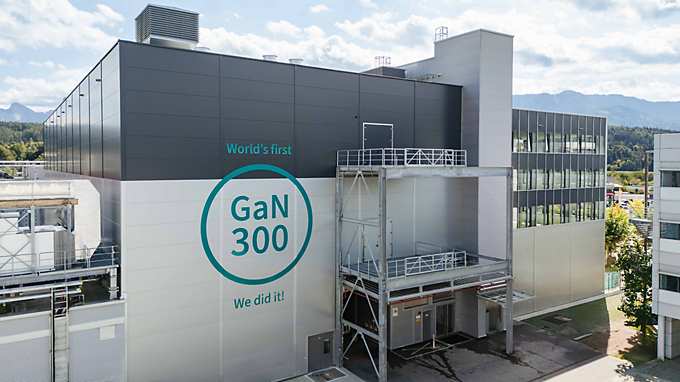
The many years of development experience in Villach are bearing fruit: Infineon is the world market leader in power semiconductors. To maintain this success, the team in Villach is already working on the next generation of chips, made of new materials such as silicon carbide (SiC) and gallium nitride (GaN): In 2024, Infineon succeeded in developing the world’s first 300-millimeter GaN wafer technology for power electronics and implementing it in an existing, scalable high-volume production facility.
These so-called wide band gap technologies can convert power much more efficiently, making units smaller and lighter. This enables charging stations for electric cars with significantly shorter charging times or the mobile infrastructure for 5G networks.
The goal in the automotive research field is to design the next generation of vehicles. Power electronics, microcontroller solutions and sensor technologies designed in Villach enable innovative applications for the cars of the future. These include, for example, 3D magnetic sensors, which are able to measure movements in all directions. This makes them universally deployable for joystick-type applications, for example for multimedia systems in cars and consumer electronics.
Another key area is the development of “smart” switches for intelligent power distribution in vehicles. These make it possible to detect and isolate faults in the entire on-board system. This field of application takes on a whole new dimension due to the functional safety requirements of connected and autonomous vehicles. Products developed in accordance with the ISO 26262 series of standards are used for automotive safety applications. Infineon is therefore developing highly available and fail-safe components for the mobility of the future.
Expertise at Villach contributes to linking the real with the digital world. Here, the focus is on the development of circuits that process digital as well as analog signals. One key aspect is the field of microcontrollers with worldwide responsibility for analog-mixed-signal know-how. In the field of power management, numerous power driver solutions have been developed for industrial applications and data centers. Sensors for computers and consumer electronics are another area of focus. In addition to a variety of other analog-mixed-signal solutions, we have also achieved system competence for 5G base stations and advanced the development of the high-speed mobile communications network of the future.
- Wireless chargers
- LED lighting
- Servers
- 5G mobile infrastructure
- Photovoltaic systems and wind parks
- Anti-lock braking systems
- Electronic power steering
- Electric and hybrid vehicles
- Charging infrastructure for electric vehicles
- Refrigerators and induction stoves
Whether we are talking about microcontrollers, the Near Field Communication (NFC) transmission standard, security chips for payment cards and sovereign documents or chips for battery management in electric vehicles – the global competence center for contactless technologies is a driving force in innovations in security, mobility, and the Internet of Things. It is so successful, in fact, that in 2022 the 500th employee was hired.
In light of the rapid electrification and digitalization trends, demand for more efficient and safe microelectronics solutions is rising continuously. In order to meet this need, Infineon’s development center Graz is expanding its range of responsibilities and is developing particularly fast, powerful and energy-efficient microcontrollers for use in many areas of everyday life. The focus is on the development, design and layout of innovative microcontrollers that are used, for example, in household appliances, power tools, charging stations and batteries for e-bikes, solar systems or industrial robots and automation systems. Above all, they enable secure data processing for the Internet of Things.
Both contact-based and contactless security chips are designed to meet a range of standards for data transmission, with the aim of further increasing data transmission rates and finding new form factors for contactless applications.
Building on its expertise in contactless payment systems, Infineon is working on new chip solutions that make payment even more convenient, hygienic and secure. With biometric payment cards, the cardholder’s fingerprint is used for authentication instead of a PIN. The finger is placed on the card, where it is identified by a sensor and then matched with the fingerprint stored on the card. The microcontroller developed by the Graz team ensures secure data transmission of the confirmation from the sensor to the security chip and back to the reader.
For the automotive market, the Graz researchers developed a module to optimize the charging and discharging of batteries in electric vehicles. The range and service life of the energy storage unit in zero-emission cars are of great importance when considering a purchase. With the right battery management, these characteristics are continuously improved, and in close cooperation with vehicle manufacturers, we were able to reach a completely new level.
Infineon has been a shareholder of the VIRTUAL VEHICLE research center in Graz since October 2019 and supports pioneering research fields in digital mobility. With its microelectronics solutions, Infineon contributes to the development and improvement of intelligent and connected vehicles.
- NFC ATM cards
- Payment and credit cards
- Smart Wearables
- Electronic passports
- Scurity components for PCs and tablets
- Health insurance cards (e-cards)
- 3D image sensor chips for Augmented Reality and Virtual Reality
- Tire pressure sensors
- Control of automatic transmission
With its development center for high-frequency parts in Linz, Infineon is a pioneer in the field of radar technologies for driver assistance systems: in 2009, the Linz team launched the world’s first 77 GHz radar chip using silicongermanium technology. These radar sensors are used in driver assistance systems such as pedestrian recognition, distance warnings and automatic emergency braking, making driving safer and more comfortable.
With more than 250 million 77 GHz radar chips sold, Infineon is the technology and world market leader in this segment. The aim is to further develop this safety technology for widespread use, as in the future, radar sensors will be part of the standard equipment of every new car. Among other things, radar systems are a prerequisite for automated driving.
The development center in Linz was established in 1999 as a spin-off of the Johannes Kepler University. Infineon Austria joined in 2000 (DICE) and has been the 100% owner of the site since September 30, 2019.
Over the past 20 years, the facility with its over 210 employees has developed into a global competence center for high-frequency technologies within the Infineon Group, with world-leading expertise in radar chips for driver assistance systems.
The other key areas of the Linz team’s activities include high-frequency components for mobile telephony and navigation applications, like for example antenna switches and receive amplifiers. With the help of these, end devices can achieve very high data rates even under unfavorable reception conditions. These products can be found in almost every smartphone, tablet and navigation system, and are therefore delivered in quantities of several hundred million per year.
- Radar chips for driver assistance systems
- High-Frequency Switches and Reception Amplifiers
- 5G Base Stations: Receiver Modules
- Distance warning systems
- Automatic emergency braking
- Autonomous vehicles
- Smartphones & tablets
Infineon Austria is performing research and development projects in future-oriented fields of technology, funded amongst others by organisations of the EU and the republic of Austria.
Examples for supporters on EU level are the European Regional Development Fund (ERDF), the ECSEL initiative and Horizon 2020. On state level, the Austrian Research Promotion Agency (FFG) is our strongest partner.
Selected research projects by funding agency
Selected research projects by funding agency
Chips JU (formerly KDT JU)
All2GaN:
"All2GaN" will strengthen the European Power Electronics Industry by offering an EU-born smart GaN Integration Toolbox as a base for applications with significantly increased material- and energy efficiency, thus meeting the global energy needs while keeping the CO2 footprint to the minimumide (GaN). The objective is to make these power semiconductors available for a wide variety of applications at globally competitive cost levels.
Listen2Future:
"Listen2Future" is focusing on acoustic sensor solutions integrated with digital technologies as key enablers for emerging applications fostering Society 5.0.
Listen2Future has officially ended.
Moore4Power (Consortium Lead: Infineon Technologies AG)
The project applies the More-than-Moore approach to power electronics through the heterointegration of SiC and GaN power chiplets with multifunctional Si chips. The goal is to develop more powerful, efficient, and reliable systems with new standards for power chiplets, AI-based real-time monitoring, and modular system architecture.
MOSAIC (Consortium Lead: Infineon Technologies AG)
The MOSAIC project aims to achieve European technological independence and digital autonomy in the field of electronic components and systems (ECS) for automated systems and is aligned with the EU Chips Act. It will develop the next generation of energy-efficient and robust cognitive ECS, with a focus on integrating diverse sensing hardware and promoting interoperability to give European manufacturers a competitive advantage.
CHAMP-ION (Consortium Led by Silicon Austria Labs)
CHAMP-ION is advancing Europe’s leadership in ion transport quantum technologies by establishing an inclusive, sustainable pilot line network for high-quality ITC production. The initiative covers the entire value chain—from design through microfabrication to testing—and enables scalable, mass-producible ion transport chips with integrated electronic and photonic functions.
FFG
FATE:
The FATE (Fault-driven Analysis and Testing for Design Robustness and Stability) project running under the FFG program "ICT-THE-FUTURE" is researching a fault-based and human-focused methodology to better guide the design of cyber-physical systems in their various phases. The results of the FATE project contribute to the safety and robustness of cyber-physical applications and promote the competitiveness of the Austrian semiconductor industry.
OptoQuant
The quantum research project "OptoQuant" is working on the integration of optical components for ion traps based on modern semiconductor manufacturing processes. The aim is to increase the reliability and precision of quantum processors and to accelerate the development of quantum computers.
iLIDS4SAM:
Automated mobility systems are presently moving towards more complex urban traffic scenarios. The iLIDS4SAM project will enable this transition by developing high performance, low-cost LiDAR sensors with increased field of view and resolution.
DragonGEM:
DragonGEM develops high-performance data connections between drones and communications satellites to extend 5G to non-terrestrial networks. DragonGEM is investigating the benefits of the resulting heterogeneous 5G/6G satellite networks for drone applications that contribute to achieving sustainability goals.
CLAIRE:
CLAIRE is developing lightweight AR glasses that can be worn all day, featuring high-quality image display and innovative sensors (3D camera, radar, bone conduction microphone). The technology is being tested using a remote maintenance app for manufacturing.
ATRIA:
ATRIA is developing a hybrid AI system to optimize manufacturing processes in semiconductor factories, specifically for GaN epitaxy systems. The focus is on three objectives: digital twins, UPI optimization, and the harmonization of process workflows.
The result is a proof-of-concept system that supports more sustainable and efficient semiconductor production—developed through Austrian-Canadian collaboration.
Horizon
Multi-Moby:
The project Multi-Moby addresses the development, manufacturing and deployment of safe, efficient, and affordable urban electric vehicles for passengers and commercial vans.
IPCEI ME/CT
Since March 2021, Infineon Austria has been part of the "Important Project of Common European Interest (IPCEI) Microelectronics I" project, thus helping to strengthen the European microelectronics industry.
Since April 2024, Infineon Austria is also part of the successor project "IPCEI on Microelectronics and Communication Technologies".
The goal is to develop new generations of semiconductors based on existing technologies and to transfer them to stable mass production in the shortest possible time. This includes MOSFET and SMART technologies as well as silicon carbide (SiC) and gallium nitride (GaN), rectifiers and MEMS applications. The aim is to accelerate the development and market maturity of cutting-edge technologies "made in Europe" and to ensure Europe's independence in high-tech solutions for electrification and digitalization as well as for CO2 reduction.
According to the Top 500 Ranking published by trend business magazine, Infineon Austria was Austria’s most research-focused industrial company in 2025. In the fiscal year 2025, 721 million euro or 15 percent of total revenue went into research and development. There are 2,506 experts working in the development centers in Villach, Graz, Linz and Innsbruck, developing new solutions, technologies and innovations. Roughly one quarter of the R&D staff of the entire Group is employed by Infineon Austria.
Local competencies and global research tasks have been continuously expanded at Infineon Austria in recent years in the areas of energy efficiency, mobility and security. The recipe for success includes short development periods, the highest quality and a focus on customer-oriented system solutions with a "from product to system" approach. The thematic focal points include the development of power semiconductors and thin wafer technologies, as well as sensors, micromechanics, new semiconductor materials and contactless security applications.
Laboratory activities usually require on-site presence. Especially during the Corona pandemic, this situation poses new challenges for research and development. In order to perform measurements and experiments remotely to protect the researchers, Infineon experts from Villach developed solutions to automate laboratory work. The measuring devices at the local laboratory workstations were configured in such a way that measurements can be started and evaluated remotely. A compact and fully automated system was developed to enable the exact repeatability of measurements on different components, even remotely. This ensures a fast and highly precise exchange of components by remote control.
Power semiconductors play a key role in electronic devices. They convert mains power from the outlet to the requirements of the respective device, with the aim of minimizing energy losses that mostly take the form of waste heat. The activities in Villach focus on the development of increasingly smaller and more energyefficient chips to be used in automotive, manufacturing and consumer electronics.
The many years of development experience in Villach are bearing fruit: Infineon is the world market leader in power semiconductors. To maintain this success, the team in Villach is already working on the next generation of chips, made of new materials such as silicon carbide (SiC) and gallium nitride (GaN): In 2024, Infineon succeeded in developing the world’s first 300-millimeter GaN wafer technology for power electronics and implementing it in an existing, scalable high-volume production facility.
These so-called wide band gap technologies can convert power much more efficiently, making units smaller and lighter. This enables charging stations for electric cars with significantly shorter charging times or the mobile infrastructure for 5G networks.
The goal in the automotive research field is to design the next generation of vehicles. Power electronics, microcontroller solutions and sensor technologies designed in Villach enable innovative applications for the cars of the future. These include, for example, 3D magnetic sensors, which are able to measure movements in all directions. This makes them universally deployable for joystick-type applications, for example for multimedia systems in cars and consumer electronics.
Another key area is the development of “smart” switches for intelligent power distribution in vehicles. These make it possible to detect and isolate faults in the entire on-board system. This field of application takes on a whole new dimension due to the functional safety requirements of connected and autonomous vehicles. Products developed in accordance with the ISO 26262 series of standards are used for automotive safety applications. Infineon is therefore developing highly available and fail-safe components for the mobility of the future.
Expertise at Villach contributes to linking the real with the digital world. Here, the focus is on the development of circuits that process digital as well as analog signals. One key aspect is the field of microcontrollers with worldwide responsibility for analog-mixed-signal know-how. In the field of power management, numerous power driver solutions have been developed for industrial applications and data centers. Sensors for computers and consumer electronics are another area of focus. In addition to a variety of other analog-mixed-signal solutions, we have also achieved system competence for 5G base stations and advanced the development of the high-speed mobile communications network of the future.
- Wireless chargers
- LED lighting
- Servers
- 5G mobile infrastructure
- Photovoltaic systems and wind parks
- Anti-lock braking systems
- Electronic power steering
- Electric and hybrid vehicles
- Charging infrastructure for electric vehicles
- Refrigerators and induction stoves
Whether we are talking about microcontrollers, the Near Field Communication (NFC) transmission standard, security chips for payment cards and sovereign documents or chips for battery management in electric vehicles – the global competence center for contactless technologies is a driving force in innovations in security, mobility, and the Internet of Things. It is so successful, in fact, that in 2022 the 500th employee was hired.
In light of the rapid electrification and digitalization trends, demand for more efficient and safe microelectronics solutions is rising continuously. In order to meet this need, Infineon’s development center Graz is expanding its range of responsibilities and is developing particularly fast, powerful and energy-efficient microcontrollers for use in many areas of everyday life. The focus is on the development, design and layout of innovative microcontrollers that are used, for example, in household appliances, power tools, charging stations and batteries for e-bikes, solar systems or industrial robots and automation systems. Above all, they enable secure data processing for the Internet of Things.
Both contact-based and contactless security chips are designed to meet a range of standards for data transmission, with the aim of further increasing data transmission rates and finding new form factors for contactless applications.
Building on its expertise in contactless payment systems, Infineon is working on new chip solutions that make payment even more convenient, hygienic and secure. With biometric payment cards, the cardholder’s fingerprint is used for authentication instead of a PIN. The finger is placed on the card, where it is identified by a sensor and then matched with the fingerprint stored on the card. The microcontroller developed by the Graz team ensures secure data transmission of the confirmation from the sensor to the security chip and back to the reader.
For the automotive market, the Graz researchers developed a module to optimize the charging and discharging of batteries in electric vehicles. The range and service life of the energy storage unit in zero-emission cars are of great importance when considering a purchase. With the right battery management, these characteristics are continuously improved, and in close cooperation with vehicle manufacturers, we were able to reach a completely new level.
Infineon has been a shareholder of the VIRTUAL VEHICLE research center in Graz since October 2019 and supports pioneering research fields in digital mobility. With its microelectronics solutions, Infineon contributes to the development and improvement of intelligent and connected vehicles.
- NFC ATM cards
- Payment and credit cards
- Smart Wearables
- Electronic passports
- Scurity components for PCs and tablets
- Health insurance cards (e-cards)
- 3D image sensor chips for Augmented Reality and Virtual Reality
- Tire pressure sensors
- Control of automatic transmission
With its development center for high-frequency parts in Linz, Infineon is a pioneer in the field of radar technologies for driver assistance systems: in 2009, the Linz team launched the world’s first 77 GHz radar chip using silicongermanium technology. These radar sensors are used in driver assistance systems such as pedestrian recognition, distance warnings and automatic emergency braking, making driving safer and more comfortable.
With more than 250 million 77 GHz radar chips sold, Infineon is the technology and world market leader in this segment. The aim is to further develop this safety technology for widespread use, as in the future, radar sensors will be part of the standard equipment of every new car. Among other things, radar systems are a prerequisite for automated driving.
The development center in Linz was established in 1999 as a spin-off of the Johannes Kepler University. Infineon Austria joined in 2000 (DICE) and has been the 100% owner of the site since September 30, 2019.
Over the past 20 years, the facility with its over 210 employees has developed into a global competence center for high-frequency technologies within the Infineon Group, with world-leading expertise in radar chips for driver assistance systems.
The other key areas of the Linz team’s activities include high-frequency components for mobile telephony and navigation applications, like for example antenna switches and receive amplifiers. With the help of these, end devices can achieve very high data rates even under unfavorable reception conditions. These products can be found in almost every smartphone, tablet and navigation system, and are therefore delivered in quantities of several hundred million per year.
- Radar chips for driver assistance systems
- High-Frequency Switches and Reception Amplifiers
- 5G Base Stations: Receiver Modules
- Distance warning systems
- Automatic emergency braking
- Autonomous vehicles
- Smartphones & tablets
Infineon Austria is performing research and development projects in future-oriented fields of technology, funded amongst others by organisations of the EU and the republic of Austria.
Examples for supporters on EU level are the European Regional Development Fund (ERDF), the ECSEL initiative and Horizon 2020. On state level, the Austrian Research Promotion Agency (FFG) is our strongest partner.
Selected research projects by funding agency
Selected research projects by funding agency
Chips JU (formerly KDT JU)
All2GaN:
"All2GaN" will strengthen the European Power Electronics Industry by offering an EU-born smart GaN Integration Toolbox as a base for applications with significantly increased material- and energy efficiency, thus meeting the global energy needs while keeping the CO2 footprint to the minimumide (GaN). The objective is to make these power semiconductors available for a wide variety of applications at globally competitive cost levels.
Listen2Future:
"Listen2Future" is focusing on acoustic sensor solutions integrated with digital technologies as key enablers for emerging applications fostering Society 5.0.
Listen2Future has officially ended.
Moore4Power (Consortium Lead: Infineon Technologies AG)
The project applies the More-than-Moore approach to power electronics through the heterointegration of SiC and GaN power chiplets with multifunctional Si chips. The goal is to develop more powerful, efficient, and reliable systems with new standards for power chiplets, AI-based real-time monitoring, and modular system architecture.
MOSAIC (Consortium Lead: Infineon Technologies AG)
The MOSAIC project aims to achieve European technological independence and digital autonomy in the field of electronic components and systems (ECS) for automated systems and is aligned with the EU Chips Act. It will develop the next generation of energy-efficient and robust cognitive ECS, with a focus on integrating diverse sensing hardware and promoting interoperability to give European manufacturers a competitive advantage.
CHAMP-ION (Consortium Led by Silicon Austria Labs)
CHAMP-ION is advancing Europe’s leadership in ion transport quantum technologies by establishing an inclusive, sustainable pilot line network for high-quality ITC production. The initiative covers the entire value chain—from design through microfabrication to testing—and enables scalable, mass-producible ion transport chips with integrated electronic and photonic functions.
FFG
FATE:
The FATE (Fault-driven Analysis and Testing for Design Robustness and Stability) project running under the FFG program "ICT-THE-FUTURE" is researching a fault-based and human-focused methodology to better guide the design of cyber-physical systems in their various phases. The results of the FATE project contribute to the safety and robustness of cyber-physical applications and promote the competitiveness of the Austrian semiconductor industry.
OptoQuant
The quantum research project "OptoQuant" is working on the integration of optical components for ion traps based on modern semiconductor manufacturing processes. The aim is to increase the reliability and precision of quantum processors and to accelerate the development of quantum computers.
iLIDS4SAM:
Automated mobility systems are presently moving towards more complex urban traffic scenarios. The iLIDS4SAM project will enable this transition by developing high performance, low-cost LiDAR sensors with increased field of view and resolution.
DragonGEM:
DragonGEM develops high-performance data connections between drones and communications satellites to extend 5G to non-terrestrial networks. DragonGEM is investigating the benefits of the resulting heterogeneous 5G/6G satellite networks for drone applications that contribute to achieving sustainability goals.
CLAIRE:
CLAIRE is developing lightweight AR glasses that can be worn all day, featuring high-quality image display and innovative sensors (3D camera, radar, bone conduction microphone). The technology is being tested using a remote maintenance app for manufacturing.
ATRIA:
ATRIA is developing a hybrid AI system to optimize manufacturing processes in semiconductor factories, specifically for GaN epitaxy systems. The focus is on three objectives: digital twins, UPI optimization, and the harmonization of process workflows.
The result is a proof-of-concept system that supports more sustainable and efficient semiconductor production—developed through Austrian-Canadian collaboration.
Horizon
Multi-Moby:
The project Multi-Moby addresses the development, manufacturing and deployment of safe, efficient, and affordable urban electric vehicles for passengers and commercial vans.
IPCEI ME/CT
Since March 2021, Infineon Austria has been part of the "Important Project of Common European Interest (IPCEI) Microelectronics I" project, thus helping to strengthen the European microelectronics industry.
Since April 2024, Infineon Austria is also part of the successor project "IPCEI on Microelectronics and Communication Technologies".
The goal is to develop new generations of semiconductors based on existing technologies and to transfer them to stable mass production in the shortest possible time. This includes MOSFET and SMART technologies as well as silicon carbide (SiC) and gallium nitride (GaN), rectifiers and MEMS applications. The aim is to accelerate the development and market maturity of cutting-edge technologies "made in Europe" and to ensure Europe's independence in high-tech solutions for electrification and digitalization as well as for CO2 reduction.

Horizon Europe is the EU's most comprehensive research and innovation program ever, to 2027, € 95,5 billion are allocated for research and development.

The Chips JU initiative der EU supports research and innovation projects in the field of electronics with fundig from the EU, member states and spnsors of innovative ideas that can bring about lasting change in our society and our private lives.

AWS supports companies in implementing their innovative projects by providing loans, grants, and guarantees, particularly in cases where the necessary funds cannot be adequately secured through alternative financing sources.

All activities of the Austrian Research Promotion Agency (FFG) aim to strengthen Austria as a research and innovation center on the global market.