eSIM applications
eSIM is a global specification by the GSMA to enables remote SIM provisioning of any mobile device. This specification is used in various applications within the area of consumer electronics, home IoT applications, industrial (IIoT) applications like smart metering or in logistics (asset tracking). In the automotive world, eSIMs are transforming in-car experience and security for connected services. eSIM as simply SIM chips embedded in your device instead of having a single SIM card.
Benefits for your design and your device setup process:
- Late-stage programming of M2M devices
- Fast and easy device set up of products without inserting a SIM card
- Every device can be IoT enabled—independent of a tethered smartphone
- Change of operator profiles during product lifetime via remote sim provisioning technology (secure download of operator‘s SIM application)
Learn more about Infineon‘s eSIM solutions for IoT, consumer, and automotive applications and find out recommended products in the below interactive block diagram.
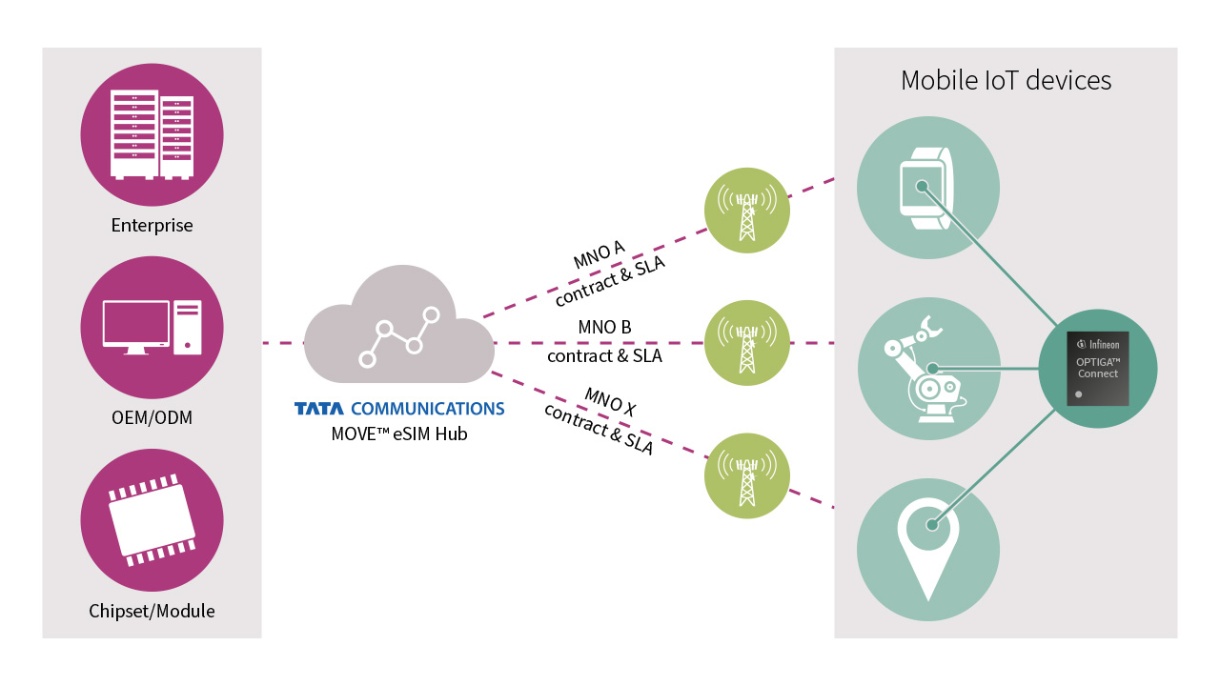
Infineon`s OPTIGA™ Connect OC2321 is an embedded SIM solution optimized for IoT devices. It has a pre-installed GSMA-compliant operating system and is pre-integrated with a bootstrap Tata Communications MOVE™ eSIM profile for worldwide connectivity. The plug & play solution allows easy deployment and management of cellular IoT enabled devices at scale.
Offering a pre-integrated approach to connectivity has the potential to enable equipment manufacturers to deliver products capable of worldwide use, rather than needing to deliver specific versions for specific markets. OPTIGA™ Connect OC2321 simplifies the manufacturing processes by enabling a single stock-keeping unit and facilitating global distribution. It also simplifies the rollout to your end customers (e.g. manufacturing plants), and since there is no need to separately purchase and distribute SIM cards for specific equipment, it helps reduce operational costs. Your end customers/users also have the possibility to change connectivity providers at any time.
Infineon has partnered with Tata Communications to offer its customers unparalleled global reach, leveraging the Tata Communications MOVE™ mobility and IoT platform. Based on certified best-in-class Infineon security hardware, this turnkey solution allows fast, easy deployment and management of IoT devices located across the globe. The pre-integrated connectivity capabilities support global cellular network coverage (Compliant with 2G, 3G, 4G, 5G LTE-M, NB-IoT) spanning over 640+ networks across 200 countries.

Industrial environments are subject to extreme temperatures, mechanical shocks, humidity, and vibrations. Moreover, unlike cell phones, industrial machines must operate uninterruptedly. Industrial device manufacturers need to set the focus on quality in their decision-making process by selecting the right quality level for their eSIM device.
Three main aspects will affect the reliability of the eSIM decision-making process: technology, application, and environmental conditions.
Silicon technologies might react differently to varying operational conditions. For example, some technologies might have higher failure rates at higher temperatures and others at lower temperatures. Infineon supports you in choosing the adequate technology for your application. Extensive measures are set in place to give you the right basis for your decision-making process—like advanced testing, tightened process controls, and quality gates as well as advanced mechanisms to protect memory against excessive stress.
The application, also known as mission profile, defines how the eSIM will be used and has a significant influence on the overall failure rate of the eSIM. The mission profile involves understanding the active operational time, the frequency of updates and the size of memory used.
Environmental conditions are normally determined by variables such as moisture, humidity, corrosion, and mechanical and electromagnetic shocks. Yet, the most influential variable is the operational temperature. OPTIGA™ Connect OC2321, for example, fits ambient temperatures between –40°C and 105°C. It is optimized for reliable operations in challenging environments and it is designed to deliver secured and dependable cellular connectivity under all conditions.
OPTIGA™ Connect is based on Common Criteria EAL5+ certified eSIM hardware, which is designed to exceed the security standards typically required by industry today. This adds an additional level of tamper resistance to these solutions, hardening them against physical attacks – which is especially important for devices that remain in the field for long periods of time.
Infineon´s SLM 97 family of security controllers are tailored to the demands of industrial environments, certified to Common Criteria EAL 5+ (High) and compliant with the Embedded SIM (eUICC) specifications according to ETSI and GSMA. Taking performance to the next level, the SLM 37 family provides a highly optimized feature set, a very small footprint and high endurance specifically required in harsh industrial settings. It is based on 40 nm technology.
Infineon’s embedded SIM solutions are available in different quality grades and form factors to meet individual deployment requirements. We are committed to guiding you through the eSIM implementation process. Contact us for support.
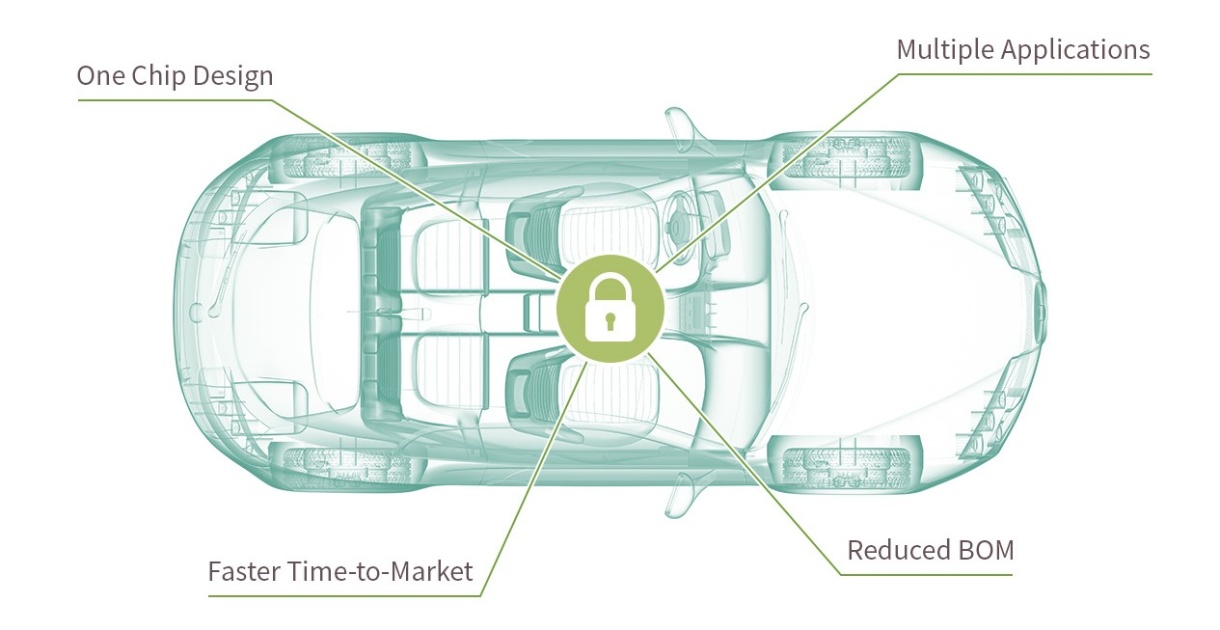
In a connected car, the embedded SIM (eSIM) links the automotive environment with the world of telecommunications. While car makers strive for the highest quality levels, mobile network operators (MNOs) focus on protecting users’ security credentials against theft and cloning. Infineon combines its expertise in security, telecommunications and automotive to provide security controllers that meet the quality demands of automotive and the security demands of telecoms.
The eSIM also plays a key role in the automated emergency call (eCall) service, which can help save lives in the event of a traffic accident by automatically notifying emergency services. The eCall service is designed to alert the emergency services even if the driver is unconscious or unable to make a phone call.
Infineon’s security controllers for eSIMs enable robust and secured cellular connectivity in the car, allowing automotive OEMs and Tier 1s to remotely manage connectivity and to provide end-users with access to Internet-based services similar to those available on smartphones.
Infineon's best-in-class security controllers - Highest quality for automotive applications
The SLI 97 family of 32-bit security controllers has been specially tailored to the automotive industry. Currently deployed by all major OEMs and Tier 1s worldwide, these devices comply with the Embedded SIM (eUICC) specifications according to ETSI and GSMA.
Our SLI 37 automotive series raises the performance bar even further, giving OEMs the flexibility to securely host multiple applications besides the eSIM, and thus maximize return on investment.
Cellular connectivity is being extended to more and more computing devices such as tablets, and to smaller devices like smartwatches, fitness trackers and other wearables. The introduction of eSIMs now allows to remotely provision SIM profiles to these devices. eSIMs significantly increase consumer convenience and create a new design freedom for device manufacturers.
eSIMs are a convenient and cost-effective proposal for consumers. They allow users to simultaneously store the profiles of multiple mobile network operators (MNOs) on a single device, and to switch between these profiles on demand. Users can download MNO profiles without visiting an online store or physically changing SIM cards. This allows them to choose the most flexible or cost-efficient solution for any given location. eSIMs thus enable consumers to manage their subscriptions easily and conveniently. They also benefit device manufacturers. Thanks to the subscription pre-loading option, eSIMs open up new business models and opportunities for manufacturers.
Infineon’s OPTIGA™ Connect eSIM solution for mobile consumer devices is based on Infineon’s certified SLC37 hardware combined with a fast, interoperable operating system. It implements all relevant specifications issued by GSMA, SIMAlliance, and 3GPP to offer full 5G compliance.
This 5G-ready solution gives device designers a new level of freedom due to its ultra-small package size of only 2.9 mm x 2.5 mm x 0.4 mm, allowing completely new designs, especially for devices where printed circuit board space is of greatest value. Check dedicated solutions for mobile devices.
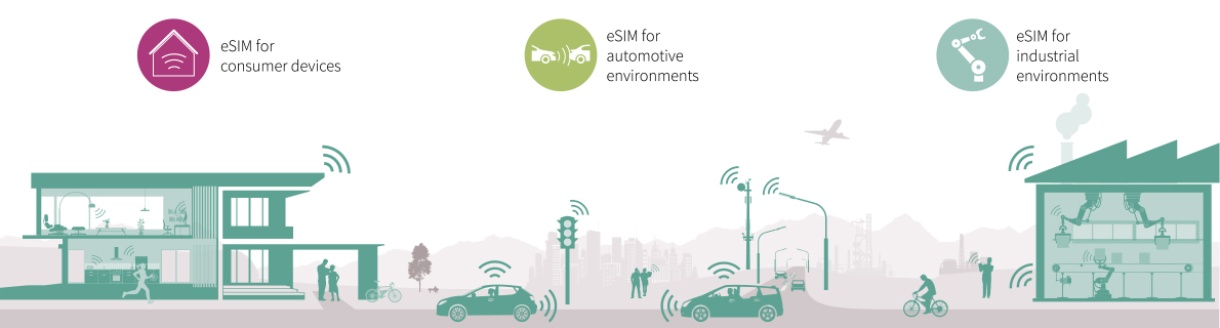
Infineon offers a broad range of high-quality eSIM solutions extending from eSIM hardware to high-end, ready-to-connect bundles such as OPTIGA™ Connect. Combining hardware with an operating system and pre-enabled cellular connectivity, OPTIGA™ Connect is optimized for IoT/industrial applications as well as consumer devices.
Since the late 1990s, Infineon has supplied more than 10 billion security chips for plug-in SIM cards. The company has also been supplying high-quality security controllers for eSIMs since 2008. In its role as a GSMA associate member, it continues to drive further development of next-generation eSIM standards. Infineon is in an excellent position to serve the growing eSIM market thanks to its technology, quality and performance leadership in the delivery of embedded security projects.
Besides industrial and automotive applications, eSIMs are increasingly being adopted to connect consumer devices to mobile networks. Infineon offers miniaturized versions for smartphones and wearables, along with the world’s smallest eSIM. Measuring, only 1.25 mm x 1.2 mm x 0.4 mm, it is 200 times smaller than a typical miniSIM.
Infineon’s embedded SIMs are available in different quality grades and form factors to meet individual deployment requirements.
The IoT with its plethora of new devices calls for flexible and reliable connectivity solutions. Cellular-based solutions provide a secured and cost-efficient alternative to wired applications. SIM-based cellular connectivity is also more resistant to security breaches than typical wireless network connections as it supports end-to-end encryption and secured key exchange.
Embedded SIM (eSIM) is an evolution of the physical subscriber identity module (SIM), replacing a removable card with a fixed, integrated module to support over-the-air provisioning and updates. eSIM-enabled cellular IoT offers significant benefits over replaceable SIM cards. For instance, the user can select a network after the connected device has been produced, shipped and deployed. This gives device manufacturers the flexibility to choose the best option, taking factors such as cost, coverage and regulatory requirements into account. In addition, eSIM solutions are the perfect choice for deploying and managing IoT devices at scale.